
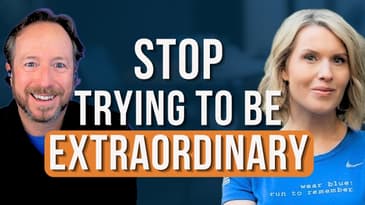
Key Takeaways
• Ordinary is not a limitation, it's a starting point: Lisa Hallett argues that accepting "I'm just me" is what makes hard, extraordinary goals reachable.
• Running became Lisa's way to process grief without losing herself to it: "I was not running from my grief, but I was running through my grief."
• Superpowers are relational: they get named, reflected, and grown through community, not discovered alone.
• One Flag Forward is a 250-mile, 5-day run from NYC to D.C. (Sept 12–16, 2026) where Wear Blue and Team RWB carry a single flag hand-to-hand.
• Holding onto "receipts," memories of past hard things you've already survived, builds the foundation for the next hard thing.
Questions This Episode Answers
• Why did Lisa Hallett choose running as a form of remembrance? After her husband, Captain John Hallett, was killed in Afghanistan, running let her feel her grief without letting it consume her. She calls it running through grief, not from it.
• What is One Flag Forward? A 250-mile, 5-day relay (Sept 12–16, 2026) where Wear Blue: Run to Remember and Team Red, White & Blue carry one American flag from New York City to Washington, D.C.
• How can you find your superpower? Ask a good friend. Superpowers are usually easier for others to see in us than we can see in ourselves.
• Why does Lisa Hallett call being ordinary a superpower? Because it strips away entitlement and comparison, and proves that meaningful, hard goals don't require exceptional resources, just the choice to keep showing up.
• How does Lisa Hallett describe community building as a superpower?
She says superpowers aren't discovered alone, they get developed in relationship with others. It’s the opportunity to have a mirror for ourselves as we be in service of something bigger than ourselves.
Chapters
00:00 Path to Extraordinary Starts with Ordinary
2:11 Lisa Hallett Introduction
2:45 Why running, not another form of remembrance
5:28 One Flag Forward: 250 miles, NYC to D.C., and why now
6:36 Hallets Do Hard Things
7:20 The permission in being ordinary
9:05 We're worthy to not be defined by our most difficult moments
11:14 We blossom in the light of others
14:05 How community reflects our superpowers back to us
17:02 The small moments vs. the finish-line moments
23:00 What does Lisa want me to know about the Gold Star Family and Military community
24:10 The Superpower of being ordinary
28:40 Permission to be ordinary and accepting self
33:32 Ordinary proves potential
34:19 How Lisa learned anything is possible
Full transcript: [link — add once published]
Resources Mentioned
• Wear Blue: Run to Remember: https://www.wearblueruntoremember.org/
• One Flag Forward: https://www.oneflagforward.org/
• Lisa's 2013 TEDX Talk: https://www.youtube.com/watch?v=y9v3TMrsbdg
Watch Next
• Lonely At The Top? Your Nervous System Can Help | Author and TEDx Speaker Kerry-Lyn Stanton-Downes: https://www.youtube.com/watch?v=Ud41XOScx6Q&list=PLbWfh34FP_dUcAaCrI31z00_fLdphi6b7&index=12&t=2643s
• Resilience is a Solo Sport? You're Doing It Wrong | Building Resilience with Bill Hefferman: https://www.youtube.com/watch?v=qA_Cd_E_W30&list=PLbWfh34FP_dUcAaCrI31z00_fLdphi6b7&index=18&t=24s
• Ignoring What’s Really Going On Weakens Your Team | Difficult Conversations with USAF Colonel DeDe Halfhill: https://www.youtube.com/watch?v=OwQ5bjOR6Xw&list=PLbWfh34FP_dUcAaCrI31z00_fLdphi6b7&index=10&t=337s
Music in this episode by Amplify Music
What Do You Know To Be True? is a personal development and leadership podcast capturing insights and experiences with people who've navigated their own reinvention, to be more aligned with their purpose and possibilities.
Each conversation offers new perspectives and inspiration for your next move. Wherever you are on the reinvent yourself path, these conversations are for you.
➡️ For insights into each conversation, subscribe to the newsletter: https://rogerkastner.substack.com/
➡️ To be in more conversations: https://www.youtube.com/@WDYKTBT?sub_confirmation=1
We're hosted by Roger Kastner and produced by Three Blue Pens. We're recorded on the ancestral lands of the Duwamish and Suquamish people. To discover more about the land you are on, go to https://native-land.ca
#Ordinary #Grief #Superpowers #Running #Extraordinary #Communitybuilding #reinventyourself #LeadershipDevelopment #personaldevelopment #RogerKastner
TRANSCRIPT - An Extraordinary Life Is Overrated - Lisa Hallett on her Superpower of Being Ordinary
[Roger Kastner]
Most of us want to live a meaningful life, and to achieve that, we believe we need to lead an extraordinary life. But what if the opposite is true?
[Lisa Hallett]
Ordinary proves potential. I prove to myself that I can do things. I'm just me. I didn't think I'd get out of bed after John died, but I did. I didn't think I could run a marathon, but I did. I really didn't think I can run a hundred miles, but I did.
[Roger]
Today, I’m talking with Lisa Hallett, who is the co-founder and CEO of wear blue: run to remember, a national nonprofit that honors the service and sacrifice of the American military while supporting the families who live with that loss every day.
Lisa founded wear blue after her husband, Captain John Hallett, was killed in Afghanistan in 2009. What began as a small community of military spouses and staff running together as a form of community support, has grown into a national movement that has reached hundreds of thousands of people and created a powerful community for Gold Star and surviving families, veterans, service members, and those who run to remember our fallen.
In addition to being a nationally recognized leader in the military community, Lisa is an accomplished endurance athlete who’s about to run 250 miles over 5 days.
Today, Lisa shares how she finds meaning in life, not just through the extraordinary events she’s experienced, but in accepting and embracing being ordinary. She also shares how all of us can turn the most difficult experiences of our life into purpose, community, and service to others.
[Lisa]
My name is Lisa Hallett and I'm the CEO of Wear Blue Run to Remember and Wear Blue is a global community that honors the service and sacrifice of the American military through active remembrance. In addition to my work with military families at Wear Blue, I am the mom to three awesome children. I'm an endurance athlete and just a lover of the outdoors.
I'm originally from Northern California. I'm a graduate of UC Santa Barbara, just very blessed to live every day.
Why did Lisa Hallett choose running as a form of remembrance?
[Roger]
Lisa, following the death of your husband, Captain John Hallett in August of 2009, and I am aware that it was the 17th anniversary of his death was just earlier this week. He was killed in action while deployed in Afghanistan and one of your superpowers of community building led you to start Wear Blue Run to Remember. As you just said, the mission of honoring service members and sacrifice of the American military through active remembrance while also supporting the families who've lived with that loss every day.
Of all the forms of support and remembrance, why running?
[Lisa]
You know, it's interesting. My brother-in-law's been asking me for years, why aren't we eating to remember? There's so many other ways to do this.
Well, that does go hand in hand with running, right? You've got to fuel. You know, honestly, when John was killed, our kids were three, one and three weeks old and grief was really scary for them.
I remember I drove Jackson to preschool. I started crying and he says, Mommy, stop crying. You're scaring me.
And it was this moment that gave me pause. My children had already lost a parent to war and it wasn't fair for them to lose me to grief. And so I ran.
It was a coping mechanism that I leaned on throughout our military career. As I started to run, you know, I was able to quiet the noise of life and I could push far enough that I could feel my big feelings and then come home and be the parent that my children needed and wanted me to be. And as I was running, I realized that I was not running from my grief, but I was running through my grief.
And it was a way for me to carry all that I had, wanted to have and saw for the future and these steps of this run and to be able to process in really healthy ways. It was a tangible in a world that was now so intangible.
What is Wear Blue: Run To Remember? What is One Flag Forward?
[Roger]
So one of my first exposures to Where Blue Run to Remember was about 15 years ago. I'm running in the Seattle Rock and Roll Marathon and along Lake Washington Boulevard, there's a mile long Where Blue Run to Remember tribute. And actually, there's a picture of that tribute in your 2013 TEDx talk.
And every 10 feet of that mile, there's a poster of a fallen service member, a soldier or family member holding an American flag. And it was one of the most moving experiences I've had in my life, running or not. And in a couple weeks, you'll be running from New York City to Washington DC with the One Flag Forward group that you've helped put together.
This is a huge physical and mental challenge that you're taking on. And it has a higher purpose and message. What is that purpose and message that you're going to be sharing in a couple weeks?
[Lisa]
We really believe that we're stronger together. And so on September 11, our nation was attacked. And on September 12, we came together.
And we came together in unity and care for one another, but also in how we responded with strength. We came together with our partners, Team Red, White and Blue and other military support organizations and said, how can we be stronger together? Our higher purpose in this moment is to make sure the stories of the men and women who have made 250 years of America possible, who've carried the weight of the last 25 years, are at the forefront of this really significant national narrative.
And personally, our mantra in our family is how let's do hard things. Life will pass us by if we let it. But significant moments demand significant action.
And for me personally, to take on 250 miles, it's my way of announcing my vow or my commitment to move forward in this next chapter with conviction, by controlling the hard, by being more than the moment, and to do it in the support and the power of community.
[Roger]
I love the strength and conviction in that statement. It's got an element of permission and inspiration. And I think this speaks to what you were just saying about your superpower before we hit record, about the power of being ordinary, about that permission that this is something that if you're authentically feeling something, share it, show it, show up in that authenticity.
And then the superpower of being ordinary, that this is something that everyone can do. There's an invitation in there. Can you say a little bit more about that?
[Lisa]
I am an ordinary person. I'm a mom. I'm a working mom.
I'm a single mom. I've got three kids. I live in the middle of suburbia.
This is the majority of America, and so many women know this journey. But I make the choice to do hard things. And it's not because I'm an elite athlete.
It's not because I'm super wealthy and have a ton of resources at my disposal. I'm just, and you know, I'm me. I'm ordinary.
And I know part of this is reminded because of John's passing, but I have this opportunity to stare down each moment and make the choice to live that moment to its potential. And when I think about the moments on this way, 250 miles, there is nothing special about me. But it is a challenge that is just beyond my reach.
And so I choose to take my ordinariness, no extra resources, and just make this hard happen so that I can maybe experience and succeed in something extraordinary.
[Roger]
And there's that invitation. This idea that we all, I mean, we all have hard things in life. And there's no, you know, comparison is the thief of joy and probably the thief of grief as well.
Joy and grief seem to go hand in hand often. And yet, this idea that we all have, like, we all have hard things. And yet, what does it call upon us?
What do we expect of ourselves in that moment? And what are we willing to give permission to and invite ourselves and to step into that moment to do hard things, to be, I want to say bigger than grief, but that doesn't sound right, to carry grief, but not let it define you.
[Lisa]
I like that a lot because I think about this a lot. And I'm going to change grief for hard. And we are more than our hard.
And we are more because of our hard. And so, we deserve, we're worthy to not be defined by our most difficult moments, but we also deserve and are worthy to be shaped and to experience growth out of our most difficult moments.
[Roger]
Recently, another guest, Bill Hefferman, was talking about resilience and the people who in the World Trade Center on 9-11. Two-thirds of them who experienced this traumatic event came out without post-traumatic stress. And it was really interesting with, you know, you think about the thousands of people in that building, and how did two-thirds of them not come out with post-traumatic stress?
And it was because a sense of belief that there are better days and connection with other people, which leads me to this thought, something you said last time we spoke, that absolutely lit me up, this idea that we blossom in the light of others. What's the moment you learned that to be true?
[Lisa]
When John first passed away, I was very protective of my grief. I felt like it made other people uncomfortable. And it was one of my few ties to John, like even in my sorrow, it was a way that I was still knit into his memories and my ties to him.
And so, I felt like I was putting on these emotional spanks every time I left the house. Nobody was going to know how sad I was. But the problem is when we start muting our feelings, we don't just mute the sad, we mute the high, the happy, right?
And then we live in this kind of gray area in between. And so, there was this inclination that I needed to pull back any time I was overcome with grief. And then it translated as I went on, am I behind in work?
Am I not worthy of this audience? And there's this idea that we want to draw into ourselves. But I realized that the more I drew into myself, like the worse it became, the sadder I was, the worse I felt about myself, the poor I did, and it became this self-feeding prophecy.
And so, stepping out into those community runs, it's like this reminder every week. You wear blue meets every Saturday morning, we circle, it's a mix of military veterans, families of the fallen. But when I showed up in that community run, whether I was late, untrained, my teeth weren't brushed, fill in the blanks, I wasn't ready to be there.
But there was a community who drew me out and I found, you have to experience, but I was talking to somebody else, it wasn't about me. And when we're in community, you realize all those narratives and self-talks that we give ourselves are only driven by ourselves. And that the narrative, it's not a monologue, it's a conversation, but we have to let ourselves be a part of the conversation.
And those weekly wear blue gatherings, whatever your social network is, whether it's fellowship after church, showing up at wear blue or your book club, you're putting yourself in that conversation and giving yourself permission to change the narrative from self to other. And when we look at other, it makes us feel a part of something, but it also puts some balance into those highs and lows that we wrestle with internally.
[Roger]
I've noticed something about people who have this natural community building muscle, that they're often building communities for people like them that are underserved, that they don't have that community that they can be a part of, that they ultimately need themselves. And I don't think you created wear blue just for yourself.
How does Lisa Hallett describe community building as a superpower?
[Lisa]
But it's interesting that you said your superpower of community building. And it's just such a powerful reminder why we need community is that sometimes we need somebody to hold up a mirror for us to help us see ourselves in ways we can't see ourselves. And what we accept as ordinary or part of who we are, somebody else is going to be able to come in and objectively say, Hey, I see this in you.
And then when others see it in us, it helps us to start to accept it. And so this reminder is that we live in isolation, we lose that gift of others coming and seeing us in ways that we deserve to be seen.
How to find your superpower?
[Roger]
One of the top questions I get is how do I find my superpower? How do I know what my superpower is? And the simple answer is ask a good friend. They'll tell you immediately. They see it. They know it.
And I think in this pathway to becoming more of our possible selves, community is one of those themes or building blocks. And it's not so much what the community does for you, but what we can give the community. And this idea that our superpowers actually are developed in relationship with other people, our strength, our love, our emotional well-being, our spiritual and social well-being are tied to being parts of communities that we can be in service of and then we can also receive from.
And as you were just describing, showing up Saturday mornings to those runs where you maybe didn't want to go, getting so much more out of it.
[Lisa]
Agreed. A hundred percent. And I think too, we talked about this at the beginning, but we need our communities, trusted individuals around us to be mirrors for us.
We need our communities to help us see things in ourselves that we can't see in ourselves. And when we have that validation and that connection or that sense of being seen, it empowers us to then grow and maximize that superpower, that strength, that goodness that is within us. And when we can do that, then our powers become superpowers.
[Roger]
This idea of becoming our possible self or growing our superpowers and leaning into the authenticity of our superpowers. It's not in this notion of just being bigger and better and stronger and having more impact, that these superpowers, again, developed in relationship, that they are in service of other people and what we get from being able to give that gift. But ultimately, people talk about wanting to live a meaningful life, but that feels like it's all future forward.
It's how do I find more meaning in this moment? And I think that's when we are in service of other people, when we are aligned to our purpose, and our superpowers just flow at that point.
[Lisa]
Yeah. And I think that you talk about future forward, but there is a moment, a moment, a moment. We are living moments and that we have to remember living our purpose in service to others is not a tomorrow project.
It is a right now project. It is how we talk to one another. It is how we harness our strengths.
It's how we interact with a stranger, but it's so important that we choose right now and start small. The perfect tomorrow doesn't exist. And so we have to choose the small right now to build into something that will one day be a better tomorrow.
[Roger]
I love how you're calling out doing the small because what I'm learning in conversation after conversation, there's an element of, you know, when we think about superpowers, when we're thinking about impact, they feel big, you know, but we're looking at it over a lifetime. We're looking at it over years of impact, but there's an element that these things happen in small moments. They're not big moments.
They're small moments. Like when we go over the finish line, that feels like a big moment, but people see the picture of us going over the finish line. They don't see the weeks of prep.
They don't see the mounds of laundry. They don't see all the calories being consumed and the 530 AM alarms that go off and you're just like, no, not today. Okay.
I got to go today. Like the small moments, it's all about the small moments and it's all about the present moment.
[Lisa]
These moments look forward and backward though. And so when we cross the finish line, it's something we've done. I am no longer running a marathon.
I have run a marathon. And so we have to choose those small moments again and again and again, so that we can continue to show up as a person of purpose and impact and service to others.
[Roger]
And what's coming up for me as you're saying that there is, there is something about holding on to the receipts. There is something valuable about holding on to those moments where we've done hard things, because when we're facing the new hard thing, we could go back and look at, oh, I've, I've done hard things before.
[Lisa]
Well, a thousand percent like running is, it is the ultimate metaphor for life when we're living life to potential, because every training cycle, you start from zero again. And I don't know why, but three miles feels impossible to me. I have run 100 mile races, but when I'm starting a training cycle to me, I'm saying, is it okay to walk, you know, 30 seconds into my three mile training run.
And so you think it feels impossible, but you do a couple of weeks, the hard and all of a sudden the three miles becomes the easy. And then you're training for five and then you're training for seven and then it goes and goes. And so it is that again, the consistent choice to keep moving forward, but doing hard things.
I love that idea of holding onto the receipts, looking backwards every time we achieve a new hard thing, it resets the foundation for where we're growing from. It's not a hill that we're capable of. It's a mountain because we're so far up on that mountain from all those hard things we've done to get there.
[Roger]
I'm just looking over at the two medals that I've, I've only, listen to me. I've only run nine marathons. The, the two medals that I, that I display the ones, the PR and the other ones, Boston, I probably ran three or four marathons trying to qualify for Boston.
[Lisa]
The thread that was in there that was like nested underneath. You said, I had to try three to four times before it qualified for Boston. And there's power in that because patience, we don't just get in because we want something.
You've got to work again. And again, you're going to miss the mark sometimes, but it's not missing the mark. It's learning.
It's growing. It's, it's testing your desire. How much do you want this?
And then when you do make it there, you've fortified yourself into like the grace and power of, of being ready and able to play the long game, to be a person of character and depth. You know, what's important to you and what's not like. I love that it took you three to four times because you weren't afraid of a goal that you weren't going to hit the first time.
And I think so often we're afraid of that. And so we, we subtly pick targets that we think we can achieve, but if you can reach and touch it, you didn't stretch and grow. And so I think that's really powerful that it took you a couple of times to get into Boston.
[Roger]
Yeah. It would not have meant the same thing. I'll be joining Where Blue Run to Remember in DuPont.
What is something that a person like me, who is not directly part of the military community, what's one thing that a person like me should know about the community that I'm going to go run with?
[Lisa]
One thing, there's so much I want you to know is one is our service members are not boots on the ground. They are our friends, our neighbors, they're our classmates. They are of the community.
It's the 1% that they serve on behalf of the 99% all of us. And so there is an everydayness about our service members and their families. They have some of the same values that they love their families.
They love their community. They love their nation. They just love it so much.
They're willing to put on that cloth of freedom and put themselves in harm's way. But it's just really extraordinary when we can stand shoulder to shoulder in community at an event like One Flag Forward, at a weekly community run at Where Blue Run to Remember, and know that we are in this journey as Americans together.
Why does Lisa Hallett call being ordinary a superpower?
[Roger]
And I love how the things we're talking about feel so ordinary. This idea of setting goals and not achieving them. The small steps, like it's all small steps.
Someone who's run 100 mile races and the hardest step is the one getting out the door to go do a three miler. These feel like very ordinary things. And your superpower is in being ordinary and owning that, this might be a new word, in owning our ordinariness.
So tell us a little bit more about your superpower of being ordinary and how does it show up in what you love to do?
[Lisa]
For me, I feel like understanding and and accepting my superpower has been a journey. And I think I'm ordinary. And I love that.
I'm a very ordinary person. You know, I live in the suburbs. I have three kids.
I'm a working mom. I'm not extraordinarily wealthy. I don't have a fancy car.
But what the power of ordinary is, it's that all of us have the opportunity to tease out the extraordinary in these moments. Power of accepting our ordinariness is accepting ourself. We live in a world where we're barraged with better, faster, brighter, shinier.
What if I'm okay with who I am, right as I am? And from this base of acceptance of ordinary, I have the power to find extraordinary. The bulk of our nation, of our success, the richness of our stories are not a few, quote, great Americans.
It's everyday life. And I think leaning into that strips away some of entitlement. I'm not a victim.
I'm me. That is so cool. And being me, I can set big, hard goals.
I can be a part of my community, and I can meet others where they are at. There is power in owning our ordinariness. And that's to recognize what we share in our communities, in our neighborhoods with those around us.
I'm not somebody famous. I'm not somebody wealthy. I'm not going to win the race.
I am a single mom raising three kids who works. And this is the story of so many awesome people. You can be ordinary and awesome.
Those two go hand in hand. But I think that there is a moment that is worthy of just celebrating. I am me.
And I am just as I am. And there is no medal. There is no super exciting Instagram follow that you're going to have.
But I have this very shared, lived experience with so many people. And if we can accept a moment of ordinary, that there is something that we can build from.
[Roger]
When I started this podcast, the tagline was ordinary people with extraordinary talent making meaningful impact. And it felt a little odd when I was interviewing people and I would say that tagline. And like, oh yeah, you're ordinary, and you're ordinary, and you're ordinary.
And like, okay, how about your everyday people? Because that has a song that sounds a little bit better.
[Lisa]
It's not exciting. And maybe it's okay that it's not exciting. Just when we can recognize our similarities and that, hey, we're all in this together.
We're all special, but I'm not somebody special. But if I can set a hard goal and achieve it, and I'm ordinary, so can you, so can you, so can you. And I think if we recognize that, and we level set a little bit, I think it also strips away some of our sense of entitlement.
[Roger]
And I think it gives us a sense of permission to be us and not try to be someone else. I think authentic has a little bit of a challenge in it, whereas ordinary has permission. And part of the mission of this podcast is to invite people to become more of their possible self, which in having these conversations, I've learned it's not about being more, of adding more, of doing more, learning more, growing more.
It's really stripping down more of the things that life has put on us. The stories people have told us, the voices we have inherited from other people, that's not ours. So there's permission to be ordinary and to explore who are we.
[Lisa]
And maybe like the power of ordinary is power of accepting self, right? Where you are. And knowing that there's more you can be.
Being ordinary is not an excuse for settling. It's an opportunity to accept, accept and grow. And it's permission and an invitation maybe for all of us to accept where we are, but to continue to strive for who we can be.
[Roger]
Once you discovered your superpower of being ordinary, what's been one of the most difficult challenges you've had with it?
[Lisa]
We hear imposter syndrome a lot, but with this idea of acceptance of who I am, I'm ordinary. There's nothing uniquely different about me, can be juxtaposed into, do I belong in this room? Am I worthy of this space?
I can be ordinary and very good at what I do. Very knowledgeable, very capable. And so I think the tension I've experienced accepting, I'm Lisa Hallett.
I live in the Burbs, single working mom. This is a story of so many of us, but I am also a leader. I'm a gold star spouse.
I'm a survivor. I'm an endurance athlete. I'm a military spouse.
I am a single parent. I'm a single working parent. So juxtaposing this idea of ordinary also means I represent so many different people.
And so when I'm given the opportunity to be in the room, what is my obligation to be the voice for those people?
[Lisa]
What is my obligation to be the voice for those people with whom I align and represent?
[Roger]
All the things you just said and the evidence of being ordinary and then the receipts of extraordinary things you do. Just the awareness of both of those things feels like so emblematic of authenticity, of permission, and invitation. The other thing it brings up for me is that in claiming your ordinariness, when other people might see Lisa Hallett and see the gold star wife, they'll see the endurance athlete, they'll see the CEO and think extraordinary.
But by you claiming your ordinariness, it feels like it's an invitation for them to be in community with you.
[Lisa]
Oh, a thousand percent. And I think it's also, I love that, but I think it's also understanding our stretch goals are going to look different. We all deserve stretch goals.
And we look at our physical potential, maybe your stretch goals, another marathon, maybe it's a 5k, maybe it's just getting off the couch and walking around the block. And then we think about that professionally and academically. Is your stretch goal getting your AA?
Is it getting your PhD? Is it CEO? Is it an hourly pay raise?
We're all at different chapters and stages in our lives. Our stretch goals are all going to look different, but it's making the choice to stretch. We're all ordinary, but we can reach for the extraordinary in our lives.
If you don't know ordinary, how do you know extraordinary? And if we normalize extraordinary, we don't understand the richness and the opportunity of the experience, what makes it unique and different. We also miss some of the magic that's right next to us in our everyday lives.
[Roger]
I love that polarity between rising to those extraordinary moments and then realizing our ordinary moments are probably the thing that actually is the thing that gives life value. I love that. In this moment, Lisa, what do you know to be true about your superpower of owning your ordinariness?
[Lisa]
Ordinary proves potential. I prove to myself that I can do things. I'm just me.
I didn't think I'd get out of bed after John died, but I did. I didn't think I could run a marathon, but I did. I really didn't think I can run a hundred miles, but I did.
And so again and again, Lisa Hallett from Concord, California, didn't think she could do something, set a goal, built a community of support, and made it happen. And so this idea that anything is possible is true.
[Roger]
When did you learn that? When did you learn this idea that anything is possible?
[Lisa]
It is through the repetition of setting and achieving goals that seem hard.
[Roger]
Going back to the family mantra. Hallett's do hard things. What did you believe early on about your superpower that you've come to learn not to be true?
[Lisa]
We create a hierarchy for ourselves. They're smarter than me. They're more successful for me.
They know better than me. I'm just ordinary. Ordinary is not a limitation.
Ordinary is an acceptance of universality, sameness, connection. It is a starting point from where we build.
[Roger]
So Lisa, what's next for you? This is a silly question, because I already said what's next for you and your superpower of being ordinary. You're going to do the ordinary run from New York City to Washington, D.C. Okay, let's look beyond the week of September 12. What's next for you and your superpower of being ordinary?
[Lisa]
Wear Blue Run to Remember, is a really exciting moment of growth. And I think part of accepting my superpower or owning my superpower of being ordinary is that I can recognize there are so many more talented and bright individuals out there in the world. And I could set aside my ego and know that these are people who can make Wear Blue and who we serve even better.
And so I'm excited at Wear Blue. We've got a growing team. We've just brought on two new teammates.
And I'm just seeing entering 2027 with even greater impact, our communities really growing and just seeing races flooded with these blue shirts. And when you look at them, you know somebody is running in support of our military to honor a fallen and to make a choice to live inspired by life. And that is just so beautiful and powerful.
And so being ordinary or understanding this is part of who I am enables me to see and not be intimidated, but be excited by all the talent that's out there and around me and how we can work together to have an even greater impact.
[Roger]
And if an audience member wanted to follow you or ask you a question, where do you want to point them to?
[Lisa]
Well, first thing I want everybody to Wear Blue, of course. So I'd love for them to visit wearblueruntoremember.org. It's a great way to find a community run near them, to volunteer at one of our tribute miles, just like you ran through at the Seattle Rock and Roll Marathon, or to follow along at One Flag Forward in that 250-mile journey from New York to Washington, D.C. Follow me on Instagram, Lisa A. Hallett. There are just videos about what training looks like and I love it because it's never about running 250 miles. All I have to do is run eight minutes and then walk three more.
Well, I can always go eight more minutes and so can you.
[Roger]
Lisa, I want to say a heartfelt thank you for being here. And this message of being ordinary was someone who, I think, you know, again, from when I first came into awareness of you, yeah, I was thinking extraordinary as well. Someone who, you know, who a gold star wife, a someone who you did share with me, you've met all the living presidents, a CEO, like this feels like an extraordinary life.
But to your point, what I love about your message is these are extraordinary moments. And it's through being ordinary about being able to identify who you are and how you want to show up in the world and go out and have the impact that you know you can have to go do those hard things so you can grow and be even stronger, better, and more of yourself after those moments. And doing it in relationship with other people, building the community that you want to be a part of, being able to just love into that community and receive the love back.
It's just such a beautiful invitation for other people who are thinking, okay, well, I want to live an extraordinary life. It's like, maybe walk that back and think about living an ordinary life with extraordinary moments, with choosing goals that are hard, that know that you have the power to live through really challenging, difficult moments in life because you've taken those small steps before, you've been there before, and that you can rest in that sense of strength of who you are as an ordinary person who does extraordinary things. So thank you so much. I feel so honored to be able to be in conversation and to get to know you a little bit better.
[Lisa]
Oh, that was beautifully captured. Thank you for connecting the dots and helping thread the needle about how we can move forward in extraordinary ways with this shared experience of ordinary everydays. Love that.
[Roger]
Thank you so much, Lisa. Bye-bye.
Thank you all for being in this conversation with us, and thank you, Lisa, for the permission to embrace our ordinary and the invitation to be in community with others so we can learn more about ourselves while being in service of something greater than ourselves. What Do You Know To Be True? is a Three Blue Pens production. I’m your host, Roger Kastner.
We are recording on the ancestral lands of the Duwamish and Suquamish people.
To learn more about the power of community and relational capacity, check out this conversation with Kerry-Lym Stanton Downes: https://www.youtube.com/watch?v=Ud41XOScx6Q&list=PLbWfh34FP_dUcAaCrI31z00_fLdphi6b7&index=12&t=2643s
And if you are interested in learning more about team, resilience, check out this conversation with Bill Hefferman: https://www.youtube.com/watch?v=qA_Cd_E_W30&list=PLbWfh34FP_dUcAaCrI31z00_fLdphi6b7&index=18&t=24s
OK, Be well, my friends, and, love you, mean it!
Questions This Episode Answers
Why did Lisa Hallett choose running as a form of remembrance? After her husband, Captain John Hallett, was killed in Afghanistan, running let her feel her grief without letting it consume her. She calls it running through grief, not from it.
What is Wear Blue: Run To Remember? Wear Blue: Run to Remember is a national nonprofit that honors the service and sacrifice of the American military while supporting the families who live with that loss every day. We serve Gold Star and Surviving families, veterans, and the communities who stand beside them by bringing people together through active remembrance.
What is One Flag Forward? A 250-mile, 5-day relay (Sept 12–16, 2026) where Wear Blue: Run to Remember and Team Red, White & Blue carry one American flag from New York City to Washington, D.C.
How do you find your superpower? Ask a good friend. Superpowers are usually easier for others to see in us than we can see in ourselves.
Why does Lisa Hallett call being ordinary a superpower? Because it strips away entitlement and comparison, and proves that meaningful, hard goals don't require exceptional resources, just the choice to keep showing up.
How does Lisa Hallett describe community building as a superpower? She says superpowers aren't discovered alone, they get developed in relationship with others. It’s the opportunity to have a mirror for ourselves as we be in service of something bigger than ourselves.