

What Do You Know To Be True?
"What Do You Know To Be True?" is a series of conversations with ordinary people about their extraordinary talent, their superhero power, and the meaningful impact it has on others.
These conversations are for coaches, leaders, mentors, Organization Development practitioners and anyone who wants to think more deeply about their work and positive impact it can have in service of others.
The goal of the conversations is not to try to emulate it or “hack” our way to a new talent. Instead, I’m curious to learn what inspired them to develop this extraordinary talent, how they think about their superhero power, and the impact it has on others as well as themselves.
The intention within these conversations is to learn something about the special talent in each of us that makes us unique, so that we can have a more meaningful impact on the people we hope to serve.

Can You Do This Work Without It Hurting You? Coach Emily Fanjoy on Burnout Recovery
In this conversation, Roger Kastner and Inner Authority coach Emily Fanjoy explore the competence cage that traps high achievers into ever more work and burnout when not aligned with one's superpower and purpose. They uncover how outsourcing authority to others—bo...
Successful But Feeling Unlovable | Steve Sapourn on Trauma, Nervous System Regulation & Courage
In this episode, Steve Sapourn reframes trauma as a nervous system injury rather than a personal flaw, explaining how old survival patterns can still drive anxiety and worthiness issues for high achievers. He shares practical tools like the pause and gratitude to ...

The Power of Being Ordinary: She Didn't Think She Could Run 100 Miles | Lisa Hallett
Lisa Hallett argues that being ordinary is a superpower, because embracing who you are lays the foundation to do extraordinary things. After losing her husband, she ran 250 miles in five days, built Wear Blue: Run to Remember, and raised three kids as a single mom...

She Didn't Think She Could Run 100 Miles. Then She Did. | Lisa Hallett
For Lisa Hallett, ordinary isn't a limitation, it's proof. After losing her husband, Captain John Hallett, in Afghanistan, her grief led her to believe she wouldn't she'd get out of bed. Not only did she get out of bed, she also ran a marathon, and then hundred-mi...
Why You Don't Need to Be Extraordinary to Thrive | Lisa Hallett on her Superpower of Being Ordinary
Lisa Hallett, CEO of Wear Blue: Run to Remember and a Gold Star spouse, argues that being ordinary is a powerful starting point rather than a limitation. She shares how running helped her process grief after her husband’s death and explains that true superpowers a...
Your Superpowers Start With Something Missing | Roger Kastner on the Reinvent Yourself Framework
In this episode marking the third anniversary of What Do You Know To Be True?, Roger Kastner answers how his guests’ common thread—empathy, curiosity, and connection—becomes a true superpower when it serves others. He presents a seven-part reinvention framework bu...

The One Big Pivot Won't Work | Reinvent Yourself with Career Coach Sam Alvita
Career reinvention isn’t a single dramatic pivot but a repeatable practice you return to: building a portfolio career shaped by personal brands, side projects, and collaborations rather than a single job title. Sam Alvita and Roger Kastner explore why the old ladd...
The Courageous Conversation Your Team Needs Requires Emotional Intelligence | DeDe Halfhill
Courageous leadership isn’t just about strategy and results—it’s about having the hard conversations your team quietly needs, guided by emotional intelligence and psychological safety. In this clip from What Do You Know To Be True?, DeDe Halfhill reveals how leade...

Words Won't Build Psychological Safety. Your Body Will | Coach and Author Croft Edwards
Psychological safety isn’t just about what you say, it's about what your body is signaling long before you open your mouth. Croft Edwards (former Army Lt. Colonel turned somatic leadership coach) reveals how embodied presence and self-regulation are essential to b...

Your Voice Always Tells the Truth, Even If Your Words Don't | Barbara McAfee
This TEDx talk with Barbara McAfee reveals that the same inner voice fueling imposter syndrome can also be the voice shaping your authentic self. McAfee shows how truth lives in the belly, not the head, and why aligning your outer voice, inner voice, and identity ...
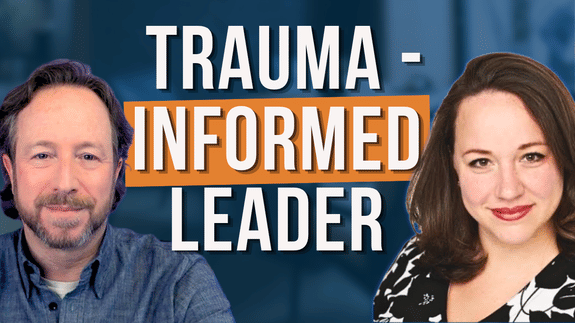
Is Your Workplace Actually Safe? Nervous System Regulation | Sharon Podobnik Peterson
Sharon Podobnik Peterson reveals that trauma is any pressure that prevents a system from returning to homeostasis, and she breaks down trauma-informed leadership through three lenses: individual, culture, and systems. The talk emphasizes co-regulation as a core le...

Leaders Who Spot This Pattern Transform Their Teams | Nervous System Regulation
This episode reframes leadership through the lens of nervous system regulation, explaining that trauma responses turn patterns of connection into patterns of protection and how that can hijack a meeting even when you’re prepared. Sharon Podobnik Peterson shows how...

Follow Your Intuition: The Career Reinvention You’re Too Afraid To Make
This episode invites mid-career professionals to reinvent themselves by trusting their gut—using Sylvia Taylor’s sparkle and the Adaptive Identity Game to answer “who am I beyond my job title.” Learn why intuition can outperform pure data for career pivots, and ga...