
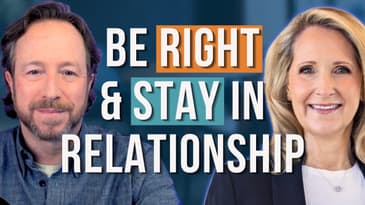
In the original conversation, Kerry-Lyn shared the 8 principles of relational capacity and offered to come back to answer audience-provided questions. This is that episode!
▶️ The original conversation with Kerry-Lyn: https://www.youtube.com/watch?v=Ud41XOScx6Q&list=PLbWfh34FP_dUcAaCrI31z00_fLdphi6b7&index=4&t=1558s
Four audience members sent in specific questions and Kerry-Lyn’s responses went deeper than theory. The questions:
➡️ How can leaders use relational capacity to improve emotional co-regulation?
➡️ How do you address someone's dysregulation with compassion?
➡️ How do other cultures develop relational capacity that we can learn from?
➡️ Is the choice between being right and staying in relationship actually a false one?
Thank you, Mark Meadows, Wynne Leon, and April McCormick for the questions!
Her answer to the last question revealed something I didn't expect.
Kerry-Lyn identifies the early warning signal we all recognize but rarely name: the moment "but, but, but" enters your internal dialogue, you've left relational curiosity behind.
The fix isn't trying harder to convince the other person. It's admitting your own defensiveness out loud, what she calls respectful candor. That single move to vulnerability disarms the entire dynamic and invites both people back to what they're really in service of.
Throughout this conversation, from ubuntu and whakapapa, from leader vulnerability to emotional co-regulation, you'll hear her eight principles of relational capacity surface naturally; not because she's reciting a model, but because she's so deeply embedded in the work that it's become how she sees.
If you've ever walked away from a difficult conversation wondering if you could have held your ground and held the relationship, this episode was made for you.
================
Recommended Next Videos to Watch:
▶️ Mark Meadows - Rediscovering Connection: Mark Meadows’ Journey to Belonging: https://www.youtube.com/watch?v=4jyDUq5VP9E&list=PLbWfh34FP_dUcAaCrI31z00_fLdphi6b7&index=44&t=821s
▶️ Wynne Leon - Overthinking: The Anti-Perfectionism Framework That Works: https://www.youtube.com/watch?v=dWK294OpZVI&list=PLbWfh34FP_dUcAaCrI31z00_fLdphi6b7&index=9&t=111s
▶️ April McCormick - Embracing Courage & Love after Tragedy with April McCormick: https://www.youtube.com/watch?v=1KWDp-iFny0&list=PLbWfh34FP_dUcAaCrI31z00_fLdphi6b7&index=56&t=8s
================
*** Don't miss another episode with amazing guests - subscribe here: https://www.youtube.com/@WDYKTBT?sub_confirmation=1 ***
Resources mentioned in the episode:
➡️ Kerry-Lyn’s Company: https://www.berelational.co.uk/
➡️ Kerry-Lyn’s LinkedIn: linkedin.com/in/kerry-lyn-stanton-downes
➡️ Kerry-Lyn’s Substack: https://berelationalnow.substack.com/
Chapters
0:00 Introduction to Audience Q&A Episode
1:01 Welcome Back & Let's Explore Relational Capacity
2:00 What Surprised Kerry-Lyn At Her Book Launch
3:30 How do other cultures develop relational capacity that we can learn from?
8:32 How can leaders use relational capacity to improve emotional co-regulation?
15:27 How do you address someone's dysregulation with compassion?
24:15 Can I Be Right AND Stay In Relationship?
Music in this episode by Ian Kastner.
What Do You Know To Be True?" is an invitation to be inspired to become more of your possible self by discovering your superpower, unlocking your potential, and creating your impact in the world.
This podcast is for leaders, coaches, org development practitioners, and anyone who works with people who want to be inspired to discover their superpower, unlock their possibilities, and make meaningful impact in the world.
Want more info about What Do You Know To Be True?
➡️ Check out the channel: https://www.youtube.com/@WDYKTBT?sub_confirmation=1
➡️ Subscribe to the What Do You Know To Be True? newsletter to get insights into each conversation: https://rogerkastner.substack.com/
"What Do You Know To Be True?" is hosted by Roger Kastner, is a production of Three Blue Pens, and is recorded on the ancestral lands of the Duwamish and Suquamish people. To discover the ancestral lands of the indigenous people whose land you may be on, go to: https://native-land.ca/
Keywords
#difficultconversations #relationalcapacity #respectfulcandor #emotionalregulation #vulnerabilityleadership #coregulation
Transcript KLSD QnA
[Roger Kastner]
In difficult conversations, can you be right and stay in relationship? Or do you have to choose?
That's the question I asked psychotherapist, author, and TEDx speaker, Kerry-Lyn Stanton-Downes on her return visit to answer audience questions about how to increase our relational capacity.
And her answer surprised me.
She listens for a signal word signal that tells her she's stopped being curious and started building a case.
I'm Roger Kastner, and this is What Do You Know To Be True? a series of conversations with people about their experiences with their superpowers, to serve as inspiration for us to keep on our path towards our possibilities.
Today, Kerry-Lyn returns to answer audience questions about relational capacity, such as
· How can leaders use relational capacity to improve emotional co-regulation?
· How do you address someone's dysregulation with compassion?
· And, how do other cultures develop relational capacity that we can learn from?
I’m glad you’re here, let’s dive in.
Hello, Kerry-Lyn. Thank you for coming back and thank you for this wonderful idea of getting relational with the audience by offering for them to ask questions and then you would come back a couple weeks after our episode to answer those questions and that's what we're going to do today. So thank you for coming back.
[Kerry-Lyn Stanton-Downes]
It's an absolute pleasure and this is one of the most exciting things for me is that actually we stay relational because while I may be sharing concepts and ideas, what's most important for me is what happens for people when they hear those and to leave it empty where they've got nowhere to go to get answers to their questions that emerge as a result feels very unrelational. So this is very exciting to have the opportunity to actually engage with the audience and find out what's landing and what they've become curious about as a result.
[Roger]
I love that and you recently had an experience where you got to get this in a very visceral way. You were a week out from when your book launched. Tell me, what's been surprising to you?
[Kerry-Lyn]
It's been an experience I both anticipated and never dreamed would happen. The anticipated was the excitement that there'd be a lot of momentum, that people would be going, oh it was lovely to see you. One that I wasn't expecting was what it felt like for me when I signed the book.
It was the genuine experience of handing over the material to every person who bought the book and handing over the conversation to every person who bought the book. It's as if the stewardship moved from me to them and I just never saw that really coming in that way. That over the last week has really hit me.
[Roger]
What does that feel like?
[Kerry-Lyn]
It's actually a very heartening experience because I go, this is not mine alone anymore. It's really out in the world and knowing that it's going to move, it's what I always wished for and dreamt of, but I didn't quite know that this is what it would be like.
[Roger]
What a lovely way to start. Are you ready for some questions from the audience?
[Kerry-Lyn]
I am. I'm deeply curious about what they're going to be. Let's go.
[Roger]
Former guest Mark Meadows posted a question for you and I love this one. What cultures and societies have you considered or studied that have maintained greater relational capacity based on their values and worldview?
[Kerry-Lyn]
What an interesting question. There's something quite almost anthropological in that question. What it makes me think about is as an African baby, one of the first places that I experienced a culture that was really holding the relational was in Africa.
It's born out of a word and a philosophy that we use there, which is Ubuntu. Many of your listeners may have heard of it before, but Ubuntu is a philosophy of Southern Africa. It's really where we say that a person is a person through the other person.
When they meet each other, we say Ubuntu, and that means I see you, and the other person responds Ubuntu, and that's I see you. That's not a metaphor, it's a real worldview. It's really saying that the self is not something that you discover alone in a room in isolation, that it's something that is born in the space between you.
And I think that's the complete antithesis of what modern Western civilization teaches us, demonstrates, models to us, or even tells us the world is about. If we go back in history, we spend at least 200 years building a culture that treats the individual as the foundation, and that the relational is the optional extra over there. Whereas something like Ubuntu starts from the opposite position, and it says no, no, no, the relationship is foundational, and the individual is what happens within the relationship.
You get that also in cultures like the Maori cultures. They have something, forgive me, I'll probably say this wrong, I think it's waka papa, I think is the word. And whoever is from that part of the world, forgive me for my very poor pronunciation for that.
But you also get it in the Bhutanese culture. They all do the same thing, particularly in the Bhutanese, because what they do is they explicitly measure the relational, and community well-being is a core of their economic indicators. And if you have a look at certain parts of Italy and certain parts of Greece, they have relational at the center of their daily practices that keep them and their communities knitted together.
Things like long lunches, honest disagreements that don't break the relationship. Repair is part of an ordinary everyday practice. So they're not afraid of the rupture.
What they pay attention to is how they repair. And so I think that what we've really forgotten and need to remember is that relational capacity is not a personal achievement. It's a shared infrastructure.
And the cultures that have kept it alive, treat it as an infrastructure. So they build their days, they build their meals, they build their rituals, their conflicts, their repairs around it. Whereas we in the West tend to build our days around productivity, and we make this assumption that relational will happen in the leftover time.
But the challenge is, as you and I, oh I'm making an assumption that you and I both feel this because I definitely do, is that there is no leftover time anymore. So the relationals become incredibly thin, and we're now in this very odd position of needing to teach ourselves again deliberately what some of these other cultures do instinctually. What I've come to understand by doing my research is that there are cultures that really have held on to it.
The challenge is that the Western way of being has infiltrated those cultures in many ways, and is influencing what is intrinsically and naturally part of those cultures, which is very sad to see.
[Roger]
Mark is going to appreciate that answer because he and I have talked about that word, I think it even comes up in the episode that Mark is in, his superpowers around connection, and this idea that we're already connected, we're innately connected, which is at the heart of that concept. We just need to allow that connection and that realization of connection shine through, and not do things that get in the way of how we're already connected.
[Kerry-Lyn]
Love that.
[Roger]
Yeah, Mark's a big fan of that response, he doesn't even know it yet. Next question comes from Wynn, also a previous guest. How can leaders approach changing the relational landscape with presence and curiosity without making it feel like another task or time-consuming exercise for the people who work for them?
Wynn gives an example of when a leader takes a team out for lunch, the leader loves it, and everyone else feels like it's work. They have to wear a mask or show up in a certain way to be able to navigate that power differential. So how would you respond to that question?
[Kerry-Lyn]
I think this is one of the sharpest questions I've been asked for a long time, and it begins to name something that most leaders have never had said back to them, and which I think they need to hear, because the comment is spot on. You know, lunch with a boss is absolutely work. A lot of leaders will potentially feel slightly defensive against that and go, oh well I'm trying to build relationship.
The reason that this lunch will feel like work is not because your boss is doing something wrong, their intention is often right, but it's because of the power differential itself. So the person who's been invited to the lunch by their boss often feels that they are managing more of the relational space, because their nervous system is doing more of the calibrating, because they're reading more of the cues. You know, their job depends on it, and they're deciding more carefully what they can say, how they're going to say it, what they can say, what they can't say, and it's exhausting, even when the conversation is very pleasant and very surface level.
And in fact, that's probably even harder, because the rules of pleasantry are actually harder than the rules of structure and formality. So it puts somebody in a double mind, which is I need to be pleasant, and I need to be nice, but I don't really know what this conversation is about, and I don't know where we're going, and I don't know what I'm allowed to say, and what I'm not allowed to say. That's tiring.
If we move on to looking at it from the leader's position, I would say this, which is the first thing is for a leader to accept that the power differential happens, and it doesn't just disappear, because they want it to disappear. It's not just going to happen, because you say to your team, oh, call me by my first name, or you can ring me up anytime you like, or you don't have to, you know, formally ask for a meeting, you can knock on my door. That doesn't change anything.
Pretending it not almost makes it worse for the relationship, because then the team is managing both the differential and the denial of the differential. That's exhausting even more. Then let's look at what would be the next move.
The next move is to almost stop asking the team to do extra relational work in service of the leader trying to be a good leader. What do I mean by that? Well, look at off sites, look at team building exercises, look at the lunches.
They ask so much of those that actually show up and be participants, even the vulnerability circles where the leader sort of expects the team to be vulnerable on demand. These feel like a trap for your team. They might feel like growth or something that the leader goes, I'm really leaning into, but they're not necessarily helpful, because if we think about it, the relational work that really changes things is in much smaller moments.
It lives in almost in the work itself. It's in the meeting where the leader offers a 30 second reflective pause to say, what's landing for everyone? It's the leader that says, as somebody asks them a question, do you know I don't have an answer for that, and I don't know.
Would you be willing to explore that further with me? It's in the moments where a leader is not present and realizes they're not present and says to their team member, you know, I'm so sorry, give me a second to write that down, because I really want to be present with what you're sharing, because it's important. It's in the repairing of the sort of small ruptures that occur in real time conversation.
Oh, sorry, I just spoke over you. I noticed I was getting quite excited. Tell me that again.
And it's making it safe to disagree without consequence, to share thinking without being shamed or being wronged. We're not asking the team to do anything extra. We're asking them to just allow a space for the leader to show up differently in the space.
And I think there's one other piece that's almost really important to talk about, which is that I really believe it's important for a leader to go away and do some of their own work themselves and to not always do their work in the space between them and their team. So what do I mean by that? So get a coach, do the reading of my book, start living the principles so that when you show up, you're actually embodying, you're not just applying, but you're embodying them and you're not asking the team to start doing the work first.
Go do that work first and then bring it into the space with you, modeling it already. It's not the big gestures, it's the tiny little gestures that are important. Going back to where the question started, you know, the power differential is absolutely real and the relational work is real, but they sit best together when the leader does some of the growing privately and then comes into the room and embodies it and implements it in the smallest possible ways in the space between.
[Roger]
Well said. The next question comes from April McCormick, also a former guest. I love this community we're creating of all these guests and just yesterday I was having a conversation with two people who'd been on the podcast who didn't know each other until they saw each other on the podcast and now they're beginning to collaborate, which is lovely, and they're inviting me to come in and be a thought partner on it.
So it's just lovely to see that when we put a request out there for people to submit questions, the podcast guests are answering the call. So thank you both to Mark and Wynne and now for April McCormick, she asked the question that she's grateful to be part of an organization that speaks about the concepts of regulation and connection. So that's happening within her organization, which is wonderful.
She goes on to say it is, however, a huge challenge to feel comfortable and confident in pointing out someone who may need to take a moment to regulate themselves at the office. So do you have any suggestions on how, when we recognize someone is maybe dysregulated, how that could be done to point it out in a caring and compassionate way?
[Kerry-Lyn]
So firstly, April, thank you for this question because I think it's a question that everybody should be asking as they lean into this work and it's the right question to ask because, you know, learning to truly be relational can feel uncomfortable for both parties at times and so what you're highlighting is the discomfort in learning how to do this. That's the first thing I'd say. The second thing I'd say is that the work, when you build relational capacity, is really pointing out an issue.
The work is creating the conditions for the person to notice what's happening for themselves. If you point out to someone who needs to regulate, even compassionately, often it'll land as criticism because their nervous system is already activated and it's already weeding the room for threats and safety and usually the deactivation means I feel threatened, not just I feel threatened but I feel vulnerable and I feel afraid, not necessarily because I feel threatened but because my system is being asked to do something it doesn't know how to do.
[Roger]
Yeah, absolutely.
[Kerry-Lyn]
This is a very personal story and one I've not really shared before. My best friend and I, we climb and we were having a climbing lesson and she was belaying me very high up and the instructor and my best friend were about this big because I was so high up and I couldn't work out how to reach the next move so I couldn't figure out how to get my hand and my foot into the next hole and I shouted down from a very high level, how do I reach the next hole? And the instructor shouted back the answer and it was quite noisy in the environment and I remember being up there and thinking, I really don't understand, so I shouted down, I can't hear you, how do I grab the next hold?
And with that, he shouted out up to me, calm down and I just remember looking down and seeing my best friend start laughing because she knew exactly what was coming, which was, if you tell me to calm down once more, I will bleep on your head. Now, here I am, a psychotherapist, I've built relational capacity, I do the work, I run clinics, I work with teams and my system became utterly and completely dysregulated because in that moment, the teacher failed to understand what I needed. What he should have done was say, come down a few rungs so you can hear me.
Instead, his fear of me being dysregulated meant he became dysregulated and in order to appease his nervous system, he told me to calm down, which meant he completely failed to understand what was needed in that moment and so I often wonder when we want to say to a person, calm down or you need, can you breathe or you need to breathe or do you want to go for a walk, that's more about our nervous systems rather than their nervous system.
What often needs to happen is that person needs to feel the quality of your presence in their dysregulation, for you to meet them in that space and for you to not get caught up in the fact that they are dysregulated, so what, rather move to a place where you say something simple like, that sounds important to you, what's the one thing about that that you want me to hear because imagine somebody is saying something to you and getting very animated and frustrated, the frustration is a representation of something is meaningful to them, find out what is meaningful because when you ask a question like that, they naturally begin to regulate because they don't feel they're having to defend their position, so it's in the small lower stakes interventions that you give the person permission to settle their own nervous system, so I really believe if you're with somebody who's deregulated, you start by regulating yourself and asking yourself why am I so activated by the fact this person is dysregulated, take that moment to take the break for yourself, do whatever it is that you know works well for you to bring you into presence so that you can be the co-regulatory space for the other person because I think one of the worst things we can do is go, you need to regulate but we fail to observe that we are dysregulated because the other person is demonstrating a level of distress and I think being a psychotherapist and training to be a psychotherapist taught me this in ways that no other environment could have taught me to do that, was to truly sit deep and stay regulated so that the person could have a positive corrective felt experience of what happens when somebody sits deep when they are dysregulated, that is the co-regulatory experience that is more powerful than anything else that's out there.
[Roger]
There's a couple things that are coming up for me in that response, one I love the idea that like we are becoming dysregulated when the other person is acting out of their dysregulation so it speaks to the connection in the space and how we can co-regulate or co-dysregulate, this reminds me of a conversation I had with Christine Scott a little over a year ago, Christine does work around conflict resolution and she said something that blew my mind, it's this idea that when people bring a conflict to us they are entrusting us with their needs and that speaks to what you're just talking about, this person who in the meeting is dysregulated and they're presenting something, it's an opportunity for us to recognize their need in the moment and by being curious about it we can actually start that process of co-regulation by us asking them a question about figuring out why am I getting dysregulated, what question will help them say what's important to them helps ourselves and helps the room, I love that response.
[Kerry-Lyn]
I think that's so beautifully put, absolutely beautifully put, that when somebody brings us their dysregulation they're bringing us their need, you know one of the most powerful things I ever heard one of my teachers say to me that has never left me and has changed how I sit with dysregulation is anger is the equivalent of a baby's cry for help and that says it all.
[Roger]
Yeah, as someone who used to only have three emotions, anger, frustration and joy, I can really really appreciate that. So last question and it comes from another former guest named Roger, it's something that I've been sitting with since our conversation and it's around relational capacity and it's a conflict that I feel that comes up again and again for me. Throughout my career, I've been in these positions where I'm reminded of the story or the familiar question of do you want to be right or do you want to be in relationship and this you know anytime we have that option A, option B polarity, I've learned from friends that the answer is somewhere in between so you're going to help me unpack this in the moment.
So the scenario that I'm working with is when I'm working with a leader or a colleague and we're developing a solution and they are choosing or advocating for a solution that I find in my experience and my opinion is suboptimal. It will not achieve what we're trying to achieve and in that moment I'm making case for option B, I am thinking about the hundreds or thousands of people who are going to be impacted by that solution and I'm no longer thinking about the person in front of me. Now I'm probably also thinking about myself and that like am I being right, am I doing my job, am I advocating for the right thing, I might not be aware of that but I am thinking about the audience who's going to be receiving that solution and I'm probably not attuning to the person who I'm in conversation with.
I run into this conflict around I feel like I'm doing the right thing for the masses, for the audience, for the people who are going to receive that solution and I'm not aware of the impact I'm having on this other person. So Carrie-Lynn in the scenario of being right versus being in relationship, what would you advise people, perhaps named Roger, do differently so we could achieve both?
[Kerry-Lyn]
Why am I pausing? Because I can feel myself wanting to go in five different directions with that and I need to pick the one that I think is going to be the most impactful and it also brings me great excitement because it brings me straight to the heart of the eight principles of relational capacity and moves directly to firstly curiosity and what do I mean by that? Curiosity as I talk about it is relational curiosity.
Can I allow myself to be influenced by another person's thinking or am I using curiosity as a way to defend my thinking or my position? And whenever I find myself getting defensive, which happens, because when we are attached to our thinking or we're attached to what we believe is the best outcome for the user, for the viewer, for the end product, then of course we're going to be attached to our own thinking. What I do is I like to move to that place of reflection where I pause.
The minute I notice myself starting to get a little bit like but, but, but, but, right? Because we do, we start using but. That almost is always the thing that tells me I've moved out of relational curiosity and over time I've become very observant of those words and what they tell me about the state that I'm in.
And so when I notice them, the first thing I do is I move to vulnerability and I turn around and say to the person, do you know what? I'm laughing inside because I noticed I've moved to a position of defense. And if they go, what do you mean?
I'm going to take a sip of water. I'm going to laugh at myself and then I'm going to get us to come back to asking what are we really here in service of? Because something's clearly important to me and something's clearly important to you.
And by us going back and forth, we're missing what's important. So let's just pause, recalibrate, understand what we're here to do. And then I really want to hear from you how your thinking is in service of that.
Help me and then I will share that with you. And it's interesting, what happens in that moment is that move to vulnerability becomes incredibly disarming. Because I'm not blaming and shaming.
I'm going, oh this is hilarious. Look where I'm at. And in a way it also embodies that mindset of abundance that says, we can do this together.
I don't need to defend my position. I don't need to be right. What I need to do is understand where you're coming from.
Because it's clearly different to where I'm coming from. And you'll see that just even in that small scenario, I literally moved through all of the eight principles. I brought myself into presence because I've observed, I've done the reflection that actually I'm starting to use language that tells me that I'm in defense.
I'm in my survival state. I've admitted I've been vulnerable. I've admitted that I'm in that state.
I then become relationally curious.
I've gone back to what am I in service of. I can even use respectful candor, which is I find myself wanting to defend my position.
That is respectful candor in itself. So we're constantly, you know, then there's mindset of abundance. I'm saying this is really funny.
My internal world's quite funny. I'm sure we can unpack this together. It's not a problem.
So I'm moving, I'm constantly applying and embodying those eight principles in that moment. It requires me to really choose to be relational. It requires me to observe when I'm caught in my own state.
That's where the work starts, not in trying to convince the other, but letting the other know that I can see what's happening for me. It is disarming. It is relational.
It is also more powerfully an invitation. Meet me in that space. Meet me in what Rumi calls, you know, there is a field beyond right thinking and wrong thinking, I will meet you there.
That is what that is about. It's come and meet me there. I don't have the answer.
But I might have the right questions.
[Roger]
Thank you. I found myself at the beginning of your response having a bunch of butts come up. Because I was putting myself in that situation with a colleague or a leader that I can recall where we were in that scenario and thinking, but what if this is my only chance to get my point across?
What if, blah, blah, blah, blah, blah, blah, blah. And then I started just relaxing into what you were saying. And I think that's the first step, being present, being aware that the butts are coming out.
And then realizing this idea of when I get curious, when I am vulnerable, I'm not giving up my position. I'm not surrendering my opinion. I am inviting the other person to meet in the middle, as you said.
Like, it's the space in between right and wrong, whoever determines that. And it's not giving up the territory or the opinion that I feel so strongly about. And in being vulnerable, it invites the other person to be vulnerable, to learn where they're coming from, and opening up the possibility that I could be wrong or that there's another way of seeing this, of taking their perspective, my perspective, and creating a better response.
And that happens through that question of what are we in service of?
[Kerry-Lyn]
Adam Grant, who wrote the book Think Again, he said something that has stayed with me, which is the best person to change your thinking is yourself. And if I go in and say to somebody, well, I don't agree with your thinking, they're going to defend it even harder. So when I invite a person to share more about their thinking, and I own that I've become attached to my thinking, they're more likely to become relationally curious, and less likely to defend their position.
Because then what you have is, through their ability to hear you, with a regulated nervous system where there's co-regulation happening, where the eight principles of relational capacity are being applied and embodied, they are more likely to allow their own thinking to be influenced by another's thinking, without you telling them that they must.
[Roger]
Kerry-Lyn, thank you for that specific response. I think it's going to be helpful for that guy named Roger. I also want to thank everyone who submitted questions after listening to the conversation.
So thank you, Mark and Wynne and April. And again, Kerry-Lyn, I so cherish our first conversation and the suggestion to come back and review current questions that have been provided, and to go deeper into this idea of relational capacity. Because I think in this time and age, when we are feeling more alone, when there's a lot of overwhelm and stress in the workplace, in our communities, leaning into our relations, our connections, our ability to be with one another, and recognize the humanity in each other, is our path through, and ultimately path out of the overwhelmed stress and dread that people are feeling today.
So this is really important work. And I really appreciate the world, the universe, bringing us together, because I think I need this in this time. So I appreciate you and the work you're bringing to the world.
And I'm deeply appreciative, because I think it's, again, going to be helpful for me and the people around me. So thank you.
[Kerry-Lyn]
It's a total pleasure and genuinely a real delight. And like you, I'm very grateful for the way the universe brought us together. And I hope you and I come to have many conversations on and off your podcast, and where we can explore and think and, you know, be relational together, and allow that to begin to inform more about how we show up in the world.
[Roger]
Thank you, Carolyn. Take care. Bye-bye.
[Kerry-Lyn]
It's a pleasure. Bye-bye-bye.
[Roger]
Thank you all for being in this conversation with us, and thank you, Kerry-Lyn, for answering audience questions and sharing how we can all increase our relational capacity .
What Do You Know To Be True? is a Three Blue Pens production. I’m your host, Roger Kastner.
We are recording on the ancestral lands of the Duwamish and Suquamish people.
If you enjoyed this conversation, you’ll want to check out this episode with
Mark Meadows and how to increase the quality of our connections
And check out this episode with Wynne Leon on how to be a better tryer and experiment-er.
OK, be well, my friends, and, love you, mean it!