
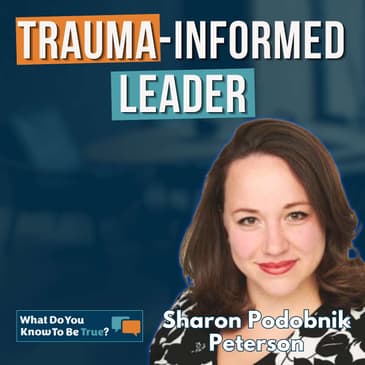
Sharon Podobnik Peterson, founder of the Center for Conscious Leadership, explains why trauma isn't a diagnosis, it's anything that turns patterns of connection into patterns of protection. She walks host Roger Kastner through the three lenses of trauma-informed leadership, why co-regulation is a leadership skill nobody taught you, and her "unripened tomato effect": how organizations promote emerging leaders before their nervous system capacity can support the role, and then wonder why burnout and imposter syndrome follow.
Key Takeaways
• Trauma is anything that puts sufficient pressure on a system that the response doesn't let it return to homeostasis, not just a single catastrophic event
• Trauma-informed leadership comes down to three questions: am I safe here, do I matter, and am I loved or cared for
• Defensiveness in a conversation is a signal, not a character flaw, it means someone's nervous system has already shifted from connection into protection
• Co-regulation starts with staying in tune with your own nervous system before you can help regulate someone else's
• The "unripened tomato effect": teaching people to perform executive presence without building the underlying capacity for it leads directly to burnout and imposter syndrome
Questions This Episode Answers
• What is trauma? Trauma is anything that puts enough pressure on a system to activate a protective response, and that response doesn't let the system return to its normal state afterward. It's the difference between stress that resolves and stress that gets stuck.
• What is trauma informed leadership? Leadership that engages with people from a place of safety, assuming that everyone you work with has experienced some form of trauma, and looking at nervous system safety through three lenses: the individual, the collective culture, and the systems and structures around them.
• How to not activate a trauma response in others? Stay tuned in to whether the person in front of you is still in connection or has shifted into defensiveness and protection, and give them real choice and agency, like the option to pause a conversation, rather than pushing through.
• How to regulate my nervous system? Start by staying in touch with your own state before trying to help anyone else, since you can't co-regulate someone if you're not already regulated yourself. It's less a single technique than a constant tuning to what's actually present in the room.
Chapters
0:00 What Is Trauma-Informed Leadership?
3:56 Defining Trauma: When Nervous System Regulation Fails
5:21 The Three Lenses of Trauma-Informed Leadership
8:47 Co-Regulation: How Leaders Create Nervous System Safety
13:54 Psychological Safety: Am I Safe? Do I Matter? Am I Loved?
17:00 Burnout Symptoms: The Unripened Tomato Leadership Metaphor
20:29 Holding Space: Sharon's Origin Story & Superpower
36:09 Imposter Syndrome: The Cost of Looking the Part
41:46 Leadership Development As Public Health & Well-Being Requirement
Full transcript: https://whatdoyouknowtobetrue.com/video/is-your-workplace-actually-safe-nervous-system-regulation-sharon-podobnik-peterson
Resources Mentioned
• Sharon's LinkedIn: https://www.linkedin.com/in/sharonpodobnik/
• The Center for Conscious Leadership: https://www.thecenterforconsciousleadership.com/
Watch Next
• Why You Overreact Then Regret It Instantly | Nervous System Regulation with Ashley Douglas: https://www.youtube.com/watch?v=Yim5d8FO7Oo&list=PLbWfh34FP_dUcAaCrI31z00_fLdphi6b7&index=13&t=677s
• Lonely At The Top? Your Nervous System Can Help | Author and TEDx Speaker Kerry-Lyn Stanton-Downes: https://www.youtube.com/watch?v=Ud41XOScx6Q&list=PLbWfh34FP_dUcAaCrI31z00_fLdphi6b7&index=11&t=2643s
Music in this episode by Amplify Music.
What Do You Know To Be True? is a personal development and leadership podcast capturing insights and experiences with people who’ve navigated their own reinvention, to be more aligned with their purpose and possibilities. Each conversation offers new perspectives and inspiration for your next move.
Wherever you are on the reinvent yourself path, these conversations are for you.
➡️ For insights into each conversation, subscribe to the newsletter: https://rogerkastner.substack.com/
➡️ Catch more conversations: https://www.youtube.com/@WDYKTBT?sub_confirmation=1
We're hosted by Roger Kastner and produced by Three Blue Pens. We’re recorded on the ancestral lands of the Duwamish and Suquamish people. To discover more about the land you are on, go to https://native-land.ca
Keywords
#TraumaInformedLeadership #NervousSystemRegulation #PsychologicalSafety
#impostersyndrome #emotionalintelligence #coregulation #personaldevelopment #leadershipdevelopment #reinventyourself #RogerKastner
Transcripts - Leaders Who Spot This Pattern Transform Their Teams - Nervous System Regulation - Sharon Podobnik Peterson
[Sharon]
One of my favorite ways of thinking about trauma is it's anything that has turned patterns of connection into patterns of protection. As leaders, as people in connection with other humans, one of the most important things that we can do is stay in touch with ourselves to see if we're still in connection with them and then to stay in connection with their experience around things and see, okay, are you still in connection with me or are you seeking to protect yourself in some way? Because if there's defensiveness, we're already disconnected.
Something has gone a little too far for your nervous system to feel sufficient safety and stay in connection with me.
[Roger]
What if two thirds of the people you work with and you lead had experienced a traumatic event in their life? Wouldn't you want to know how to show up in ways that did not reactivate that trauma?
Well, it's not a hypothetical. The World Health Organization has said that nearly 70% of people globally have experienced a traumatic event in their life. That's why I'm grateful today to be speaking with Sharon Podobnik Peterson. Sharon is the founder of the Center for Conscious Leadership and she is the creator of the Trauma-Informed Leader Program.
Sharon shares with us today what trauma is, how we can show up in ways that does not reactivate someone's trauma response and what we can do to attend to our own trauma response so that we can show up better for the people we lead and the people we love. Welcome to What Do You Know To Be True. I'm your host, Roger Kastner.
These conversations are with people who are living into their purpose and their values so they can create more meaning in their work and in their lives. I'm glad you're here. Let's dive in.
Hey, Sharon, thank you for joining me today. I'm so excited for the conversation we're about to have.
[Sharon]
So excited to be here. I'm looking forward to it.
[Roger]
I'm excited to learn more about your superpower of holding space and being willing to see the full complexity of a person, place, and or thing. I came to know you through your work and the organization that you founded, the Center for Conscious Leadership. And then I heard you speak on our mutual friend, Susan Weller's podcast, The Courage Effect.
And that was the moments like, I need to know more about you and the work that you do. We're gonna get into all of that. But before we get too far, what else is important for us to know about you?
[Sharon]
One of the things I like to share about being in these conversations is the nerves that go into it beforehand, during and afterwards. Because I think from the perspective of folks listening, and I think I actually talked about this on Suzanne's podcast, right? There's nerves that always come with doing exciting things and doing important things.
And I wanna normalize that for humans, right? And to recognize that voices can sound confident and clear and credible and all of that stuff and still have nerves. So naming that just for humanizing sake.
And I think that's it. I think I'm just, I'm excited to be here with you.
[Roger]
And we will be talking about nervous system regulation through this conversation. And before we got on, we were talking about the nerves of hosting a podcast and being on a podcast. So it's perfectly aligned.
And it's kind of funny, this idea that we get to talk about these things while we're feeling them. It's kind of fun to be that observer and experiencer and try to mesh those together and then try to explain it to other people what's going on. And they're doing the same thing, right?
They're having their nerves, they're having their experience and they're trying to make sense of everything. So we're all in this big soup together.
[Sharon]
The meta experience. I love it. I love it very much.
[Roger]
And we keep using food as metaphor. I wonder if we're both hungry. So anyway, let's start with another definition.
What is trauma? And what happens when trauma goes unresolved?
[Sharon]
The way that I see trauma, it is anything that puts sufficient pressure on a system to activate it, mobilize it, to resolve whatever's happening. And the response does not sufficiently meet the need for that system to return to its homeostasis. So for example, when we're talking about the difference between stress at work and traumatic stress, stress is not inherently a bad thing.
Stress mobilizes our systems. We get more excited, we get more energy, we get the blood flowing. There's a lot that happens.
And if we're able to meet the deadline, if we're able to do what we need to do, if we are crossing the finish line on a marathon, then the stress has sufficiently done its job and we get to then return to homeostasis afterwards. However, in a traumatic situation, whether it is unresolved because it's going on for too long or it's too much, and our system is not able to sufficiently cope with the level of stress, then it has exceeded our capacity to deal with it, resulting in a protective strategy of some sort putting into place instead. And that protection pattern, that strategy, can stay our strategy if our system does not return to homeostasis in an effort to protect ourselves in the future from being similarly overwhelmed by a stressful event.
[Roger]
At the Center for Conscious Leadership, you offer a trauma-informed leadership course. Tell us what that means to you and why do leaders need to be more trauma-informed?
[Sharon]
I think about it through a couple of lenses. One is this understanding that we can basically assume that the humans that we meet on a day-to-day basis have experienced some form of trauma. It might be big T trauma in terms of one of these acute overwhelming experiences, natural disasters, major life experiences that are traumatic, but there can also be chronic little T trauma where we're having too much stress for too long or too little of what we need for too short a period of time and we're not able to cope with it.
I don't know anyone who has not had that sort of experience in some way, shape, or form. And so as leaders in a workplace, it behooves us to assume that the person we're talking to, the people that we're working with, the clients that we're delivering for have experienced some kind of trauma in the course of their lives. And to be trauma-informed in that way means to engage with people from a place that is creating sufficient safety so that we are not re-traumatizing.
We are providing safety. We are providing opportunities for voice, choice, and agency in the normal goings on of our work and day so that we are not increasing harm, exacerbating harm that's already being caused, or pushing people into protection patterns unnecessarily. What that tends to look like for us is thinking through a couple of different models around things.
One is the degree to which we are providing sufficient safety for our nervous systems. Are we allowing for recovery time? Are we making sure that we're not overloading our people?
Is there the capacity to be able to keep ourselves safe in the normal course of the day? We then think about it biologically in terms of like people coming together. We think of culture as the result of a bunch of nervous systems coming together to create its own sort of collective nervous system.
What happens when a bunch of nervous systems get together? And like who has the strongest voice in the room? And like what happens when there is some kind of external event?
How does the culture respond in the same way that like nervous systems do? So we talk about it through that lens. And then finally is through the lens of like systems and structures, right?
So systems and structures are not neutral. They are existing things that can heal. They can harm.
There's a lot of different impacts that systems have through trauma-informed leadership. We take a look at the system itself and see what impact being in that system has on the humans within it. Is it creating more stress?
Is it so bureaucratic that I feel like I can't get anything done on a day-to-day basis? Is there perpetual urgency that is causing my system to feel overloaded every day? What's happening in the system itself?
And then we bring those three together to think about what I can do from where I am, from my position, wherever I sit within the system to take better care of myself, better care of the people around me and change the system where and as needed in order to make sure that it is not creating more harm in the future.
[Roger]
I love the systems approach nature to this. First start with self and how do we regulate ourselves and how do we address and heal our own trauma? And then when we're working with someone else, how do we not re-traumatize or create harm?
Then we think about the collective, the team, the collective nervous system that is in work and how do we show up in a way that doesn't traumatize or re-traumatize the system or the team, I should say the collective. And then it's the whole system in which we operate and what are the stressors and how does the system typically handle its own organizational trauma or stress? That makes a lot of sense.
I'm curious about that interpersonal, that working with another person and this idea of not re-traumatizing them, of whether it's through co-regulation or helping them and maybe it's not helping them but working with them in a way that doesn't re-traumatize them. Could you speak a little bit more to that piece because I'm really curious about how do you get a sense of what would be the actions that could cause harm or re-traumatize someone else?
[Sharon]
One of my favorite ways of thinking about trauma is it's anything that has turned patterns of connection into patterns of protection. When something has overwhelmed me and my ability to connect with myself or overwhelmed my ability to stay in connection with other people, and I have to then go and protect myself, that is a traumatizing event. And so as leaders, as people in connection with other humans, one of the most important things that we can do is stay in touch with ourselves to see if we're still in connection with them, to see if we're becoming overloaded by their experience or our own experiences and disconnecting.
And then to stay in connection with their experience around things and see, okay, are you still in connection with me or are you seeking to protect yourself in some way? Is there defensiveness? Because if there's defensiveness, we're already disconnected.
You are already protecting yourself. And so something has gone a little too far for your nervous system to feel sufficient safety and stay in connection with me. That doesn't mean it was necessarily my responsibility.
It doesn't mean I was the one that pushed you over. For some people, any feedback feels like too much, right? But to be in relationship with other people means that we can do what is in our capacity to do, to create the conditions for folks to stay in tune with themselves and others.
I mean, you mentioned regulation, you mentioned co-regulation. I think it's being in tune with what we call the regulational field, right? Like how, what is happening?
What is present? What is the energy in the space right now? And how can I tend to it?
And then for folks who might not even know that they're in a protective mode in that moment, we have the choice to also provide them choice and say, do we want to take a break here? Like let's take a breather on this. Let's come back to this conversation later and or to name it, right?
So I love when we have teams and cohorts come into this and go through it together because then when they go back to their next meeting and a certain person is having a big reaction, they can have a pause in a very different way to say like, okay, something is feeling too big right now. What is that thing? And how can we make it smaller?
Is it in our capacity to actually make this a little smaller for you right now? Like what wiggle room do we have? What capacity do we have to create more safety for you?
So quite frankly, there's a lot of ways that we can create safety for one another. And I think a tuning, intentionally a tuning to the person across from you and being willing to work with what is across from you is the most important like summary of all of the potential things that you could do in relationships with other folks. This is why we need to see people in the full complexity of things, right?
Because this is not this, the you that shows up here and now is a fraction of your fullest person who you are, what you do. And the experience you had yesterday directly impacts how you're gonna show up today. And we have all of our rules around professionalism tell us that who you are outside of this engagement doesn't actually matter.
And what happened to you yesterday doesn't actually matter. When in reality, it impacts everything. Cause of course it is, it's top of mind.
And I actually want that. I want to hear what's top of mind for you. And I want to hear the lens through which like you're engaging and seeing the world and all of that stuff today and always.
Cause it matters, like it matters.
[Roger]
This message of you matter and your work matters. We need managers and leaders to show up with this idea that they will focus on ensuring their employees know they matter and their work matters. And if they're not doing that, fuck the rest of it.
It does not, we will not get the performance that we can get if people don't feel like they matter.
[Sharon]
That's trauma-informed leadership. If I truly boil down trauma-informed leadership to its most core elements, it is being able to answer the questions of, am I safe here? Do I matter?
Does my existence have an impact on the people and spaces around me? And am I loved? Am I cared for?
Is there care that is going to be available to me if something goes wrong? And if we start with a foundational assumption that everything is figureoutable in relationship and that if I matter to me and I matter to you and you matter to you and you matter to me, and we're able to stay in a relationship to get everybody's needs met, then we're actually approaching leadership from a lens of qualitative humanity and respect for myself and others and recognizing that all impact, all outcomes, all business impact directly relies on a foundation of mutuality, respect, and connection. Without those things, providing us with the sufficient safety to stay in relationship and to do our best work, we actually don't have access to our best selves and we don't have access to our best work because our nervous systems are so busy protecting us.
We're gonna be less and less and less effective the more stressed we are and the more disconnected we are. If we stay in relationship in order to solve all of the problems, then we are by definition respecting the human and the nervous system across from us and making sure to not do undue harm to anyone in the system in connection with us. We talk about this a lot in terms of the unripened tomato effect.
Systemically in our culture, especially in the United States, we care so much about how something looks that our factory farming system will pull tomatoes off the vine far earlier than they should be to be beautifully ripened and delicious tomatoes and artificially ripen them with ethylene gas so that they look nice and ripe at the store and then we bite into them and they're mealy and they're undeveloped and the sugars haven't fully formed and we do this with our leaders. We don't actually wait until the nervous system can sufficiently tolerate and have capacity to deal with the complexity that they're going to be engaging with. We tell people how to look like they have executive presence to stand tall and to make eye contact and to do this and to do that so that they give the veneer of executive presence without having the nervous system underneath that can tolerate it, which is why we have an entire epidemic of imposter syndrome and burnt out leaders all at the same time because looking like something without being that thing is incredibly metabolically taxing to our nervous systems.
We're burning ourselves out and we're burning each other out and we're asking ourselves to fake it until we make it and sometimes it works and sometimes we burn out before we actually make it because we're looking the part.
[Roger]
It's such a good metaphor. The ethylene gas that's being poured into them might be alcohol, might be other vices that aren't healthy with them as they're trying to cope and this idea, I need to go take more classes where we get into that trap of the self-improvement paradigm where we're not enough, where we're deficient and that's not the right headspace. We want leaders to be in when they need to be, they need to ripen themselves a little bit more.
It's true. It's the ecological theory of leadership, right? The conditions matter so much more than we give it credit for and we have this expectation that tomatoes will ripen if the soil's not sufficient.
That's not real. Our leaders are not going to develop and mature and wisen in systems that are causing them deep stress and trauma. Those are not the sufficient conditions for people to mature effectively, right?
And I talk about this all the time in terms of like maturity is not a biological process, right? It is a totally optional endeavor that adults go through provided that the conditions are sufficient for supporting that growth and development and evolution. It is not required.
So from the perspective of leaders or trauma-informed leaders, knowing what conditions are good for tomatoes, knowing what conditions are good for leaders, they're not actually that different. Actually, we need substrates, we need nutrients, we need water, we need rest. It is taking responsibility for creating the conditions for the outcomes we actually want, right?
Because from a systems perspective, systems are engineered to get the outcomes that they do. And so if we are working in burnout factories, then our systems are set up to be that. And so what is my responsibility as a leader in interrupting that, being a trader where we can, knowing the system so that we can use the system and interrupt and find the leverage points and all of those things.
Again, to your point, to create the substrate and make sure that the leaders have what they need so that it is not a forced ripening situation. And I'm gonna throw you into the deep end and hope you make it. But we've done the work to make sure that the tomato is gonna be ripe enough before we put you in this situation.
[Roger]
So your superpower of holding space and being willing to see the full complexity of a person, place, or thing. Could you tell us a little bit more what that means to you?
[Sharon]
Yes. I don't think I can explain it without the backstory. My particular childhood experience was one in which I didn't feel seen very regularly.
I was sort of a, I think, object in the world of the adults around me and not necessarily received as a full and complete human, who was also a little person. And therefore, there was not time or space or energy really put into understanding me, my wants, my needs, my perspectives, my hopes, my dreams, my everything that goes into being a human with interiority. And there was very little credence given to, I think, my experience as a kid.
I was very much in a kids should be seen and not heard kind of household. Kids do what they're told to do, and they get in trouble if they don't. And beyond that, there's just not like spaciousness.
There wasn't a lot of room for my entire humanity. Several things came out of that. One is an incredible tolerance for discomfort by accident, right?
Just by virtue of being in really uncomfortable situations, I developed a huge tolerance for ambiguity, for chaos, for not knowing, for also not being seen. And at the same time, it meant that I recognized how crappy it felt to not be seen. It meant that when I showed up with other people, I was much more present to their entire experience.
I did a lot of journaling as a kid, and I'm really glad for that because I got to sort of evoke my own interiority, right? And like recognize that it was there and not totally bypass it. And I think that meant when I was then, even a teenager going into conversations with other people, a basic assumption that they were doing the same at home or like that they had a similar expansive interior experience and I wanted to hear about it and I wanted to know.
And I'm always curious about like that part of you that doesn't get airtime or that like, whether it's your deepest, darkest secrets or the like part of you that just doesn't come out, doesn't see the daylight, there isn't space for excitement, right? I think I have a near compulsion to sitting with people in really deep conversation. And it might just be like, I don't know, an ADHD aversion to small talk.
And, but also I am so deeply curious about humans, almost feel incomplete myself at the end of a conversation if I don't have a like pretty thorough understanding of who the person is across from me. And so I think that then translated into a bunch of different things across time and space and experiences, right? I went to school, I studied humans and by that I mean I studied psychology and neuroscience and social psychology and majored in sociology and studied power and systems and dynamics.
And there was this ability to then add so much complexity and nuance to my understanding of humans and how the world works. And I think combining that sort of academic trajectory with my inherent desire, need, superpower in seeing people and holding space and tolerating not knowing things, tolerating the discomfort of things mean that when you put the two together, I find myself with this sort of undying need to see people systems in as much complexity as humanly possible so that I can understand exactly what's happening in the person, in the system. And I do so through all of these lenses and perspectives that I've sort of collected along the way. I sort of see frameworks like nervous system science and frameworks like power systems and sort of organizational theory.
And I collect them as somebody might collectibles. They're all in my back pocket, waiting to be sort of brought out in order to see things much more differently. I think the other thing that is part of this superpower is part of that, like holding the discomfort thing is the layer that is growing up without sort of reliable narrators in my world that were trustworthy sources of information.
I was handed several sort of explanations for the world that were sort of intolerable to my soul. They did not jive. They did not sufficiently explain my experience nor what I saw in the world around me.
Also at the same time, gathered a sort of knack for skepticism and curiosity and questioning things and making sure that whatever story I was handed, whatever story I generated myself, whatever hypothesis I developed about the person sitting across me or the system I was observing, held up across multiple domains, multiple frameworks, multiple lived experiences. And I hold them very, very, very lightly so that I can run them through sort of all these pressure testing experiences, right? It means that when I come back to this superpower of holding things in complexity, holding things in ambiguity, almost requiring a level of complexity, I then come back to that feeling quite good about where things landed because they've been put through so many ringers around things, right?
And they've been tested across so many sort of platforms and frameworks and understandings of the world that I'm like, okay, if this can hold up across multiple experiences, if I have a theory about who Roger is and what makes him tick and it holds up across every single time that we get together, then I can share it with you and say, hey, does this like actually match your lived reality? And it's not gonna hurt my feelings if I'm wrong. It's just gonna provide me more information to sort of fine tune my working theory of you or of the world or of how things work.
It's allowed me to really like mix and match and choose and develop my own theories around things, which has been really fun because I get to take elements from this way of seeing the world and elements of that way of seeing the world and sort of construct a working hypothesis for myself that is pulling from the best elements of all of these other things and sort of synthesizing my own to describe how a human works, a system works, a person, place or thing operates, what makes it tick, et cetera.
[Roger]
I really, really enjoyed that response. So many things that were in there that little fireworks were going off for me. One of them was this idea of the untrustworthy narrator.
I've come to learn through our friend, David Hutchins, who's taught me that being a storyteller is really about making sense, making meaning out of what's going on. And I love the idea that little Sharon was calling bullshit on the stories you were being told. And you had that curiosity, that compulsion to learn more about, okay, what is the actual meaning?
What is the story here? What I was hearing as the young Sharon would have been looking for safety, would have been looking for love and a sense of value and place. And not finding that from the system around you, you created it for yourself.
And through that becoming the superpower feels like it's driven by curiosity. And so that switch from safety to curiosity, I'm curious about that, of today, how much of that does that feel like curiosity and how much of it is still driven by that sense of need for safety?
[Sharon]
What a good question. There's probably very little difference for me in the curiosity and seeking of safety. I think the one sort of potential distinction is that tugging on the threads of curiosity is very fun for me. But I do think, to your point, like, if curiosity is one of my, like, sub-superpowers around things, it was probably both a thing that was inherently there and joyful for me and something that I temporarily used to create immense amounts of safety and therefore reinforced the almost pleasurable nature of it as well, right? This is a thing that's good for me, and I enjoy it, and I probably used it to create safety because I enjoyed it and had access to it too.
I don't know that there's a huge difference between them. I think now I can just do curiosity without the sub-need for safety being ever-present. It's, you know, the quality by which we do something matters as much as the thing that we're doing.
Curiosity from a place of hyper-vigilance is qualitatively different. The result of that curiosity still in some ways does create safety because it is going to either contribute to my ability to feel helpful in community or create a new framework for the way that I see the world, which, you know, provides this, like, safety in understanding the world, which is again, like, coming back to the utter paradox, a thing that I know to be constructed and unreliable. So I'm still doing this thing because it's enjoyable.
It is still contributing towards safety because of a secure footing in the world and how it works. And I know it to be a sort of mirage of safety because knowing how the world works doesn't inherently create safety all the time, especially when it's unreliable.
[Roger]
Thank you for that very vulnerable response. And I, after asking the question, there was a moment of me thinking how you had shared earlier about rejecting reductive thinking. I was thinking, oh, did I just reduce her superpower to the drive for safety and curiosity?
So thank you for not dunking on me there.
[Sharon]
Not at all. And actually what I think is super interesting about it, right, is, like, again, because I so value thorough complexity and making sure it, like, lands across all places, any question like that actually forces me to reexamine it from a completely different lens and, like, coming back to axiomatic thinking of, like, what is the core truth here? And a need for safety is a fundamental core truth that exists for all of us.
So being able to examine this superpower, this thing that I do through the lens of, like, a core fundamental truth of humanity, that we need safety, we deserve safety, we seek safety, is just pressure testing it in a whole nother way. And so it's very sandbox for me, right? It's very exciting to see, to be put in a place of, like, okay, Sharon, does it hold up here?
I'm going to throw another curveball your way. Let's see if it still applies. That is so fun for me.
The first thing that it actually made me think of in this moment was, like, I love escape rooms. I love figuring my way out of things through things, you name it. It's very, I thrive in those situations.
And tossing me a question that isn't inherently or obviously related to it, like, it's not a planted question. Throwing me a curveball is one of the most, like, joyful improv experiences in my world.
[Roger]
Okay, you're teeing me up to ask a really improv curveball question. And unfortunately, it's the name of the podcast. In this moment, what do you know to be true about the superpower of holding space and being willing to see the full complexity of a person, place, or thing?
[Sharon]
Again, the irony of it is that I can't, Roger, I cannot be reductive about it. I'm so sorry, right? What do I know to be true about my superpower?
Nothing.
[Roger]
I don't like to judge responses. That might be the best. And the less, you know, the best and the incomplete answer.
Yeah, I don't know if that's true. And yet, based on everything you've shared, it's perfect. How could it be anything else?
[Sharon]
Right? How could it be anything else?
[Roger]
Gold star.
[Sharon]
Because I've listened to your podcast in so many ways and heard so many of the responses. It's interesting because I will experience envy when people share exactly what they know to be true. And I have this tinge of, oh, must be nice.
Must be nice to so thoroughly know something, either about yourself or the world, right? That you get to relax into it. That sounds nice.
[Roger]
And I love the level of comfort you have. Because you talked about being comfortable in the places of discomfort and you are compelled to those spaces. I mean, it makes sense for you to know what is true is antithetical to your superpower of diving into the complexity of continuously testing it and saying, OK, well, maybe in this moment something's true, but I can't hold on to that because experience has told me there's more.
[Sharon]
There's more. And how inconvenient that is sometimes, right? When people want clear, easy answers that they can digest around things.
And I, by virtue of being who I am and operating the way that I do in this world, I am wildly inconvenient to some people.
[Roger]
I relate to that.
[Sharon]
It doesn't jive. It doesn't make things easier. And I'm sorry, but I'm also not.
[Roger]
Yeah. OK, this question might be equally fun to explore. What did you believe early on about your superpower that you have come to learn to not be true?
[Sharon]
I mentioned earlier how I love a curveball. I think the thing I might love more than a curveball and the ability to improve something is a question that makes me sit there and repeat it in my head again and again and again and again, because it threatens the entire foundation of everything my belief sits on and therefore is actually like difficult for my brain to process it. And so I then need to hear it again and again.
This is a really good one. I think I used to believe that what I was doing and seeking to do and asking to do was outlandish in some regards, when in reality, I do think that it has the non-reductivity has the capacity to be sort of a core tenant of the human experience, if we let it. And so it's not actually this wildly radical thing of honoring complexity and like this unattainable ideal.
I actually think it could be a fundamental part of parenting, friendships, marital relationships, leadership. And I think I didn't value it at first because it was so sort of stress-inducing in so many places when I refused to accept the easy answer and I got in trouble. One of my favorite questions is like, what did and mine was asking why I needed to understand why decisions were made.
I needed to understand why this thing worked. I needed to understand why the rules were the way that they were. And I got in excessive amounts of trouble at school, at home, at church, everywhere in between.
And I realize now that like, it has the potential to be such a blessing in all of those places where it's being asked. If we choose to see it that way, it's the good trouble side of things. It can be good trouble to be encouraged to excavate our beliefs and our understandings and our rationale for doing things if we let it.
It reminds me of like repressed artists in some way where like, they're not going to do the thing until they're ready to do the thing. Not to say like that, holy cow, that could sound egotistical if I'm like, I'm a repressed artist. But I think it was a skill, a strategy, a thing that went underground for a very long time until there was sufficient safety for it to come out again.
And it makes me think about the people who were told they were bad drawers or singers as kids, who then have to work through all of that to find a safe place for it to reemerge. I wonder how many superpowers are just right there under the surface. Similarly, because of punishment or censure or just not being accepted.
[Roger]
And I think the work that you're doing through the Center for Conscious Leadership, through Trauma-Informed Leader, through the work that you're putting out on LinkedIn and doing the workshops that you're doing, it's an invitation for people to get curious about who they innately are and the superpowers that are within them. I applaud that. I like to think that these conversations are the same invitation to have people understand other people's exploration into their superpower as a way to say, hey, the water's fine.
Come on in, come explore your superpower. And people tend to, maybe they know their purpose, maybe they know their superpower, but it's like, okay, is this the right thing? How do I explore that?
And what's the cost of exploring that? And how do we, you know, I love sharing these stories because it's people who've gone through that, who've dove in headfirst when it wasn't, when they weren't sure, when it wasn't safe, when it wasn't a clear path, and yet they persisted. And I love that coming through in you.
So Sharon, what's next for you and your superpower of holding space and being willing to see the full complexity of a person, place, or thing?
[Sharon]
It is such an emergent experience for me. As I encounter new ideas, as I encounter new things, it so then deeply informs where I'm going next and like what I'm going to do next. When I was writing my book, I like had an idea of what I wanted to write about, but there's no way I could have really predicted what she was going to become.
And the same thing is true of me, of my work, of all of that good stuff. I think I'm still in said process of evoking my fullest self. And I think you sort of lightly touched on the idea of like what we have to sort of lose along the way to find our fullest forms and the cost of the process itself.
And I am still very deep right now in said cost. And so the sort of present and near future is playing with that and seeing how everything is going to land and seeing what is left at the end of sort of a great shedding of many things. And then, you know, I got ideas.
I have a hypothesis of what I want to play with. And I guarantee more conversations like this and more conversations out in the world are going to significantly shift what that looks like. When I set out to do leadership development, I had no idea I was going to land in trauma-informed leadership.
It makes perfect sense given everything right now. But there's no way I could have planned this, predicted this, set this as a goal or something like that. And so I hold space for what it will become.
And where I stand right now with my hypothesis for how things are going to play and shake out is there have been like we're doing this program. It's going very well. It's being very well received.
I'm loving the data results that come out of it. There have been asks for a book on it. So I think at some point in the mid-future, we will be trying to capture sufficient complexity in the written word form without it also being, you know, a thousand-page tome.
The concepts around trauma-informed leadership and honoring complexity of humans at work is really, it's striking a nerve in really big ways. And so I will also hold space for how that materializes in terms of like my future and what that looks like. But my hope is that we get to continue bringing these ideas to more incredible places where we're able to institutionalize humanity in our systems and processes, make sure that humans are being respected.
I would love at some point, this is just like maybe my fever dream side of things, but I would love at some point for leadership to be recognized as the public health social determinant that it is. Equally as important as OSHA standards, right, in terms of like protecting the safety of our people, how do we factor in safety in terms of emotional safety, psychological safety? What do we do to recognize that and protect that in our people, in our workplaces?
So that is like my hope for where this goes next. I would love to see that happen. And we'll see.
[Roger]
Again, I love asking these questions. And there's almost an element of, well, like the answer's in the superpower, right? This idea of like we're going to continue to test and learn.
We're going to continue to dive into the complexity. We're going to come up with a thesis and then continually test it. That's what's next.
And I love this notion of where you're going about if you're accepting a leadership role, whether that's as an individual contributor or as a declared leader role, that you are also taking on a portion of people's well-being as a focus, as recognizing the impact, recognizing the choice that we're making, whether to create harm or to reduce harm, and to lead people in a way that is in full recognition of the humanity and not the extractive nature of the system we're in, not in a I-tell-you-what-to-do-and-you-go-do-it, because that went away a long time ago, and in full recognition of how human systems work.
[Sharon]
Amen. I was going to say, can I get an amen? Yes, you can.
I got it again. Amen. Yes.
Yes.
[Roger]
So if an audience member wanted to follow you, wanted to ask a question, wanted to learn more about the Center for Conscious Leadership or the course around trauma-informed leadership, where do you want to point them to?
[Sharon]
Thank you for asking. Always great to connect with folks on LinkedIn. Would love to stay in connection.
And if you want a little dose of me in your inbox every week, we send love letters every Monday, which are these cute little ways to start off your Monday right with either these reflection questions or inspiration to start off your week. Generally themed in this direction of how do we make sure that we're honoring ourselves and the people that we're working with along the way. So if you want that in your inbox, you can go to thecenterforconsciousleadership.com, and we have a way to sign up there. You can also just email me or LinkedIn me, and we will make sure to get you on that. I am Sharon at thecenterforconsciousleadership.com, or again, you can find me on LinkedIn, and we'd love to continue the conversation there.
[Roger]
Sharon, thank you so much for being here, for being your full, authentic, and vulnerable self. And I use the word vulnerable. I don't know how much vulnerability it feels like.
It probably feels like more than it comes across. It feels very authentic. And I know sometimes it takes more vulnerability to do that in certain circumstances.
And oh my goodness, I love how much I was able to learn in this conversation about your superpower and how much I was able to relate to it and see myself in it. And it was just such a privilege to learn how you discovered this at such a young age and continued to test and learn your own superpower at that young age and move into that space of, like, going from safety into curiosity and now seeing how that superpower is having an impact on me, having an impact on so many other people who are coming into contact with you. So from the collective, I want to say thank you for putting it out there and for living fully into your possible self.
[Sharon]
Thank you. I have no other choice. And thank you for saying so.
And thank you for doing what you are here to do too, because it has enabled me to also better understand my superpower today and to think through more lenses still. So I want to thank you too. Thank you for being here.
Thank you for being your purpose and doing what you're here to do as well. I appreciate it. Mm.
[Roger]
Thank you so much. Take care. Bye-bye.
Thank you all for being in conversation with us. And thank you, Sharon, for coming and sharing your superpower and what it means to be a trauma-informed leader. What Do You Know to Be True is a Three Blue Pens production, and I'm your host, Roger Kastner.
We are recording on the ancestral lands of the Duwamish and Suquamish people. If you liked this episode, you'll enjoy this one with Ashley Douglas on nervous system regulation. And you'll also enjoy this episode with Kerry-Lyn Stanton-Downes on how to increase our relational capacity.
Okay. Be well, my friends. And love you, mean it.