
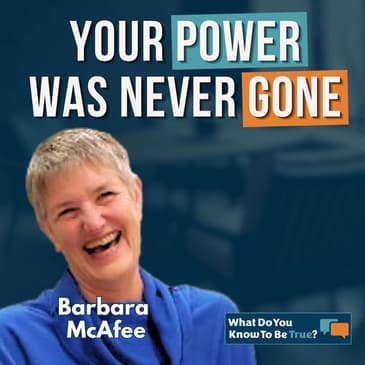
Master voice coach, singer, and TEDx speaker Barbara McAfee explains why your imposter syndrome and your most authentic self are running through the exact same instrument, your voice, and why the truth always lives in your belly rather than your head. Barbara walks host Roger Kastner through the five elements of vocal expression (earth, fire, water, metal, air), how internal family systems work applies to the "parts" behind your inner critic, and her central thesis: you can't change your voice without your life coming along for the ride.
Key Takeaways
• Imposter syndrome and your most authentic voice use the same instrument, the question is which one you let speak
• Tone of voice reveals what your words are trying to hide, since the truth lives in your belly, not your head
• Your inner critic is a "part" in internal family systems terms, and it softens when your grounded self, not the part, leads the conversation with it
• Expanding your vocal range literally expands your sense of who you are, it's not just a communication technique
• The five elements framework (earth, fire, water, metal, air) gives you access to vocal registers most people have shut off since childhood
Questions This Episode Answers
• How can I find my voice? Use simple physical entry points into each of the five elements, like yawning like a bear for an earth voice or howling like a wolf for a water voice, rather than trying to think your way into a different sound. Big, playful changes are often easier to access than small, careful ones.
• How to overcome imposter syndrome? Recognize that the same voice powering your inner critic is also the voice of your most authentic self, so the goal isn't to silence it, it's to let the unexpressed parts of you speak safely (through sound, story, or character) instead of leaking out sideways as anger, illness, or shutdown.
• How do I fix my inner critic? Treat it as a "part" that's trying to protect you, not an enemy to defeat. Have a conversation with it and let your grounded, curious self, rather than the activated part, lead that conversation.
• What does a voice coach do? Help people access vocal choices they've shut off, not replace the voice they already have. Barbara's approach is to expand someone's range (through the five elements) so they can match their voice to the moment, whether that's projecting authority or telling a story.
Chapters
0:00 The Shadow Will Speak
1:15 The Five Elements & Barbara's Air Voice Story
3:52 Ancestors, France & The Workshop That Changed Everything
7:03 IFS: The Parts Speaking Through You
9:48 How Secrets & Abuse Live in the Voice
11:23 The Decoder Ring
14:28 A Client Transformation Story
16:24 Why You Cringe at Your Voice
19:25 Five Elements Practices for Your Voice
24:30 Tone vs Words, Boundaries & Connection
27:26 Coregulation with 1,000 Strangers
30:20 Trusting Your Multi-Passionate Path
34:59 Training 85 Practitioners & The Next Generation
37:51 "It's Weird and Touchy-Feely" No Longer
Full transcript: https://whatdoyouknowtobetrue.com/video/your-voice-always-tells-the-truth-even-if-your-words-dont--barbara-mcafee
Resources Mentioned
• Barbara's website: https://www.barbaramcafee.com/
• Barbara's book, "Vocal Intelligence: Leading with Vitality, Presence, and Impact": https://bookshop.org/p/books/vocal-intelligence-leading-with-vitality-presence-and-impact-barbara-mcafee/d7b6df5d69ba9bb6
• Brain Rats video: https://www.youtube.com/watch?v=ZOuzuMx9wP4
Watch Next
• Your Inner Critic Is Trying to Protect You | Janet Livingstone: https://www.youtube.com/watch?v=aOUomW7i2sI&list=PLbWfh34FP_dUcAaCrI31z00_fLdphi6b7&index=20&t=350s
• High-Achievers Stay Stuck For This ONE Reason | Brooklyn Dicent: https://www.youtube.com/watch?v=2qLW1CMu2G8&list=PLbWfh34FP_dUcAaCrI31z00_fLdphi6b7&index=14
• Is Your Workplace Actually Safe? Nervous System Regulation | Sharon Podobnik Peterson:
https://www.youtube.com/watch?v=XX6Hs-CQp4c&list=PLbWfh34FP_dUcAaCrI31z00_fLdphi6b7&index=5&t=1610s
Music in this episode by Amplify Music.
What Do You Know To Be True? is a personal development and leadership podcast capturing insights and experiences with people who’ve navigated their own reinvention, to be more aligned with their purpose and possibilities. Each conversation offers new perspectives and inspiration for your next move.
Wherever you are on the reinvent yourself path, these conversations are for you.
➡️ For insights into each conversation, subscribe to the newsletter: https://rogerkastner.substack.com/
➡️ Catch more conversations: https://www.youtube.com/@WDYKTBT?sub_confirmation=1
We're hosted by Roger Kastner and produced by Three Blue Pens. We’re recorded on the ancestral lands of the Duwamish and Suquamish people. To discover more about the land you are on, go to https://native-land.ca
Keywords
#FindYourVoice #ImposterSyndrome #ExecutivePresence #authenticleadership #personaldevelopment #leadershipdevelopment #reinventyourself #RogerKastner
Transcript - Barbara McAfee - Imposter Syndrome Lies: Your Voice Speaks the Truth
[Barbara McAfee]
Because the truth lives down in your belly, down in your guts. And if you can't express, it's got to go somewhere. The shadow is going to speak.
It's just, are you going to go off on your kid? Or are you going to have road rage? Or are you going to get sick or depressed?
Or can you express it and then just let it have its voice and not wreck your life? So I often say you can't change your voice without your life coming along for the ride.
[Roger Kastner]
That inner critic that's telling you you're not ready, you're not qualified, you're not good enough. And the part of you that's telling you to become your true self, use the same instrument, your voice. Today's guest, Barbara McAfee, a master voice coach, a singer, an author, a songwriter, and a TEDx speaker has spent 30 years proving that you could address the imposter syndrome and become a more persuasive leader by awakening your full voice.
I'm Roger Kastner. This is What Do You Know To Be True. These are conversations for people who are navigating the space between who they've been and who they intentionally want to become.
I'm glad you're here. Let's dive in. In your book, Vocal Intelligence, you talk about the voice being the thing how we show up and effectively lead, connect, and inspire others.
So many of the conversations that we've had here have been around the inner voice. And so I'm curious now about if we're using our outer voice to inspire and lead change externally, how do we use our inner voice to inspire and lead change internally?
[Barbara]
Well, it's all one system. So I often say you can't change your voice without your life coming along for the ride. And each of these elements correlates with certain human qualities or gifts, like the earth voice is great for getting grounded and calm and accessing your innate animal intelligence, your gut instinct.
If you become more grounded in your exterior voice, your whole nervous system changes. You can probably feel it. I can feel it.
My heart rate just probably dropped a little bit. My shoulders relaxed. And that is such a great voice, except if you're trying to project in a loud room, or you're speaking to someone after lunch, a big group of people in an overly warm room, and they're like, I'll go to sleep, right?
When you change externally, the inside changes too, because it's all just the same system. For me, I hated the air voice, because I'm a very tall woman. I'm 6'2", and I'm from Minnesota, and I'm practical, and I'm smart, and I could never get away with that girly thing that, you know, I probably would have if I could have, to be honest.
So I just slammed the door on that part of my voice, because I thought that was ditzy and stupid and fluffy. Turns out there were a lot of gifts in that voice for me, because it's great for telling stories. It's great for talking about things that haven't happened yet.
Like, I have an idea for this wonderful possibility. Do you want to hear it? It's like, yeah, I do.
So there was a lot of gifts waiting for me in this voice. And as that external voice shifted, so many other things shifted. I changed the way I look.
I changed the way I sing, the way I move, the way I dress. It's just like a whole lightness came into my life. So I feel like it kind of doesn't matter where you begin, because it's all connected to the same system.
If you expand your voice, you expand your sense of who you are, which changes the conversation you're having with yourself.
[Roger]
So what or who inspired you to have the superpower of helping people find their voice?
[Barbara]
Part of it is ancestral. My grandfather sang on the radio in Iowa. He had a beautiful voice his whole life.
And my mother was a singer. I heard her mostly singing at church and around the house. But she had a beautiful voice.
My big brother, who I thought rocked the world, was in a band and was a solo singer. So I feel like I had this wonderful ground to stand on. I have a gift that feels like it came with my bloodline.
And I also had a lot of vocal issues. I never wanted to sing alone. I was terrified of being seen in that way and had a lot of, you know, constrictions and limits in my voice.
I found these teachers from the south of France. They came to Minneapolis where I was living, and I don't know why I went to the workshop, but I went. I was so terrified.
I was going to leave if they were mean to me. I remember saying to myself as I was walking in, if I'm leaving if they're mean to me. In that workshop, I met my beloved teacher, Shaul Ryan.
He's a British guy. And I was in my late 20s, I think. Changed the whole course of my life.
It was like I was going one direction, and then after that, I was going another. When I walked in there, I thought my voice ended here, which isn't that high, especially for a woman in her 20s. And in that first weekend, he took me way up to the top of the panel.
No one had ever asked for all the sound I had. It was mostly like can you quiet down because you're irritating your father, or can you blend with the outer section, or could you be seen but not heard, or whatever. All those messages again.
To be invited into the full range of sound blew the doors off my life. And so I got busy. I wrote a grant, went to France, to the Roy Hart Center, and studied with some other teachers there, as well as some teachers in Toronto.
And eventually, Shaul Ryan and I taught together for over 20 years. I don't know who I'd be without that beautiful experience. And it is one of the foundations for the work I do now, is that experience of being invited into fullness and wholeness, beyond perfectionism and niceness, and being appropriate to just being fully human, including the shadowy parts that we don't get much invitation.
That's so liberating. I think they're going to express these shadows. They express regardless.
I think Jung was right. The shadow is going to speak. It's just, are you going to go off on your kid, or are you going to have road rage, or are you going to get sick or depressed?
Or can you express it through a character or a sound, and then just let it have its voice, and not wreck your life?
[Roger]
In internal family systems, a mode of psychology, as well as used by many coaches, in working with clients to help them understand why they're having certain reactions to certain things, we call those parts, parts. Often you'll hear someone says, well, a part of me is feeling this way. Well, let's have a conversation with that part.
Let's understand the emotion. Let's understand the job that part is trying to do. We'll often talk about, are we talking from the part, or are we talking for the part?
Are we talking from that sense of protection, that thing that thinks it needs to do a job to protect us, versus are we talking from ourself? Our voice from ourself is confident. It's curious.
It's calm, whereas the part can be very activated. I think sometimes when we're having that road rage, when we're yelling at our kid, that's talking from the part. That's letting the part take over.
The way to soften that part is not only by using voice, by having a conversation with it, but ultimately it's letting it know through that conversation that the current you, your self energy, is a better resource to take to protect yourself from that thing the part is trying to protect itself from. As you were just sharing that story, a couple of things were coming up for me. One, this idea of once you had this discovery, it's almost like from The Wizard of Oz when it goes from black and white to color.
Love those pivot moments, but also this idea of those parts and how much of our voice is directed from those parts versus directed from ourself. I think you illustrated that beautifully.
[Barbara]
Yes. There are a number of people who have studied IFS who are trained in my work as well. It's a really great compliment because I know sometimes by the sound of my own voice, I'm a big proponent of making sound when you cry.
I actually wrote a song about that called Oh for Crying Out Loud. I could tell when I would cry. It was like if I'm a little, if I feel mad and little, or if I'm just in this ancient grief.
I know that I could hear it in my mom's voice. I took care of her for years. She is my sweet kooky mom.
I was her caregiver increasingly. She was almost 95 when she died. I could tell by the hello if it was a good day or a bad day for her.
I think our voices are just hidden in plain sight. There's so much we are leaking about our mood, our education level, our values, all kinds of things, region, where we're from, our original language, and also the story we're telling. I've talked to people who are actually choking as they're talking, that vocal fry thing.
That is not a natural human voice. There's a constriction there. The voice here, that's a part of a voice, but it's not an entire voice.
That is a pattern that got laid in when somebody maybe put a curse on you. I've worked with a lot of people who have survived abuse and kept it secret. And all of that stays right in the voice.
That's usually where it lands, because the truth lives down in your belly, down in your guts. And if you can't express, it's got to go somewhere. So I've worked with a lot of people who are unwinding the vocal constriction that comes with keeping secrets for their family.
[Roger]
As you were saying that, I was just thinking about why aren't we training doctors and therapists and coaches, teachers, bosses, about listening for the voice? And then I realized, oh, no. I think in each of those professions, there's the opportunity to tap into our own innate wisdom, and we're already hearing it.
We're already being able to discern how someone is presenting based on tone. And to your point, not the words. When they're in conflict, we're able to judge their energy, and that's a felt sensation as well as probably a heard sensation.
[Barbara]
It is. And I sometimes think what I offer is a kind of decoder ring for what you're hearing, because sometimes if you're not connected to your whole voice, you may not be able to hear other people's whole voices either, because it's all one system. And I caution people not to use this work as a way to judge people.
We don't need more tools for that. Thank you very much. But it may make you ask smarter questions.
So for instance, I had the client, I had this young woman who was brilliant in every way and had this very light, airy voice. And her boss saw her getting passed over at the table. So she would offer an idea, and no one would pay attention.
And then Mark would offer it. Well, some of that was just sexism. Let's just name it.
But he got concerned because she's brilliant. And so he sent her to me. And I said, before we get into your voice, expanding your choices, tell me, are you the person who sees the future before anyone else?
And she gets this light in her eyes, and she says, oh, my boss always says that about me. So a lot of the times that people are living here, they might be living in the spiritual realm, the dream time. They might be not quite here on earth.
And so to me, asking that question or asking the guy who's down here who's kind of maybe monotone and not that interesting, are you the person who stays calm in an emergency? Yep. So a lot of times having that little decoder ring can help you ask questions that make people feel more seen in their gift before you expand their possibilities.
And I think that's, I mean, what do we want besides being seen and received in our gifts? What else?
[Roger]
Yeah. What a great example of appreciative inquiry about being able to hear the strength in their voice and then being able to recognize that and help people feel seen because that's basic human need number one, right? Seen and heard, I should say.
[Barbara]
Yeah. Same thing, basically.
[Roger]
Yeah. So Barbara, you've worked with many different people from CEOs to physicians to teenagers, and as you put it, shower singers. Can you tell us a story about someone who came to you feeling like they were lost in the sauce, that they knew where they wanted to go but couldn't find their way?
And can you tell us about how you helped them find their voice and in doing so really helped them shift their journey in a significant way?
[Barbara]
I was doing this on the side when I was being an organizational development consultant. That was my day job. My worlds were kind of separate.
I was developing my own voice and expanding my own range of expression. And one of my organizational colleagues came to me and said, Barbara, please, can you work with my person that I'm working with here? She has all these talents, incredible talent.
But she has a voice that sounds like this. And she's going nowhere fast because all those talents are not getting recognized, received, because you want to run out of the room screaming. It kind of broke my heart, Roger, to think about her but then also all of the people who carry such immense gifts in this world and they can't express them.
I worked with her. And the thing about my approach to voice is that I like to let people keep what they have. That voice of hers is great in a live restaurant, but maybe not so good for a lot of other things.
So I worked with her to expand her vocal choices, which really involved her expanding who she thought she was, her story about herself. So it gave her some other possibilities so that when she spoke about passionate things, she could be fiery. And when she needed to be grounded and authoritative, she could use her earth voice.
That was the first crossover and I've never looked back.
[Roger]
Most people, when they hear their own voice, they just cringe at the sound of their own voice. For people who don't like the sound of their voice, any advice or any little practices that you give them to either accept or even fall in love with their voice or to address the parts of their voice that they find cringy?
[Barbara]
Well, let's just start with the reason why we find most of us get that cringe factor. The voice we hear in our own head is conducted primarily through bone. That's a hard substance, right?
And what other people hear is conducted primarily through air. And so that disorientation is almost universal. But what I find most interesting, Bradgett, is that how horrified people are.
You know, it's like, oh, that doesn't sound like me. It's not usually like that. It's like, oh my God, is that how I really sound?
You know, there's this horror, which to me reveals how powerfully our identity and our voice are connected. The story we tell about how we are, who we are in the world is deeply connected to our voice. First of all, it's just physics, friends.
That's the thing. It's just physics. As far as opening to more affection for your own voice, I like to give people more range and choice about the sound that comes out of their face.
We generally have a favored sound that we use that works for many things, like the woman with the voice that would be good in a loud restaurant, that it might not be good for the rest of our lives. My approach is to open people to more vocal choices. And I use the elements to do that.
Earth, fire, water, metal, air. And I help people step out of their voice box, to use a really terrible pun, to expand their voice, but also their sense of who they are, so that they have more vocal choices and a bigger sense of who they are in this world.
[Roger]
I find it so lovely how you are able to use your voice to be able to demonstrate those five elements. As I heard those, I could visualize them because of the control and all the practice that you've done. I think of my own voice and I would want it to sound more resonant.
I want it to get a little bit of that FM radio DJ voice, yet I think that's probably the strength of my voice. It already has that resonance that I'm looking for and I'm ignoring the other pieces. When you're working with someone, how do you help them recognize where their strength is, where their comfort zone is, where their voice, and what are some simple practices that you give to them to experience the other four elements?
[Barbara]
I like to start with sound beyond speaking and singing because sometimes a big change is easier than a small one. I use characters to isolate and exaggerate those sounds. If you want to get more resonant and what I would consider earth, I'd have you yawning like a bear or a caveman because it opens the gate down into your torso.
It just opens everything up and makes it deeper and darker. The characters help you get outside of who you think you are and then you can also find your way back to these sounds using the characters. You may not remember what the water voice is, but you might remember being a little bit like a drunk British lady.
For one thing, it's just fun to just be ridiculous, but it will help you remember. People never get bored in my presentations and they always remember the character because you've inhabited it. It's inhabited you.
I love to invite people to voice their yawns to get their more earth, to sing along with rock and roll for fire, or just yell like a cab driver in New York. You can howl like a wolf for water. You can laugh like a witch for metal and you can say hi to your pet or baby for air because most of us, when we see a little cute somebody, we go, hi baby.
Those are some easy entry points to each of the five. Or you can just grab a children's book and read it because most of them are full of characters that express in that way. There's the trolls and the giants and the fairies and the bombastic heroes.
That's also a really good shortcut.
[Roger]
You just mentioned in your workshops, no one's ever bored. Everyone's always paying attention when you're demonstrating those voices by switching up those tones, those elements. Because it sounds different, my brain activates.
It pops to attention. I'm totally picking up what you're laying down here as far as using the different vocal elements to get attention, to have people hear you that may not be hearing you, that might be ignoring you or might just be paying attention to something else. That sounds amazing.
I love this idea. We're talking about the outer voice, the voice that we're sharing with other people. This is exactly the conversation I wanted to have today, Barbara, because I'm thinking about when I'm grinding on something, when the thing isn't working out the way I want to work out, I think I get a lot of that metal voice.
At least that's what I'm hearing right now in my head when I'm replaying that. I'm wondering if I switched up to the earth voice, then would that anxiousness calm down? I use the breath to do that.
Could I also use the voice internally to do that, to regulate my own system by changing the voice? Does that make sense?
[Barbara]
Absolutely. Yeah. Sometimes that harshness can come in metal or fire.
Fire can be angry. Fire is just about passion, of course, but it can be angry, but it can be joyful and enthusiastic too. It's very creative and it's very physically, it's like physical vitality.
It's your blood going. Sometimes that intensity can be useful and sometimes it can't. The water voice also might be a good choice because the water is the voice of the heart.
That is like, oh, you know, when we were talking earlier, we talked about that inner voice of, you know, is it a kinder voice? I started calling myself Babs when I made stupid errors, you know, dropped an egg on my foot or something. I just noticed I used to have horribly harsh self-talk.
In fact, I wrote a song called Brain Rats about all that stuff. I'll send you the link to the music video so you can put it in the show notes. It's very silly.
But the internal voice has gotten much kinder. And so when I do something silly, I'll just go, oh, Babs. And that's the water voice.
That's the voice that says, you know, I care about you. Anything your heart has to say. That sounds difficult.
It'll be okay. It's intimate, warm. A lot of people, a lot of healers carry this voice.
And so it's wonderful. You know, they also have people, total strangers, come up to them and say, you know, I've never told anyone this before, but I'm going to tell you now here in the grocery store line. Because your voice is saying, tell me everything.
And you may not want to hear everything.
[Roger]
So what voice do you switch to when someone's in the grocery line telling you their life story and you don't have the time for it?
[Barbara]
Well, fire and earth. Earth can be very good for setting a boundary. So the feeling you get when I say no, as opposed to when I say no.
Second one, it's so confusing. And I mean, I'm exaggerating it, but so often the words and the tone don't agree. Another example they use a lot is, I'm sorry.
Right? It's like, and when the tones and the words are at odds, people are going to believe the tone. And that's why I am writing books and doing podcasts and teaching my work.
I'm teaching people how to carry this work in the world. Because tone has so much to do with whether we're going to connect or not. Often we're using a tone that is not consistent with the message we want to convey and or if it's not working.
We can often tell if we're paying any attention at all. We can see the little frown and the backing off and they're kind of, what? And we often persist in where it's not working.
And having more of a variety pack of choices, you may say, oh wow, fire is a little intense. They're backing away. I wonder what happens if I come with a little water?
Or do they like, do they want their imagination tickled with the air? What would that be like? It is so hard to connect with people right now because we're going really fast and it's very chaotic in a lot of our lives.
So I've talked to people all over the world in my work and so have people who are trained in my work. And so we're also dealing with cultural difference, generational difference, gender difference. So having more vocal choice can help us be kinder to ourselves, but also have a better chance of connecting because nothing happens without a connection.
[Roger]
That feels really powerful. I mean, you just had said when tone and words are at odds, people believe the tone. And then this idea of the differences.
And yeah, like I totally agree that we should celebrate differences, but it seems like we've gone to the point where we're not only identifying those differences, but they're almost taking precedence when we likely have more similarities than differences. And we're not, we don't seem to be celebrating the similarities. And I wonder the role of the voice in being able to connect us emotionally and able to co-regulate with each other.
That feels really powerful. So thank you for sharing that with us.
[Barbara]
You're welcome. And I do a lot of, one of the things I'd like to do is to get people singing together, even if they feel like they don't know how. And I've been doing this for decades in Minneapolis, primarily and beyond.
And I think that co-regulation is the secret sauce. I've done two TED Talks. The first one is about the voice stuff that we've been talking about, the elements.
And the second one is about the power of oral tradition community singing. I was doing these experiments over the years where I would just get the group started. Most of them were strangers.
At least a third of them had never been together before. We'd sit in a big circle. I'd start a song, second or third song, and then I would sit down and shut down all my leadership.
And I would abdicate to the group to decide when it was over. And they would end together on a dime all the time. And so then I tried it with 50 people, 75, 100, 300.
And when I did my TED Talk about it, there were almost a thousand people in the room. And I had no plan B, Roger. I was living really dangerously.
But I gave them control. I set it up. I talked about this and then I set it up and I said, okay, let's go.
And I felt them decide it was over. And it was clean. There was no dribbly dribbly sound, nothing.
And the silence after that, I'm still feeling that all these years later, the silence, the kind of shock and delight. And I was doing leadership development and team building for all these years. I think, wow, I should have had people singing together because in 10 minutes, people woke up their collective intelligence through this ancient mechanism.
So I feel like I like getting the individual voices and the inner voices awake, but I've always felt compelled to include the collective voice as well.
[Roger]
I'm instantly thinking about how we had it right in kindergarten. Like we sang together, we did art together, we would laugh together, we would go play together. And, you know, how much were we learning in those moments how much were we growing in those moments how much were we able to do together.
At such a young age, with our just our innate capabilities, not a whole lot else on boarded and yet you see kindergartners, when they are walking together and holding hands and they are smiling and having a great time together and taking care of one another. And we need that more as adults. So once you discovered that superpower of helping people find their voice.
What's been the most difficult challenge that you've encountered.
[Barbara]
I've been really blessed Roger, honestly, I did never plan to write a book I've been invited now to write to didn't see that coming, and they're both out on audio book and of course I got to read them both. And I have over nine recordings of my music, so I've been able to meet and collaborate with really brilliant people like Peter block Margaret Wheatley Parker Palmer Angeles area and I mean these like powerful wise beings. So, when I look at challenge I kind of go like, wow, lucky Barbara.
A lot of it is internal, like not believing that how I am, and how I work is valued, because I didn't pick one thing and get good at it, which is what any marketer usually says find your lane and then just keep going there and I was like, Oh, just kill me now. I'm an artist, I'm always going to have multiple channels, I can't give up writing and singing music, I will not. I can't be myself.
I will not stop waking people up to their full voice because that is a huge part of my mission on this planet. And I do want to get people singing together that feels absolutely necessary. And then I also had this thing around being around a lot of death and dying and I've learned a lot about being present with people who are dying I have a little choir that sings for people in hospice.
We're been at it for 19 years now.
[Roger]
What's interesting what you said about marketing is, and this idea that we need to, as the, you know, and the creators economy talk about, you have to niche down, you have to be like, stay in your lane. The problem is that's for the benefit of the system that's for the benefit of your bank account. It's not for the benefit of your being.
It's not for the benefit of yourself. And so I think there's a little bit of like be careful what you choose because if you're choosing to do something that, you know, maybe going to help the economy, maybe help your personal economy, it might not be the choice that's actually going to feed your soul.
[Barbara]
I would not have been able to make the life I made if I picked a lane. And now I feel like I use the metaphor a lot of the crop circle. It's like, for so many years, I just felt like I was like, just in the corn, just like corn, more corn, more corn.
Where am I? And now I feel like with time I've gotten high enough that I can look down and say, oh, there's a pattern there. There's been a pattern at work this whole time.
And so I think the biggest challenge for me was believing in that pattern. There was something inside me that was navigating that would not settle for anything that that didn't feel aligned with whatever my mission is. And I also have to say, bless my mentors to be seen and named and welcomed by such venerable human beings was wonderful because I was just kind of groping.
It seems like it makes sense that we should have people singing or we should have music at every gathering or whatever that the soul should be welcomed in. And then to have it be deeply and lavishly affirmed by the likes of Peter Black and Meg Wheatley, it was like, okay, well, if they think it's valuable, maybe I don't stink.
[Roger]
Yeah, it's evidence of something we already know. Exactly. And I think it's, yeah, we need to choose wisely the evidence we go looking for.
You just also use some words that really resonate with me. Earlier I referred to your superpowers helping people find their voice. But you just said, awaken the full voice and others.
I love the poetry in those words. So, Barbara. In this moment, what do you know to be true about your superpower of awakening the full voice and others.
[Barbara]
It's the great privilege of my life to witness what can happen when people reinhabit their fullness and their full expression. And so many unforeseen things happen. People may come for one reason.
You probably have this all the time in your work too. They come for one reason. And then all of a sudden, there's like seven doors that open in their lives.
I also get the great privilege of training people to do my work now. And I have a group of nine starting next week from all over. Amazing human beings in various kinds of work and orientations.
And I can't express how powerful it is to see what they take from it and how they shape it by what they know. And so when this group graduates in a few months, there will be about 85 people trained in my work around the world, which is stupendous. There's a lot of voices out there that need midwifing.
And I don't want to work that hard, frankly. And I can't do it all in the way they do it.
[Roger]
Oh, I love this idea of the ripple effect. It is healing. It is to witness other people's healing.
It is inspiring to see other people get inspired. And so, being able to train, equip, empower other people to go do this, even though you don't get to witness it, you know what's happening. Those 85 people are going to go out and help countless others awaken their own full voice.
That's amazing.
[Barbara]
Yes. And one of them is my beloved nephew, Travis. He worked with my teacher for years, and me, my teacher from France, and he and I are now taking over the teaching together.
And he's trained as a full voice coach. There's two different trainings. One is a trainer where you just can present the five elements, and the other one is more in depth as, you know, using it as a coaching practice.
But to see the next generation step in has just been fantastic. And we are amazing together. He's in his 40s.
I'm in my 60s. And we are, as he says, our family relationship is the least of our connections, really.
[Roger]
And I'm going back to what you said earlier, when you were talking about the inspiration for the superpower, how it was handed down through generations to you, and now you're handing it down as well. And co-creating at the same time. It's incredible.
So what did you used to believe about your superpower of awakening the full voice in others that you used to believe was true, that now you know is no longer true?
[Barbara]
That it is weird and touchy feely. It doesn't belong in a serious workplace environment. That is no longer true.
I actually presented this work to 500 leaders at a wonderful company based in Atlanta last year. And they got it. And they loved it.
And I know they can't forget it. Yeah, I'm a believer in it, even when people are uncomfortable with it. I just don't believe the discomfort anymore.
[Roger]
Well, we know we have to go. We have to go through the discomfort. Exactly.
That's where growth comes from, right? It's in those spaces of discomfort. And I think there's an element of this, it's just, it's an innate capability.
And we innately, I would, I'm going to make an assumption, my apologies to ass and umption and all that. But I'm going to make the assumption that the reason why people are responding to the way that they are is because it's an innate truth that our vocal gifts have a way of expressing intent, wisdom, connection, empathy, anger, the whole wheel of emotions. And so when we become intentional and not reactionary, when we choose the voice for whatever purpose we want, we can make great things happen.
[Barbara]
It's so true. It is. It's just thrilling that we can talk to more people about more things more effectively.
What could possibly be wrong with that? Except that all the wounds that shut down the different parts of our voice come screaming out when we touch those unexpressed parts. Yeah.
So that's the tender part. That's the tender part right there to say, Oh, it's going to be okay. Yeah.
Is that when the water voice comes out? Exactly. Tell me more.
I can see that's hard.
[Roger]
I see some tears. So if an audience member wanted to follow you or wanted to ask you a question, where do you want to point them to?
[Barbara]
My website, BarbaraMcAfee.com. I love questions. I love reflections.
If you have a story that showed up, hit me up. I would love to hear it. I love stories.
One of the places I start with people in all my coaching is what's your story about your voice? Unbelievable what I hear. So my website is the best place.
There's a lot of music videos there. There's a lot of resources around the five elements framework, both TED Talks, all of the things are there. I was wondering if I should sing something.
I would love that. Lyrics from this are based on a Daniel Ladinsky interpretation of the great Sufi mystic poet Hafiz. And I wrote the tune and I wrote it for that beloved nephew of mine when he was sort of having a bit of a dark night of his soul.
And this is my wish for all who are listening. I wish that I could show you. I wish that I could show you.
Whenever you are lonely or walking in the dark. I wish that I could show you. I wish that I could show you the astonishing light of your being.
[Roger]
Beautiful. Good. Now I feel complete.
Comparison is the thief of joy. I'll admit to that right off the bat. Your voice reminds me of Annie Lennox.
[Barbara]
She's my superhero. I have been loving on her since the beginning of time. Listening to her voice.
She's a great fire voice, by the way. And I love who she is now. She's one of my models for aging, seeing her up there, you know, shaking her money maker and her activism and her.
She's just awesome. So thank you. I could try to have her haircut.
[Roger]
Yeah, I think we wore out a CD player to listening to Diva. Yeah. I'm getting emotional just on bringing that up.
Thank you. My pleasure. I hope it worked.
Well, I was going to say more so than you know, but no, you know.
[Barbara]
Yeah.
[Roger]
Barbara, thank you so much for this time together. Thank you so much for sharing your superpower of awake in the full voice and others. I just love how that sounds.
And it feels more powerful than helping other people find their full voice. I don't know why that's how it's landing on me so I'm going with it. But I really appreciate and find a lot of value in this idea of how much of the work that we've talked about in the series of conversations around how our inner voice is the one that's telling us reinforcing those limiting beliefs, repeating the stories that no longer serve us, and that we know we need to address those things we know we need to rewrite those stories we need to change our beliefs and we've talked about different mechanisms for doing that. This is a wonderful add on to that of choosing the voice that actually is the one that we want to hear the new story, the, the liberating belief, and the voice that that comes with that feels like a really important piece that you've now added to this conversation and helping people become more of their possible self. So thank you so much for sharing your wisdom, your love, because it feels like love, and this superpower of creating more connection, more empathy, and really all through curiosity, creating this invitation for us to be in relation with each other.
Thank you.
[Barbara]
It's been my great joy thank you for inviting and it was a wonderful conversation.
[Roger]
Take care. Bye bye.
[Barbara]
Bye.
[Roger]
Thank you all for being in this conversation with us and thank you, Barbara, for sharing what it means to awaken our full voice, and what that can do for us as far as what we want and address that imposter syndrome and inner critic that holds us back.
What Do You Know To Be True? is a three blue pens production and I'm your host, Roger Kastner, we are recording on the ancestral lands of the Duwamish and Suquamish people.
Since you enjoyed this conversation I recommend checking out this conversation on addressing your inner critic and internal family systems with Janet Livingston, and this episode with Brooklyn descent on how to change your limiting beliefs.
Okay, be well my friends and as always love you mean it.