
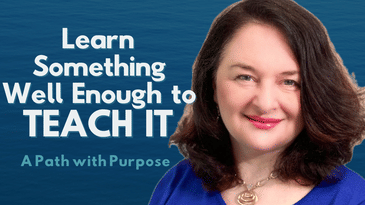
“When the student is ready, the teacher will appear.” Many of us are familiar with this quote from Lao Tzu in the Tao Te Ching.
What our guest, Marianna Lead, would want us to focus on is the next line in the Tao Te Ching: “When the student is truly ready, the teacher will disappear.” And that is because they can become one. In sharing her superhero power of Teaching, coach, business owner, and author, Marianna highlights that “the best teachers are the best learners.”
Marianna owns and operates a Internation Coaching Federation (ICF) approved coach training program, she’s an ICF-Certified Master Coach, she’s a life-long learner, and she recently joined the podcast to share with us her passion for teaching...which for her is synonymous with learning.
Want to listen on the go? You can listen to this episode on Apple Podcasts or Spotify.
In this episode, Marianna answers the following questions:
- What is teaching and why is it important?
- What makes a good teacher?
- Why are open-ended questions valuable?
- How do your values and your needs inform your purpose and your brand?
At the end of the episode, we go a little deeper into her book, "Me, My Brand, and Why?" and talk about how it uniquely connects the concepts of purpose and personal branding. In the section on purpose, Marianna and her co-author smartly walk the reader through one's values and needs to reveal their true purpose, and I even take a stab at re-writing my purpose statement: "I believe I am unlocking my potential when I'm working with others to unlock their potential."
My favorite quote from the episode: “It’s important to remember that [coaches can] provide resources if you are an expert in something…but it’s like a gift you give [and] the client doesn’t have to unwrap it.”
What I know to be true about the episode: I love how Marianna connected one’s needs as a contributing factor for discovering one’s purpose.
What I learned from the episode: Marianna has me questioning my own thinking about how a teacher should always learning. For the classes I’ve taught, I don’t think I’ve continued to be as curious about those topics to continue to learn about them. Then again, maybe I’m not interested in leaning more about project management as I am about other things like curiosity, purpose, and neuroscience.
Resources mentioned in this episode:
- Marianna’s book: “Me, My Brand and WHY: Infuse WHO You Are Into What's Most Important” by Marianna Lead and Maureen Miller B. Ed https://bookshop.org/p/books/me-my-brand-and-why-infuse-who-you-are-into-what-s-most-important-marianna-lead-m-c-c/18565772?ean=9781458392541
- “First Break All the Rules” by Marcus Buckingham https://bookshop.org/p/books/first-break-all-the-rules-what-the-world-s-greatest-managers-do-differently-gallup/594575?ean=9781595621115
- Marianna’s company: https://www.goalimageryinstitute.com/
If you like the episode, please do us a favor by leaving a review, hitting that like button, and subscribing. This helps others discover the podcast.
Music in this episode created by Ian Kastner.
"What Do You Know To Be True?" is hosted by Roger Kastner and is a Three Blue Pens production.
"What Do You Know To Be True?" is recorded on the ancestral lands of the Duwamish and Suquamish people. To discover the ancestral lands of the indigenous people whose land you may be on, go to: https://native-land.ca/
Episode Transcript
Marianna: Look, I'm all for breaking rules. I'm a revolutionary at heart. Seriously. Uh, it's like, yeah, go ahead, break the rules, but only consciously, which means you have to know them really well before you decide to break them. So if a student breaks rule, they better be able to explain to me why they decided that it's a better decision.
They make a decision to consciously break a rule. Because when you break a rule consciously, That's innovation. That's progress. That's you creating something new out of, uh, some old things, and that's beautiful. But if you are doing it because you don't know, there's no learning and there's no creativity in that.
You're just doing it because you're used to doing something new. Things certain way, it's easier, but you're not getting anywhere.
Roger: Hi, I'm Roger Kastner and welcome to the, what do you know to be true podcast. In these conversations, I talk with ordinary people about their extraordinary skill, their superhero power, and the meaningful impact it has on others. The goal is not to try to emulate or hack our way to a new talent. Instead, the intention is to learn more about the world.
Their experience with their superhero power, and in doing so, maybe we can learn something about the special talent in each of us. That makes us unique. This conversation is with Mariana lead and her superhero power of teaching Mariana. It's a dynamic personality, and she brings that strength and energy to everything.
She does from teaching. To acting to coaching and running her own business. Her superhero powers tied to her deeply personal values and needs. And as she points out, it's the same for you and me. If you're ready, let's dive in.
Roger: Hi, Mariana. It's great to see you. Thank you for joining me today. Thank you, Roger. I've been looking forward to this conversation because we have a passion in common, and that's helping others develop and grow through our knowledge and experiences as an author and instructor, you have many opportunities to live into your superhero power of teaching, and I'm sure as a business owner, a coach and an actor, you have even more opportunities to help others learn and grow.
I'm looking forward to hearing why and how teaching is important to you, but first. Tell us about Mariana lead.
Marianna: Thank you so much for this introduction. First of all, and, uh, I have to share, like, I'd like to share that the best in me brings out the best in those I teach, I coach and I mentor. And, uh, I think it's this energy, um, that is created when I'm doing those things is what makes me want to do them more.
and better, you know, like, so it's all about also self improvement and growing and learning. So, because I think that, um, the best teachers are the best learners. Right. I mean, we always want to be learning, we always want to be absorbing. So so then we could share it, give it back. And that's the exciting process of it.
Right. So I've been teaching since I was like 17 years old. I started teaching classical music, piano, because that's what I was learning back then. And then I was teaching acting techniques because that's what I was learning later. For the last year. 20 something years I've been teaching coaching and mentoring people on how to coach from the perspective of mastery.
And so it's all about finding the right teacher and getting that synergy that allows people to learn and grow. And become amazing coaches.
Roger: Is there a connection between being an actor and being a coach? What are the similarities there?
Marianna: Such an interesting question. I think yes. And I think that's what actually pulled me into coaching to begin with.
Well, let's start with the fact that every coaching session is an improvisation. Like we, we don't have the scripts. We don't know even if it's the, uh, if it's, if it's the old client, if it's someone that you, you already know, you still don't know exactly what mood they're going to be in, what they're going to be saying, what specifically they would like to look at in this specific coaching session.
And you have to kind of be on, on, uh, on your, uh, on tip of your toes, right? You have to be really ready to respond. And it's a partnership. There is the same kind of feeling of partnership exists in acting scenes and in improvisational scenes. You're kind of feeding off of each other and you're being creative together.
And I think that, uh, that brings me to another point that I think coaching is an extremely creative process. There are definitely certain rules. Uh, that you follow, there is a process that we follow, but there's also the part that's very creative and fluid. And the same thing in any art form, actually, specifically in acting too.
So there are, there are rudiments of acting, just like there are rudiments of coaching. And then there is this creativity that comes and can be developed once you know those rudiments. So in coaching, it's, uh, The process that we follow the SCF core competencies, and then we become fluid in that and we are developing our own voice.
Roger: It always seems like a paradox between creativity and rules or guidelines, but I have found that actually, the more stringent those rules and guidelines are, the more creative it forces people to be. Have you found that to be true as well?
Marianna: Yes and no. You have to be in agreement with the, with the rudiments.
If you're not in agreement, then maybe it's not the right philosophy, or maybe it's not the right industry altogether, right? You have to really synergize with the principles of whatever you are doing, right? So I think that's the important kind of, Differentiator.
Roger: That is such a good insight as someone who might have colored outside the lines and break a rule or two.
I really appreciate that distinction. You just called out. Yeah. If you agree with the rudiments, then, uh, then you can, you could bring forth your creativity. But if those rules are barriers, then yeah, that makes sense that it, it, it will dampen your creativity.
Marianna: Yeah, and you know, even, even with that, I say, look, I'm all for breaking rules.
I'm a revolutionary at heart. Seriously. Uh, it's like, yeah, go ahead. Break the rules. But only consciously, which means you have to know them really well before you decide to break them. So if a student breaks rule, they better be able to explain to me why they decided that it's a better decision. It's a, it's a, they make a decision to consciously break a rule because when you break a rule consciously, that's innovation.
That's progress. That's you creating something new out of, uh, some old things, and that's beautiful. But if you're doing it because you don't know, there's no learning and there's no creativity in that. You're just doing it because you're used to doing something new. Things certain way, it's easier, but you're not getting anywhere.
Roger: What I'm hearing, what I'm taking from this is that, you know, to be conscious about the rules and whether or not you're in alignment and then to be conscious about the creativity that comes through. Um, there's something about being switched on in both scenarios that I really, I really loved and how you pulled that, you tease that apart.
Marianna: Thank you. Well, um, There's an interesting thing that you're bringing up for me right now, which is a controlled type of thinking or consciousness, bringing it to consciousness. Because in reality, when you are creative, it's spontaneous. You can't be conscious in your creativity. It's just, it's a flow of feelings and thoughts, intuition, and then just kind of happens.
When we think about the rules that you want to break, right? The rules that you're breaking, you're breaking them consciously only when you know them so well that those rules become part of you. So those rules are also something or they become something that you don't consciously have to remind yourself about and think about the kind of part of your being.
Uh, if I know that in coaching, I need to, um, ask questions mostly. That are open ended that start with what, right? And of course there are exceptions like with anything else, but I'm going to practice so much that it's just a natural thing for me that even in my regular conversations now, most of my questions start with what, because it's a second nature.
But if I want to ask a question differently, I'm not going to ask it just because, Oh, you know, I didn't really know. That the most effective way to start a question is with a what I know that, but I'm intuitively creatively choosing a different path. So it's not always a very conscious thing, but if you stop me and ask me, I'll, I'll be able to, then when I'm thinking back about what I did, I'll be able to bring it to my.
Analyzation, you know, to analyze what I actually did, and I'll be able to explain it and rationalize it. So I think it's a little bit of a backward process sometimes, or sometimes it happens simultaneously.
Roger: Mm hmm. I think there's two different levels of, of being or two different levels of thinking. Um, and you're right.
I think that the deep analysis or the rumination, um, that gets in the way of flow. Mm hmm. But I think I think there's something very central to flow, um, where there's still that level of consciousness of being aware and reacting. But it does feel a lot more natural. And there's a lot less brain processing going on.
And and perhaps that's why it might be a more desirable state to be in. Because sometimes I think our brain just gets gets in the way of, uh, of a better experience. As
Marianna: you were saying these things, I was thinking about, um, how do I experience in my body? Um, the coaching flow, you know, the flow, the creative flow, um, when you're actually thinking, you know, and digesting what the client just shared and something is coming up for you and you're thinking about how to formulate it.
And I think that there is this kind of dual dual reality that's happening where, um, there is a lot of subconscious stuff that's happening such as intuition and creativity, but then there's also this kind of a consciousness. Consciousness, um, that is happening, um, in a, in a way of an observer, like as if there's an observer, um, speaking to the creative part and they're kind of doing things together.
And that's the duality that I'm referring to. I think that, uh, When we're trying to explain it, I think it's a very complicated process actually that's happening, but when you're in it, it feels very fluid and natural.
Roger: A good friend of mine, Enrique Martin, um, once was, um, explaining a topic to me or explaining his experience with a topic and he talked about the limit of language.
And how we, you know, we don't have words to explain a lot of the things we're trying to explain. And it really kind of made me sit back and think a little bit about no, no, no, there's plenty of words. I mean, there's so many words. There's a bunch of words. I don't know. And I, I tend to use the, the, you know, the smaller words, because those are the ones that my vocabulary can handle.
And there's got to be bigger words to explain the things we're trying to explain. I know Enrique knows those very big words and for him to say that there's a limitation in language. I believe that to be true. And so I think there's, there's some of the challenges we're talking about, um, part of our challenge is that there's a limitation of language and words and then, you know, not even throw in our, you know, our processing of how we not only encode, but then also how we decode those words and what the words mean to us. It's, it's amazing we get any ideas shared amongst each other.
Marianna: To add to that. So our school is one of the first schools that. Was completely 100 percent online school and part of the reason for that was because I always wanted to have all kind of, um, cultures present in my classes, but different time zones, um, different mindsets, uh, and people whose native language was maybe different than English and, uh, well, because, you know, I'm also an immigrant, right?
You know, like I came many years ago, but you know, I came from a different country. I'm actually from Kiev. I'm from Ukraine. But the, the bottom line is that people assimilate when they come here. Um, And, but those who are in different countries, they literally think in other languages. And even people who came here still think sometimes in their mother language.
And so I ask sometimes, do you actually interpret in your head into your own language what you hear and what you and what you would respond and then going back and forth between English and another language? Because I don't, I literally think in the language that I speak, but I know that many people don't.
And I think that. Um, coaching being focused. I mean, all of our tools are language related in coaching, right? Um, and so I think it's interesting to see the differences with different languages.
Roger: And,
Marianna: and so it just becomes, It's fascinating to, to see how that interpretation, uh, especially when people, cause I, I understand English and maybe two other languages, right?
But um, three other languages. But so when, when people say something, I can hear the, that, that mental translation that they're trying to do. Um, and it doesn't sound exactly right. But it's just, it's fascinating to me because people who are, who, who will speak European languages, even though they're going to speak in English, they're going to have a different pace to the sentence, for instance.
And if another European is listening, they will understand 100 percent the question and then they'll respond to it. But if it's someone from Asia or American born, they're going to say, can you please rephrase your question? I didn't get it. It's, it's just, it's. It's beautiful and it's also a little scary because you think about how careful you need to be with every single word that you're using.
Roger: There's a big step that happens in the coaching world that when we start thinking as a coach, instead of thinking as an advisor, it's easier than to manage ourselves to self govern, um, through those situations when we start getting idea of like, oh, I think they need to, they need to do this. Instead, we need to think.
You know, start off that conversation or switch into the language of a coach thinking like a coach rather than thinking like an advisor.
Marianna: Yes, absolutely. I also find that it wastes a lot of time. So, uh, it does. So I hear a lot of like newer coaches. They're asking questions such as have you thought of. Or have you done this and that and more often than not, the answer would be, I already thought about this, but it doesn't work for me or I've done that.
Or, you know, very rarely you're going to hear. Oh, you know, actually, I haven't really tried that. I'm going to do that. Right? Um, and so I'll call these type of questions, the fishing expedition. Because you, did you do this? Did you do that? Did you think of this? Did you think of that? And it just goes on and on and it wastes a lot of time.
And if we go back to an open ended question, so what have you tried in the past that worked? Ding, ding, ding, ding, ding, ding. No, they're going to tell you what they, what they did that, that, that worked. But I also have to mention something that's pretty important. I think that it's important to remember that we do provide resources.
If you are an expert in something like what you were mentioning, you know, I really know something and I want to give an advice, so you don't give an advice. Uh, but it's like a gift. You give a gift, but the client doesn't have to unwrap it. You know, it's like, Oh, I don't want it. flashing down, you know, no, no attachment, right?
So, you know, yes, we can provide advice, but we definitely bring in what we know, uh, in terms of resources and our personality. Right. You know who you are, your background, all of you, because your clients are not hiring you just because you completed a year of training with the best school in the, in the world.
I don't care what school it is, or even two years, right? The hire you for all that you bring to the table.
Roger: That's a great point. And it does, it does remind me of the, the International Coaching Federation ICFs rules. And 1 of them are principles, and 1 of them being that we treat our clients as creative, resourceful and whole, um, that they are able to find solutions within themselves.
And those solutions tend to be, um, not only the ones that better fit their needs based on their experiences and capabilities. Um, and I, I, I remember. Seeing that most recently in your book. Me, my brand and why you called out that that principle that yep, right back there And we'll we'll link to that book in the in the show notes But one of the things I really enjoyed reading in your book Is the connection to values, or as you call it, fuel and one's needs, or as you refer to it as the essentials.
So, could you tell us a little bit about what you've come to learn about the connection between a person's purpose, or their why, and their fuel and essentials?
Marianna: I couldn't find a connection, you know, a book that would, or, or a school or a program that would offer a connection between who you are, your why, your how, and your what.
Right. And so, um, like for instance, um, Simon Sinek, he wrote an amazing book start starting with why, and I then started to try to work on my why. And I realized it's not so easy. It's just not because it sounds very easy, but it's just not. And before you get to why, you really need to understand who you are first.
And so there are tons of books on helping you decide define who you are, and tons of books on personal branding, but none of them seem to connect the two. But they're like inseparable and they need to be, um, integrated. within the same program. So the road to creating your why starts with, um, who you are and what you sell and what you do is the last step.
Actually, your question, who you are, includes your fuels and your essentials. So a fuel is the value, but it's a very specific value. It's value that moves you to want to do something. Something also that is easy for you, relatively easy for you. Because if it's easy for you, it means it's your thing. It means you're meant to do it.
If it's easy, if you don't struggle to do it, it means you have a talent for it. Because I may want to do other things like, you know, um, I love art. I love looking at painting, but I can't really paint for nothing. You know, like I just, you know, right? So those are the fuels and they're always joyful. It's always something that, oh, I really, I do it.
Roger: Well, yeah, Marcus Buckingham in, um, first break all the rules when I read the book 20 years ago, and I found that some of the research he did at Gallup showed that only 20 percent of people are actually able to use their strengths. In any given day, and defining strengths as something they're good at, but also something that gives them energy, something they're passionate about.
And when I read that, it was heartbreaking. The idea that 80 percent of people are showing up to work and doing the thing. They're probably good at the probably the thing they get recognized for. And and rewarded for, and that probably feels good. And probably the reason why that person had that thing at the top of their resume.
But if it's not the thing that gives them energy, then it's not a it's not a true strength. And it's not something that the, you know, if they want to live a more fulfilled life or more purposeful life, they do need to remove that thing off the resume. And they do need to focus in that area of not only the thing that they're good at, but the thing that that gives them strength, that gives them energy, And then when you combine it with the thing that, you know, creates value in the world, that's needed in the world, that's in service of other people.
Now, now I think you're on your pathway to purpose.
Marianna: Exactly. And you use the exact phrase, perfect phrase, gives you energy. So a fuel is something that gives you energy and an essential, we came up with that word essential to replace the word need because there's just so many negative connotation with the word need, uh, as like being needy, right?
Um, however, it's true though, you know, because people who are not satisfying their needs, uh, slash essentials do show up as needy and no one wants to be around the needy person. It's just, it's such a turnoff.
Roger: Yeah.
Marianna: Roger, please have me on your podcast. I really need it. I want it. When can I show up, you know, right.
So you can't do that. It's just, it's, it's bad, but it's going to happen. You're going to have that kind of show up if you don't take care of your needs slash essentials consciously. So again, it's, it's about work. working with the coach, ideally, right? Cause it's always quicker and quicker and easier and more effective to find what they are, to identify exactly what they are and, uh, find positive ways to satisfy those needs, to satisfy those essentials.
So for instance, I pretty early on, you know, not that early, but in my twenties, I realized that my essential was getting attention, but my negative way of getting attention was being late. Like I was chronically late to anything and like everyone, it didn't matter what I was doing, who I was meeting, um, what it was.
And of course, when you're late, everyone stops and pays attention to you. You're getting lots of attention. The attention is negative, but subconsciously you don't differentiate. So your subconscious doesn't know negative from positive. It just knows that it gets what it needs and it needed attention. So it was getting what it wanted and is in his quickest way possible.
So your subconscious will come up with the quickest way possible to get what you need. You know, you're essential. And when you identify what it is that you can Consciously come up with a healthy way of getting it done. So for people like me who need attention, maybe it's, um, becoming an actress, you know, an actor, um, creating your own show, uh, becoming a speaker.
So, consciously thinking of ways to get attention in a healthy way. And so, you asked me about the connection between fuels and essentials. If essential is, uh, not satisfying, you're just not going to have enough energy to, to be fluid with your fuels. You're not gonna, you're gonna be, your mind, body, all of your energy is going to be focused on satisfying those essentials because they are necessary for you to live.
it's your emotional oxygen. Let me put it that way. And fuels is like when you were like already on the boat and you have your sails up and you're moving and you're enjoying, you're, you're in your zone, right? So that expression being in the zone, that's it. That's what you feel when you are exercising your fuels.
But so that it takes growth, right? You have to, you know, balance essentials and fuels.
Roger: I really appreciate you walking me through that. And as you were, what I have noticed in these podcast conversations I've been having, there is a very specific connection between people's superhero powers and a need that they have.
And oftentimes it's an unmet need that the superhero power started off as a way of addressing that need. Um, and then with practice, with time, with experience, it becomes a superhero power. And then it becomes really meaningful when they are using that talent in the service of others, which I think we can draw.
And you kind of just did that connection between the, the essential that you have for, for attention. and using that, you know, fulfilling that as an actor, fulfilling that as a teacher, and then finding, ooh, this teaching thing, this is really cool. And then getting, you know, it probably, you know, with a combination of the fuel, really lit that fire.
And now, with your class, with the workshops, with the instruction you do in creating other coaches, You know, now you're in service of others. It's, it's, you know, you've kind of proven out your model. And it resonates with me because it's what I'm witnessing here on these podcasts about how these pieces connect in a really, really exciting way.
Marianna: You're mentioning superhero and I'm thinking about Jungian archetypes. I know I'm thinking about that. Uh, and it's true. So there is a superhero and there's also a shadow. So your essentials are your shadow. That's what it is. That's how it connects.
Roger: So, what or who inspired you to have this superhero power of teaching?
Marianna: No one.
Roger: Mm hmm.
Marianna: I don't have any models. I really don't. And it's not because I'm, I'm not coming from the position of being a snob and saying that I don't have people that I admire. I do. For me, it was important to come something that was really personal. And I didn't know that teaching was it for many years, actually, but it was coming back and coming back and coming back.
And, and then they just had to embrace it.
Roger: And were you aware of your essential? That that need for attention early on or was or the blinds, the dots just connecting and you were going,
Marianna: that's what connecting and I was just going and I became really conscious of all of it.
Roger: So what does it feel like when your superhero power of teaching has a positive impact on others?
Marianna: I think that, uh, and you can vouch for that. I think that when we are exercising our fuels, uh, when we are exercising our superpower, it's extremely rewarding. And to see, to understand that it actually results in some value. for others, for society, for the world you live in, it's just so rewarding, you know, because it also gives meaning, it gives meaning to life in general, and gives meaning to your life in particular.
And I think that people are much more focused nowadays. on bringing meaning and living through meaning. When you talk to young people nowadays, um, I think salary is important, but one of the first questions that they ask now is how meaningful is it going to be? How fulfilling is it going to be? To me, it's so encouraging.
I think that this literally reflects that the world is changing to the better. I mean, I'm hopeful that the consciousness is changing towards what meaning am I intending? Uh, how am I expressing, uh, in a positive way what I'm here to do? And I think that's very important.
Roger: This idea that more and more people are looking for purpose of looking for that connection of creating meaning, um, up and down the spectrum of wherever you are in life.
Um, it's, it's wonderful to see that. I think the more we live into our purpose and the more we, um, experience joy and the thing that we, you know, Fulfilling our own personal needs, but then doing in service of others. If we can do that in the context of work, we're going to leave work much more fulfilled, much happier.
Um, and we're going to bring that joy to our families and to our communities. So I think it's actually not only creating a better world with inside of us, but it's creating a better world in which we live in. At least that's the story. I'm telling myself and I'm sticking with it.
Marianna: I like this story. I agree.
Absolutely.
Roger: So Mariana, what do you know to be true
Marianna: about teaching? Teaching is learning. That's true about teaching. Teaching is learning. I constantly learn from my students as they learn from me. And it's a circle. And it's an ending circle. And as the moment you stop learning and you stop teaching and vice versa, and the moment you stop doing either of those things, we stop living.
Roger: That reminds me of, of the, um, very popular saying about learning of when the, when the student is ready. The teacher will appear and and maybe the idea I've always thought of that as there's two people. There's the learner and the teacher, but maybe they're more connected to that. Maybe as the learner, you could also be the teacher.
Marianna: I think that if you just sit and wait until the teacher appears, you may sit there for a very long time and nothing is going to happen.
Roger: What did you believe early on about teaching that you've come to learn is not true?
Marianna: I thought that I knew how to teach anyone and I was wrong because I'm very eclectic and I'm very creative.
And so people who are like me, uh, the follow, the follow along very easily. But there's also, um, quite a large population of a very illogical thinkers. Um, people who really need and want everything all the time. organized and structured. And so I learned to do it in a structured way in an organized way while still keeping my creativity and flow.
Uh, you know, it goes back, uh, full circle to the teacher wanting to meet the student, like all of them, right. And wanting to be better, get better and get back to the drawing board and make changes. That's what it's about, right? You know, so, because I could have said, you know what? They don't, they don't like me.
They don't have to come.
Roger: Right. Which I think, I think that is a pervasive, um, perspective of a lot of instructors. I think you might see that on a lot of college campuses, unfortunately.
Marianna: Well, those are not really teachers who have teaching as their calling, right? You know, those are people who are working for a paycheck.
Roger: Well, Mariana, are you ready for the lightning round?
Marianna: Yes, I am.
Roger: I love the enthusiasm. So fill in the blank. Teaching is
Marianna: Wonderful. Rewarding. Meditative.
Roger: Who in your life provides teaching for you?
Marianna: Everything and everyone, uh, literally. So I think that, and my students specifically. So my students, but also people around me.
And I think that we'll learn from all of our relationships all the time.
Roger: I think if we're paying attention.
Marianna: Yes.
Roger: Yeah, there's definitely an opportunity there. So is there a practice or routine that helps you grow, nurture, or renew your ability to perform teaching?
Marianna: I think that just being creative, um, in the ways that are not professional, uh, meaning a hobby, like playing piano because I don't do it for a living anymore, right?
Playing piano or playing with my cats. Uh taking a walk anything it has to do with nature playing getting my hands dirty in the garden You know, um, which brought me two years in a row to poison ivy thing And my daughter is like We should be just doing comedy show on you because it's like, why are you doing it?
It's like, you're like, you want to get to poison. I mean, you're like seeking it out on purpose. Um, but no, but so things like that really bring me relaxation and, uh, reset. And I get to be set.
Roger: Those sound like mindfulness practices. Is that how you would describe it?
Marianna: Yes, totally.
Roger: Lovely. So what's one thing that gets in your way of teaching?
Um,
Marianna: when I get a student that hasn't been doing homework for more than once or twice.
Roger: And
Marianna: so then I have to really watch my energy, uh, so that I'm still in a neutral versus angry mode because I do tend to take it personally. And And I, you know, I shouldn't, and I don't want to take it personally. It's not healthy for me either.
Right. So I have to be really conscious of my responses when that happens.
Roger: But I love that idea of that. It's a give and take like we were talking, we were talking earlier about the, you know, when the student is ready, the teacher appears, there's a relationship there and you're going to bring everything you can to that relationship.
And there's, it sounds like there's an expectation that the student is bringing a certain level of energy. Of participation of engagement back. And so when it doesn't happen, when it doesn't happen for you, when you're not able to bring that energy or they don't put in the energy, that probably does feel a little deflating.
Marianna: Yeah.
Roger: What word or phrase describes what teaching feels like when it's had a positive impact?
Marianna: Enlightening. Going back to relationships and experiences, right? I think that especially in coaching or any art form, Um, why would you take a course? Like, what would be the other reason, another reason to take the course other than to actually experience it and learn how to do it live under the guidance of your mentor teacher, right?
Because you can read, it's like when you say book knowledge. Well, go and buy a book, like, it's like, this is, this was my problem in school, you know, in high school and the middle of school, I usually knew more than the teachers did because I just read the book, okay, just like you could just read the book, like, why do I have to sit here, let me go home, I already, I already read this, because the teacher would literally like open up the book and go through the pages, and it was just boring.
It's like that's not what we want. I don't think that's what anybody wants.
Roger: I've had the instance where a student might be required or they feel like they're required to be there. Um, like they need a, they need a certification to keep their job or to get promoted. And so they show up and it's, it's kind of a shame.
And I, I try to go into, um, go towards inspiration. You know, and I'll, I'll probably say something to the student along the lines of, well, if you're here and I'm here, how do we get the most out of this experience or something like that to see if that could inspire them to see where's where are the opportunities to learn something and not just physically put in the time.
I love
Marianna: it. I absolutely love it because it really shows, uh, that coaching partnership that we've talked about, right? It's a partnership and same with between teacher and student. It's a, it's a two way street. So, right. So we're totally on the same wavelength.
Roger: So if a listener wanted to ask you a question or follow up with you or learn more about your business and your, your classes, where do you want to point them to?
Marianna: My website probably, which is goal imagery. com and they could, uh, press on contact form and contact us directly. And, uh, if you want to talk about coaching with me, then there's a button there that allows you to actually, um, book a meeting with me on my calendar. And I personally will show up and I'll be happy to talk to you about coaching.
Roger: No, lovely, and I'll put I'll put the links to those in the show notes. So, Mariana, thank you so much. I really appreciate you. I appreciate this conversation. I've learned so much from you in just the short time. We've we've been able to know each other. Thank you for sending me your. Book, which I highly recommend.
I think it is at that intersection of understanding your own personal. Why there it is, as well as understanding the brand and how you put yourself out there and how you get other people to know what you're about. I really, I really found a lot of value out of that book and you're not paying me to say that.
So it's, it's, it's what I really, truly feel. Um, And I really appreciate this conversation and everything that we've, we've talked about. So thank you. Thank you very much for your time and your insights.
Marianna: Thank you so much. I, I am going to offer a workshop, um, that will help people to like, literally, I will take you through the steps of creating your own brand, because I think that not just for new coaches, I think anyone, for anyone, uh, it's just so important to understand who you are and what's your personal brand.
Is it's just, it's, it's a, it's, it creates so much freedom and joy in your life when you know it, and it also serves as a decision, actually decision maker for a lot of dilemmas and like really important dilemmas, like, like that was mentioned before, where to live or whom to marry.
Roger: Yeah,
Marianna: you can, you can find those answers when you know your why and your personal brand.
Roger: I had the opportunity to actually do a little brand work with a client a little over a year ago. And to prepare for that, I actually went and consumed a lot of materials about helping people create their brand. And I will say your, your approach where you're connecting it to purpose and connecting it to people's needs and values, um, is unique.
I didn't see that before. And so I wish I did, but now, now that I've had, I'm, I'm much better at being able to articulate that, but I, I, um, I actually played with it myself. Um, and I came up with my own statement. Do you want to hear it? Yes, absolutely.
Marianna: Oh my goodness. It's
Roger: exciting. I believe I am unlocking my potential when I am working with others to unlock their potential.
Marianna: I love it. That's great. It's great.
Roger: And it's tied to my fuel of having impact. And, you know, you you in the book, you break out fuel by categories. And so there's impact and the word in there that really resonated with me is spark. And I think that's, you know, creativity, innovation, energy, but then also freedom.
And the word under the freedom category was liberate. And I think it goes back. I was telling the story earlier about market Marcus Buckingham, and that 20 percent of people there's 20 percent of people out there that get to experience their strengths every day, meaning 80 percent don't, meaning that there's a lot of people that are like, sort of tied in a situation that's not giving them energy that maybe makes them feel stuck.
And to me, I want, you know, helping people unlock their potential feels like liberating them. From from that that experience. And then my essentials. My needs is to be acknowledged. And I've talked about that in terms of with, uh, with my clients, like the thing I am looking for is at the end of the engagement for them to say, thank you for the contribution.
I made now I'm getting paid for the work. I'm getting I'm seeing the, the, the impact, like, I see all that stuff and that stuff's really valuable. But I've always known it's that. acknowledgement is really important to me. So as I was going through the book and I'm like, yeah, yeah, my essential is to be acknowledged.
Um, and I can tie that back to an unmet need. And, and I'm sorry, this is beginning to sound like a coaching session or maybe even therapy. When I was growing up, we moved every year. And so from kindergarten through The end of high school, I went to 8 different schools, lived in 8 different towns. Um, and so not only was I was the new student without a friend group at the beginning of every year.
I also had a speech impediment. And I was pronouncing my R's as W's, so as the kid with the funny, the, the, the funny way of talking and the new kid, um, and I, I take away from that, that experience that, you know, I was, I was being acknowledged, but not for the right thing. Not for the thing I wanted to be acknowledged for, and maybe even not seen as someone who is valuable, and so this idea of the work that I'm doing, yes, I want to be acknowledged, but I want to be acknowledged for actually making a real impact, a real contribution to the lives of others.
And I see that as where, you know, their unlock is tied to my unlock. And that gets us back to liberation, because it makes me think of, um, the Lilla Watson quote. Lilla Watson is an aboriginal activist who is quoted as saying, if you've come here to help me, you're wasting your time. But if you've come here because you realize your liberation and my liberation are tied together, let's get to work.
And that, that sparks joy and fuel for me.
Marianna: Well, I mean, I'd like to acknowledge you, Roger, for all of these amazing thoughts. And you're such a great interviewer, and it was easy to talk with you. And I really hope that we are going to jointly create impact. Your fuels and essentials are very close to mine, very close to mine.
And no wonder we are, it's easy, you know, for us to talk with each other. And, uh, Well, hey, you know, for the audience, maybe you guys won't need a workshop. Maybe you'll be able to crack the code as easily as Roger did just by buying the book. So it's me, my brand, and why it's available on Amazon. Just type it up correctly and it'll come up.
And, uh, and just, that's it. And leave us, uh, leave us your recommendations and feedback. And I would love to hear your whys. I would like to hear whys and what you come up with. From all of our listeners. It's amazing. I think that this is speaking about impact. Uh, just even that you read it and you inspired you to do the homework and actually get this done, and you were telling me all of this stuff that you were just sharing, it's amazing, you know, so I'd like to acknowledge you for that work as well,
Roger: you know, when the student, when the student is ready.
Thank you so much. This has been lovely.
Marianna: Thank you, Roger.
Roger: Thank you Mariana. This was a very enriching conversation for me and one that I learned more about my relationship with my values, my needs, and my purpose. The question I'm asking myself after this conversation is, besides my superhero power, Where else are my core values and needs showing up? And are they getting met there?
What Do You Know To Be True is a Three Blue Pens production. I'm your host, Roger Kastner. We are recording on the ancestral lands of the Duwamish and Suquamish people. To discover the ancestral lands of the Indigenous people whose land you may be on, go to Native. plans.ca. Okay. Goodbye my friends.