
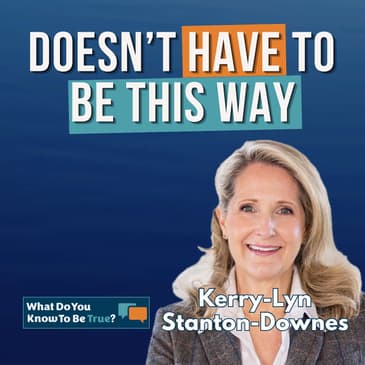
That feeling of it being lonely at the top, it's not a leadership job requirement. It's a signal that you're going against your nature.
And yet most leadership development doesn't talk about the impact of loneliness on performance, burnout, and well-being. Not enough at least.
Psychologist, TEDx speaker, and author Kerry-Lyn Stanton-Downes makes a bold case: our brains are relational organs, wired to regulate, heal, grow, and perform through connection with others. Yet most leaders have accepted the story that loneliness is just the cost of leadership.
In this conversation, Kerry-Lyn unpacks why that story is costing more than we think. When leaders prioritize task over relationship, what looks like discipline on the outside is actually the early signs of relational drift. Over time, that impacts not only the leader, but the team's working relationship and performance.
Kerry-Lyn introduces the concept of relational poverty, the barrenness in the space between us where we can't repair, can't challenge, can't think together. It's not just a personal cost; it's systemic. When a leader's nervous system is in survival mode, that state becomes the relational climate for the entire team. People start managing the leader instead of collaborating with them.
The good news: Kerry-Lyn offers a framework for building relational capacity through eight principles: presence, curiosity, reflection, vulnerability, being in service, navigating difference, a mindset of abundance, and repair. And you don't need all eight. Start with one.
For a leader already running on empty, the first step isn't adding more to their plate, it's regulating their own nervous system so they can show up for others.
This conversation is for any leader who feels the weight of isolation and suspects there might be a different way.
BONUS: Kerry-Lyn offered to join us for a follow-up episode to answer your questions. If you want to ask Kerry-Lyn a question, drop a comment in the YouTube version of the episode. Thank you!
In this episode, Kerry-Lyn answers the following questions:
- Why is leadership so lonely?
- What is the cost of loneliness?
- What is one thing a Leader can do about loneliness?
- How do I develop more relationships?
Resources mentioned in the episode:
- Kerry-Lyn’s Company
- Kerry-Lyn’s LinkedIn
- Kerry-Lyn’s Substack
Music in this episode by Ian Kastner.
What Do You Know To Be True? is a personal development and leadership podcast for professionals discovering, building, or already living into their purpose and possibilities.
Each episode is a real conversation with a guest who's navigated their own reinvention: from discovering a talent built out of something difficult, to now using their superpower in service of others. Their stories offer new perspective, validate what you already know, and inspire your next move. Wherever you are on that path, these conversations are for you.
Each conversation gives you something real: a guest's honest story, a practice or perspective you can actually use, confirmation you're on the right path, and you're not alone.
➡️ Subscribe to the What Do You Know To Be True? newsletter to get insights into each conversation: https://rogerkastner.substack.com/
➡️ Visit the Channel: https://www.youtube.com/@WDYKTBT?sub_confirmation=1
"What Do You Know To Be True?" is hosted by Roger Kastner, is a production of Three Blue Pens, and is recorded on the ancestral lands of the Duwamish and Suquamish people. To discover the ancestral lands of the indigenous people whose land you may be on, go to: https://native-land.ca/
Keywords
#Leadership #loneliness #Burnout #LeadershipDevelopment #wellbeing #LonelyAtTheTop
#personaldevelopment #RogerKastner #reinventyourself
Transcript - Loneliness doesn't have to be the cost of leadership - Here’s the Fix - Kerry-Lyn Stanton-Downes
[Roger]
You know that story you're telling yourself that it's lonely at the top? What if that story doesn't have to be true? What if it's a story we've just accepted?
And what if that story is costing us more than we think?
[Kerry-Lyn]
When we do everything in isolation, we create this poverty in the space between us. Then what happens is we lose out on collective thinking, we lose out on collective decision making, different perspectives, and the most important thing is our nervous systems start to become numb and we go into survival state. But what eventually happens is people burn out, anxiety goes up, depression increases, stress rises, because people don't even realize that the relational conditions have moved into poverty.
They just think that's how it is.
[Roger]
That feeling of being lonely in your role, it's not a job requirement. It's a signal that you're going against your nature. That's why I'm so excited to be sharing this conversation with Carrie Lynn Stanton Downs.
Carrie Lynn is a psychologist, a TEDx speaker, and an author whose core argument is that our brain is a relational organ. We are literally wired to regulate, heal, grow, and perform through connections with others. Welcome to What Do You Know To Be True.
I'm your host, Roger Kastner. These conversations are an invitation to explore how to become more of our possible selves through the experiences of others who've been right where you are. In this conversation with Carrie Lynn, she shares how we got here, why it's costing us more than we think it is, and what we can do about it.
If during this conversation you think of a question you'd like to ask Carrie Lynn, well, stay tuned, and I'll tell you how you can do that. I'm glad you're here. Let's dive in.
Hello, Carrie Lynn. Thank you for joining me today. I'm grateful we're here together, and I'm excited about the conversation we're about to have.
[Kerry-Lyn]
That makes two of us. I'm really excited about this conversation and can't wait to get into each of it.
[Roger]
I'm excited to learn more about your superpower of the ability to notice and pay attention to the space between people, to name it, and to be honest about what is happening with kindness. It was a previous guest, Bill Hefferman, who originally told me about you, so I looked you up on LinkedIn, and I'm so glad I did. Since then, I've learned that you're a psychotherapist, a leadership advisor, a TEDx speaker of recent, and then you have a book coming out, Beyond Words, How to Lead People from Survival to Success, that comes out on May 14th.
Before we get into, deep into the conversation, what is important for us to know about you?
[Kerry-Lyn]
The most important thing I think to know about me is that I've made a lot of messes in my life that I haven't got here because it's been easy, and I'm deeply grateful for that. It's actually in the mess, in the challenge, in the confusion, in the not knowing, in the trial and error that I sit here today, deep in my seat, having developed and created what I've created, and to be able to actually embody the very thing that I talk about. It's because of the mess, and I'm very grateful for it.
[Roger]
Yeah, I love that. This idea that the mess is not something that detracts from us, but it makes us who we are. It reveals our character.
It reveals and helps us become more of our true self and not a deficient self.
[Kerry-Lyn]
Absolutely, and that really is determined by how we choose to engage with the mess.
[Roger]
A phrase that is now synonymous with your work, be relational, is a term I want you to unpack, along with this other term, relational capacity.
[Kerry-Lyn]
If we think about that in terms of purpose, and then the how, my purpose is to help the world be relational, and to come back to what we innately know we need, and who we really are, which is to be relational. That's my overarching longing, and purpose, and journey in the world. The how, I will do that, is to help people build their relational capacity.
Relational capacity is the ability to stay present, curious, and open, especially when it's relationally hard.
[Roger]
That last part seems really, really important, especially when it's hard.
[Kerry-Lyn]
If we think about relational capacity, it has eight principles of relational capacity, and each one of those are a very small vessel that allows me to continue to move towards my purpose. Because otherwise, what often happens is, we have a purpose, and we drive towards it, and we think everything we're doing, every sacrifice, every hour that we spend working on it, is meaningful and important. That's true, it is, if it has a direction.
The challenge comes when we don't have any capacity underneath us to drive towards that purpose. Relational capacity, for me, is really about understanding that if we want to get there to our purpose, we can't do it on our own. We need to build our relational capacity so that we can fulfill our purpose.
[Roger]
In these conversations I have with people about their superpower, there's that thing that keeps coming up, something you already know, but I've learned through these conversations, is that every superpower is developed in relationship with other people. It's not a solo act. Same thing with our purpose.
We cannot fulfill our purpose unless we're in relationship with other people. I love how you're calling out that we need to build up our capacity to be relational with other people. You just mentioned those eight principles.
Do you want to briefly go through each one of them?
[Kerry-Lyn]
With pleasure. We start with presence. For me, it always begins with presence, because presence is the greatest gift we can give another.
That real focused attention, the ability to attend to and attune to another human being so that they can feel seen. Then we have curiosity. We're born with curiosity.
Look at children. They're constantly touching something, feeling something, pulling up on something, putting it in their mouth, sticking it in their ear. They're always wanting to learn.
The type of curiosity I'm talking about is relational curiosity. It's curiosity not just about the problem, but also about the person. It's that sort of curiosity that we create that's not there in order that we can confirm our thinking or defend our position.
We all know how to do that. Then we have reflection. That is the capacity to, in the moment, attend to what is happening.
We're so used to actually doing post analysis, post match analysis, but we fail to think actually we can do reflection in the moment. Reflection and curiosity and presence, you'll begin to see, are all very closely aligned. In fact, when you start to do one, you start to do the other, as with the rest of the principles.
Then we have vulnerability. What I mean by vulnerability is the willingness to turn around and say, I think I need some help, rather than the vulnerability, which is here are my emotions and they're your problem to solve right now because I don't want to hold them. The vulnerability must be in service of something.
That moves us to the next principle, which is in service. For me, this is one of the most important because when we come together and we have a shared goal, we always have something we can go back to that allows us to anchor any conversation. That, I feel, together with presence, are the two that really anchor all the others because as we go around, the next one is the ability to navigate difference.
Often we think just because we have diversity that we know how to navigate difference. We don't. We need to genuinely believe that actually we can hold different thinkings and different ways of being together in a space.
That brings us to the next one, which is a mindset of abundance. We can do this together. That's essential.
That's totally different to positive thinking, which just basically says we'll never fail. That's just not the case. It's if we fail, we can do this together.
That's what's powerful in this mix. What I love is we don't have to do all eight principles. We can genuinely just start with one.
As we use it, what we come to see is if you've got real presence, you'll find yourself naturally wondering about the other person because you're in their experience and you're more likely to naturally reflect and to be when we're present. We're able to notice what's happening for me, what's happening for you, and what's happening in the space between us. Therefore, we start to ask different questions like, oh, tell me more about that versus why did you do that?
We unpack different layers as we embody the principles. What's lovely about the principles is you can apply them instantly. Then you can embody them over time.
[Roger]
What have you found to be the most difficult principle that a leader runs into?
[Kerry-Lyn]
It's probably navigating difference. If somebody attempts to start trying to navigate difference, when there is a lack of presence, curiosity, reflection, a shared understanding of what we're in service of, or a willingness to be vulnerable, navigating difference becomes almost impossible. It becomes about you versus me, right versus wrong, good versus bad.
Then it just becomes combative. Then curiosity becomes the type of curiosity I was talking about, which is to defend my position or to attack.
[Roger]
If a leader finds themselves being challenged with navigating differences, what's one or two things you would suggest that they work on?
[Kerry-Lyn]
The first thing I would suggest they work on is reflection. What's happening for me, that I'm struggling with this difference? Then become curious.
What about this is familiar to you? What is the story I'm telling myself about what's happening between us that's making this so hard? Instantly move to reflection.
That then in itself, as you can see, moves you into curiosity, increases your presence, starts to ask, what are we in service of here?
[Roger]
Earlier, I mentioned the opportunity to ask Kerri-Lynn a question. Well, that came from after we recorded the conversation, Kerri-Lynn suggested, let's get relational and offer people the opportunity to ask a question. Then we'll come back.
We'll record another episode where Kerri-Lynn answers some of those questions. If you want to ask Kerri-Lynn a question, just drop it in the comments and we'll come back and Kerri-Lynn will answer some of those questions. Okay, let's get back to the episode.
I noticed this pattern in a lot of leaders and business owners that I talk with, and I notice it in myself as well. This idea that relationships keep getting pushed to the back of the queue in favor of something more urgent to do, the tyranny of the urgent. It feels like we're being responsible.
It feels like we're being disciplined, but ultimately, I think you would say that we're hurting our relational capacity by focusing on those transactional pieces. Kerri-Lynn, what are you actually seeing happen when the leader is making that choice of work over relations over and over again?
[Kerry-Lyn]
Honestly, Roger, that's one of the most common patterns that I see. It's also one of the most costly. Why?
Because what looks like discipline on the outside is often the early signs of relational drift. Leaders are choosing the urgent over the relational because the urgent feels measurable, firstly, and the relational feels quite diffuse and difficult to grab onto. What happens is their nervous systems start rewarding the choice that gives them the dopamine hit.
It's the dopamine hit of that closed task while very quietly beginning to deplete the very thing that they need most to do the work well. It often starts with the person telling themselves very simple things like, oh, this is just temporary. The board meeting that's coming next week, the funding round that's about to close, the launch that's happening in October, whatever it might be, there's always a reason.
Those reasons are genuine, but the problem comes where within a year or so, that pattern begins to harden. Conversations that they used to have with either colleagues or co-founders start to become transactional. Then peer relationships outside the business begin to thin because returning the call feels like it's an effort and it's one more thing on the list.
Then their partners at home are just getting this funny version of them that's left at the end after the work and everything else that's happened. By year three, something begins to shift that almost nobody names. That is that the person begins to lose a certain amount of access to their own thinking and the thinking of those around them because some levels of thinking, we do better in the presence of other people rather than on our own.
Without that, our decisions begin to narrow and confidence almost calcifies into this rigidity. I see quite a lot of that. The leaders who then become harder to challenge and not because they're arrogant, but because there is literally no one close enough to them to even ask anymore, am I doing this well?
Do you have a different thinking? They effectively begin to drift out of their relationships completely. They begin to feel this deep sense of loneliness in the position.
It's not only because they have so much on their to-do list, it's because they've prioritized relationships to the bottom. What happens then is their nervous systems become at a wired and have a new level. That's what ends up happening is that the nervous system becomes chronic in its survival mode when a person has convinced themselves that they're just being responsible.
The survival mode is in that instance what the leader believes, oh, that's my private experience. I'm tired. I'm lonely.
I have no one to go to. But that's not the truth because what happens is that it becomes the relational climate for the whole team. Whatever that leader is unable to express, the people around them are constantly managing because they have a vested interest.
The real cost of pushing relationships to the back of the queue is not just personal, it's systemic. Now, we just have survival mode happening everywhere because relationship has been demoted to the bottom of the to-do list.
[Roger]
This sounds like the opposite of co-regulation would be co-dysregulation. Is that the cost of a leader's relational state for the people around them or does it go deeper?
[Kerry-Lyn]
They then, as I say, become utterly unavailable to the person that is around them. They become numb to any of the relational interactions. People are beginning to manage the leader, the team member that is in that space of believing I've got to do it all by myself.
What happens is you find then that the team starts to believe that there is a new norm about how they must operate, what can't be said, how we're all going to function together, the subjects we can't raise, not just what can't be said, which is the challenge, but the subjects we can't talk about. So we start monitoring according to what we're experiencing, particularly if it's the most senior person who is in that state or in that place. So the cost is huge.
It costs in terms of the way the team operates, everybody else's nervous systems, but it also begins to cost in terms of how the rest of the organization interacts with those in that team or with that manager. So they can become numb to any relational cues that are sitting in the space between and then people stop coming to them and offering thinking or asking for help. So we create a norm around what is allowed and what is not.
[Roger]
So you have this other term that I'd love to unpack, but I think you're unpacking it right now of the term is relational poverty. And it feels like this is how we get to that state of relational poverty. But could you say a little bit more about that and help me understand it a little more?
[Kerry-Lyn]
So relational poverty is a term that I have come to understand to be when we are in conditions which are not conducive for us to thrive in. They are conditions where people may look like they're high performance and their measurable outputs are good, but that actually they're missing something because the relational conditions are fundamentally like a desert. Because you can have loads of people operating in their little silos and effectively saying we're very productive.
But the challenge is because the nervous system is set up for co-regulation, when we do everything in isolation, we create this poverty in the space between us. Then what happens is we lose out on collective thinking. We lose out on collective decision making.
We lose out on different ways of doing things, different perspectives, different lenses that we look through. And the most important thing is our nervous systems start to become numb to those spaces where there is poverty. And we go into survival state.
Whatever that survival state is. But what eventually happens is people burn out. Anxiety goes up.
Depression increases. Stress rises. And suicidal ideation increases.
Because people don't even realize that the relational conditions have moved into poverty. They just think that's how it is. And so only when we start paying attention to it, do we start to notice it.
Our nervous systems are noticing it all the time. And the biggest challenge is it's not in the big things. It's in the little things.
It's in the interaction where there's been a rupture, but there's been no repair. It's in the discussion where somebody has held back their thinking because there isn't enough relational safety to say I have a different idea or I don't agree. Or could we think about this differently?
And all of those things are constantly creating what I call relational drift. Which over time leads to relational poverty. Which is the barrenness in the space between us.
Where we can't repair. Where we can't challenge. Where we can't think together.
And where we're fixed on right versus wrong, good versus bad, you versus me.
[Roger]
So if I'm a leader who has focused on task and not people, and I've created this environment of relational poverty, I might be listening to this as, oh, I need to do something different than what I'm doing. And taking a positive approach. Or I might get a little defensive and think I have too much on my plate.
I have running the business. I have making sure people are doing the right things. I have the latest numbers I need to hit.
And now you're talking about other people showing up and their mental states are on my shoulders. And I think the answer is yes. I think it's always been yes.
And yet it feels harder to do it now. I think leaders not only have the burden of dealing with everything they had to deal with before, but the outside world has creeped into the workplace more than ever. And so people are already coming in feeling stressed, feeling like maybe their purpose is not aligned to their work or vice versa.
Maybe they're feeling like the environment's not allowing them to show up and do their best work. And the leader's probably feeling that too. And I think this is the path to burnout.
When you talk to leaders who are resistant to this idea of taking on the relational side of their work, what's the thing that you have found help leaders sort of shift their perspective from being defensive and saying this is too much to, oh yeah, no, this is the job I signed up for?
[Kerry-Lyn]
Most important is to break it down that it doesn't feel so big. Because when we talk about it in terms of eight principles of relational capacity and relational poverty, some people can find that feels very overwhelming. And I say to them, what's the one simple thing that you can do right now that you believe will make the most difference in a relationship in this office space right now?
And in fact, when we talk about it, what you often find, they'll say, do you know what? It's probably just the quality of my presence. It's just being more curious.
And I say to them, what do you have to risk to do that? And most of the time they'll say to me, not very much. The key though is in order for a leader to hear this, they need to have a regulated nervous system.
And that's the work I do before I invite them to become relational, is to support a regulated nervous system. Because otherwise what you're doing is you're walking up to somebody, you know, I can imagine the leaders that might listen to this podcast, they're busy. They have got more complexity than anybody has had in the history of the workforce.
And so a leader is already burnt out in stress. So we start by regulating their nervous systems, helping them find some sense of safety in their system, so that they can show up for other people. You can't expect somebody to show up for somebody else when their system is just on the edge of breakdown.
I think it's a very unfair thing to do. And I think that it's an unhelpful thing to do, because it's not helpful to them. And it's most definitely not helpful to the other people.
Why? Because we can feel when somebody is regulated or not. Remember, our nervous systems, you know, we emit a frequency up to three feet from our system.
And that frequency is reading the other's heart career adherence. And if that person's burnt out or stressed, we're feeling that and our system starts to go, no, this isn't cool. And we start withdrawing, defending or attacking, whichever it might be.
And so for a leader who sits here and thinks, Carolyn, you're barking mad. Why would I do this? This is going to cost me too much.
I'd say, you know what, right now it probably would. So let's just start with finding ways to help regulate your own system, because we cannot relate and reconnect if we aren't regulated.
[Roger]
I love that response, because we can only do one thing at a time anyway. So focusing on the one thing just seems like it fits naturally. And then it's the, yeah, don't worry about all the principles, start with the first one.
And it will have positive downstream impacts. Just if you show up more regulated, you will help other people through co-regulation be more regulated. And it enables you to use the full capacity of your upstairs brain by getting curious, by asking questions, which invites more people to be more relational and to talk about the things that they're working on or the things that are getting in their way.
[Kerry-Lyn]
Absolutely.
[Roger]
So I want to talk about your superpower, about being able to notice and pay attention to the space between people, to name it and be honest about what is happening with kindness. I'm curious about what or who inspired you to have that superpower.
[Kerry-Lyn]
This is a complex one, because there's a difference between when I started to notice it and when I was inspired to really harness it. And so what I'm going to talk to you is when I was inspired to harness it. And that happened with my boss's wife, when she stood for a number of hours in one spot with me.
And at the end of it, she said to me, I know where you need to be and my husband's not going to like it. And so the next day she sent with him the prospectus of where I went to train for the first five years. And I can remember opening the envelope and I know for a fact I didn't really read anything.
I just had in the back of my mind that this person believed in me so much that they sent a prospectus for where they thought would be a good fit. And I opened it, was shaking, and I remember phoning the place and saying, I want to come study. And they laughed at me and went, applications closed like four months ago, Carrie.
And I went, I don't care. I don't care. Please can I come?
Please can I come? And I think I badgered them so much that they said, you can come for an interview, but know that we're full and we have a waiting list of 10. And so I went for this interview, which wasn't really an interview because they were closed.
And at the end of it, the person who interviewed me said to me, you would be a great fit for this, but we're full and there's a waiting list. And I looked at them and I said, I will start here next year. And they laughed and they thought, why am I sharing that with you?
And I did, by the way, I started two months later. So not only did somebody drop out, but 10 people ahead of me couldn't join for one reason or the other. Why am I telling you both of those?
I was inspired by somebody showing up and being present with me. Somebody who asked the questions about me didn't ask me questions like, so what do you do or where do you live? They asked questions about, so tell me, what's it like living in a country that's not your home?
Things that would matter. And so I started to know what it felt like to be with somebody who was genuinely curious about me. And then when I went for the interview, the same thing happened.
The interviewer asked me questions that weren't about what education I had, where did I live? They were about who I was as a human being. And those two pieces truly inspired me at the outset.
And then across my career, I've had so many people inspire me. All of my teachers, my mentors, my patients and clients have inspired me. I originally started my career working with survivors of rape and sexual abuse.
And I have to say that they were some of my greatest inspiration for the work I do, because they let me into their worlds and helped me understand how we as humans truly function, what drives healing. Inspiration for me came in all sorts of little moments that I never anticipated, and always human interaction. They were never in isolation.
[Roger]
Now, you recently mentioned, I believe it was in the TED Talk that talked about healing happens in relationship, that when something traumatic happens to us, the healing happens when we're in relationship with others. And sometimes those other people, I'm assuming, know that they're helping the first person heal, and sometimes they don't. Maybe the boss's wife who was helping you identify by understanding who you are and what's important to you, helping identify where you need to go next, and that advisor who was interviewing you was also able to, because of their presence, be part of your journey, maybe intentionally and maybe not.
And I'm very curious with that, like, what does it feel like when your superpower of being able to notice that space, being able to speak to it with kindness, what does that feel like when it has a positive impact on others?
[Kerry-Lyn]
There's nothing more precious than the world. Nothing. Knowing that the person I am with is in that moment, seeing something of themselves, often for the first time, experiencing something of themselves, or in the space between me and them for the first time.
Everything begins to make sense. That doesn't matter if it's in my clinic, with a leader, with a burnt-out team, co-founders, it doesn't matter. But when you truly meet somebody in that space of being with, everything makes sense, because it's that moment where change genuinely begins to happen.
Not in a big way, but it is the opening. It's the moment where somebody feels seen, known, understood, and acceptable. And so the healing, I don't believe, just happens one way.
It's what actually motivates me to continue to do what I do, and in a way it provides that growth for me and myself all the time. Going, yes, this is the right path, yes, it's the right purpose, yes, you're on the right journey. Because that journey for anybody can be really hard.
[Roger]
I love how this is a big topic, this idea of being relational, with its eight principles, and the idea that when we're focused on the work, when we're focused on the transaction, which we think is the job, it's really about the relationship, and it's about the connection we have with other people. And it's not only helping them live into their possible selves, but it's helping us live into our possible selves as well. My experience with working with clients, whether it's when I'm consulting, or whether it's with coaching, I have come to learn that when I witness their healing, I feel like I'm healing.
I feel like I'm becoming more of my true self. And so I love how you just spoke to that. I also love how you're talking about there's one thing.
What's the one thing a leader can do? Not all eight principles, start with the first one. Or in a big conversation where someone has just shared with you a lot, talk about the one thing that really stood out for you.
And it's through that one thing that we improve those connections, that we're enabling the other person to feel seen and heard and feel valuable. We don't have to repeat the whole story. We can just talk about the one thing.
So speaking of one thing, Carolyn, what do you know to be true about your ability to notice and pay attention to the space between people, to name it, and to be honest about what is happening with kindness?
[Kerry-Lyn]
It makes a difference. That's the one thing I know, is it makes the difference. Because we spend so much time either paying attention to what's happening for me, or we pay so much time, we spend so much time thinking about what could be happening for the other without really knowing, that when when we start to learn how to pay attention to what's happening for me, what's happening for you, and what's happening in the space between us, almost as a third entity, suddenly we can unpack conversations and experiences and situations we would never have been able to unpack before. And so it's knowing it really works, it really helps, it really makes a difference, and in fact it is what birthed the eight principles.
That superpower is what birthed the eight principles. Through my own messy journey, through my own confusion, through these pockets of experiences where I felt seen, heard, where I made a mess, where I tried something new that really landed, it works. And that's why the book was born, because I went, I've pressure tested this over time and it works.
[Roger]
A friend and a previous guest on the podcast, Asli Aker, will talk about how she'll start off team dynamic workshops by laying down two principles. And the first one is no one has a monopoly on the truth, which seems to always reduce the temperature in the room, like people just sort of lean into that and be like, oh of course that's true, oh that's true. And the second principle is we want to finish the conversation in relation with one another.
And I think it just speaks to everything you're talking about and the why. If we leave this decision, if we leave this conversation and it's hurt the relationship, it just makes the work harder. It doesn't improve the quality, it doesn't improve timelines.
If we agree that despite the differences, despite the disagreement, despite our opinions, if we hold relationship as the most important thing, we will be a stronger team for abiding by that principle.
[Kerry-Lyn]
I love those. I think they're great. I would add one more to that.
Whenever I work with a team, the first thing I want to know is what are we in service of? Because unless I can understand what each person is in service of and whether they all believe they're in service of the same thing, we can never unpack a difficult conversation. But if we lay out what we're in service of, A, we have an anchor to come back to, but B, it also allows me to know what drives some of the thinking that's occurring.
And unless we cleanly name what we're in service of, it becomes very difficult to have relational conversations. And it just lets everybody move into presence, curiosity, reflection. Because if you name what you're in service of and somebody disagrees, you give them space to go, I don't agree.
But if everybody says we're in agreement with that, and then somebody chucks out something that feels very at odds, then you can say, can you tell me how that's in service of this, that we've agreed? Or do we need to change what we're in service of? What's the one thing do you need?
And what are we here in service of?
[Roger]
I love that idea of starting meetings with those two questions. Because if we're not clear of why we are in that room, if we're not clear why other people are there, there's no way we're meet those needs. And second, if we're there in service of different things, well, we're not aligned.
So anything we talk about, we're just not talking about the same thing. Carrie Lynn, what did you believe early on about your superpower that you've come to learn is not true?
[Kerry-Lyn]
That what I was experiencing was not okay. I was the kid that always asked why. I was the kid that felt a lot in my body viscerally.
So my sensation and my emotional world is very rich. And because nobody around me had a language or a framework to help me make sense of it, I began to think that there was something wrong with me. And that's what I learned is not true.
There's nothing wrong with me. It was a superpower I just didn't understand was a superpower. And so it took me a long time.
I share in my TED Talk about the story of my math teacher throwing my book out of the second story window and what happened. And I'm also dyslexic. So I had multiple experiences like that of constantly that reinforcement of how you think about the world's wrong, what you the way you talk about things is wrong, or the questions you ask are wrong.
And so I really did begin to think, okay, there's something very wrong with me, until I had that experience with my boss's wife. And then, until I went back to school and studied and learned that there was this whole world out there that really understood what I was experiencing and gave me a name and a language, and then I began to harness it. And then it gained momentum and power.
[Roger]
I have another friend Lakshmi Gopalakrishnan, who will talk about how the things were told that were too much of, like you talk too much, or you're too focused on this thing, or blah, blah, blah. That's not a deficiency of you, that's a deficiency of the system you're in. And so being being the person who at a very young age was asking why, love how you put that as, that was a superpower just unrecognized at the time and made you were made to feel ashamed for it.
[Kerry-Lyn]
And I think there's another piece there, Roger, which is, it doesn't mean that the way I was doing it was good. Doesn't at all mean the way I was doing this was good. What often happens for us when we're young and we have the superpower, because we don't have the language often to describe the superpower or to explain to people what's happening for us, then what we do is we get into an anxiety and we get into a vicious cycle of desperately trying to make sense of it.
And so we often in our juvenile way, go about it the wrong way. We make a mess. You know, I became brutally honest.
I didn't care how I said something, I just wanted the truth. If somebody said, oh, well, that's not true. And I could feel something in my system, I go, but it is, there'd be no relationality, it doesn't make sense.
Because I hadn't, I had no language and framework that allowed my nervous system to regulate, so that I could go, oh, there's another person on the end of that. Because I was constantly feeling what was happening in the space and nobody could help me understand it. And so my little nervous system was just becoming quite hysterical.
And so often in children, you know, we see this hysteria and we think for goodness sake, it's because they just don't have that language. And we need to find a way to when that's happening, rather than seeing it as, oh, there's something wrong with them, which now gets misdiagnosed in so many ways. But to pay attention to almost asking ourselves, what's the thing I'm not understanding here.
But often you have parents, you know, I look at my own parents, they're good, God fearing people who are in the world, not harming anybody doing good things. But they didn't have the tools to unpack this. And so they feel helpless, powerless, useless, stupid.
And that's when it just ends up this kind of, you know, massive clash, and the child starts getting more hysterical and the parent starts getting feeling more helpless. And so instead of meeting each other, you're just bashing, oh, here she goes, she asks another question. Oh, my goodness, can't you leave this alone?
We get labeled as all these things, because we've got no other language to describe what's happening. And so that that's how our superpowers often become distorted. My distortion of my superpower was being able to see something and being brutal with how I would say what I saw.
That was the distortion. Because nobody taught me how to do that. I had to go and learn that somewhere else.
And I had to lose a lot of relationships because of it. And then I found the language in the framework.
[Roger]
A couple things in that response really jump out for me, the idea that we might have a superpower, but we're going about it the wrong way. And it's not landing in the right way. And it's not that we have the wrong superpower, we haven't identified or misidentified, you know, the wrong thing, it's the right thing, we're just not using it in the right way.
I love how you pull that out. And then also this idea that, you know, I can sometimes blame my parents for things, I hope they're watching, I can sometimes blame them. But it's their first time doing this too.
We blame people for things that, you know, they're just human as well. And for some reason, I think we hold our parents as this, you know, people who should know what they're doing. And oftentimes, they're just human, they don't know what they're doing.
They're trying to do their best. And it falls flat. And then we spend years trying to unpack it and make sense of it.
And that might be what it's like to be human.
[Kerry-Lyn]
I think it is.
[Roger]
What I'm taking from this conversation is to understand that for ourselves, to make sense of that and to figure out what to do next. We're not going to figure that out in isolation. We're only going to figure that out in relationship with other people.
What's next for you and your superpower of the ability to notice and pay attention to the space between people to name it and be honest about it with kindness?
[Kerry-Lyn]
Well, my book, as you say, comes out in two and a half weeks time, which is very exciting. And I'm already writing the second, which will be for the public, the general public. So I'm taking those principles and making them incredibly accessible to everybody.
And then there'll be a third book, which will be for raising children. And then there'll be a fourth book, which I'm writing with a colleague of mine in the States, which is hopefully going to help novice therapists think about how they think about what it is that they're doing, because so many of them come out of school and just don't know where to go with it. And so yeah, so it's very much getting this out into the world to say there's hope, because the whole point of what I'm doing is to say to us, there's hope.
Everybody thinks AI is going to obliterate humans in the workforce. And I'm going, no, no, no, no, you have your AI strategy, but now you need to know how to harness what only humans can do. This is the hope.
And that's what's next for me is really spreading that word and that hope out in the world, in all sorts of contexts, from the work environment, to our homes, to our friendships, to society and community, right across the world.
[Roger]
There's one of those principles coming out right now, abundance. I believe we can only be hopeful when we're focused on abundance, when we come from that mindset versus scarcity. It's really hard to be hopeful when you come from a mindset of scarcity.
And speaking of abundance, you just have one book about to be published. You're already writing three more. I love that.
And one of them speaking to this idea of our parents, they're just doing it for the first time. No one trained them. You're offering them some help in understanding how to be relational.
[Kerry-Lyn]
So the second book is for the public at large, for anybody who wants to just understand what it means to be relational in a world that is hyper-connected, but completely disconnected. And I really believe that every generation will be able to read this book and take these eight principles and begin to use them in their lives so they can come back to connection and be more relational. The parenting book is how do we very early on instill these eight principles into our children's ways of being.
So not just for parents to use them, but for us as children to begin to actually learn what it means. What does it mean when there's a rupture? How do we repair?
What does it mean to really navigate difference of thinking? What does it mean to stay present when every part of our being says we want to run? And that's what I believe we need to instill and show children and that parents need to model for their children.
It's not having a big house and a big car and always the best school, because I really believe what is going to be creating the success for humans is this ability to truly pay attention to the quality of the way we relate. And so that's what that book is. The third book is going to allow parents to go, oh it's okay, I've got a language and framework, I can do this.
And for children to go, oh so this is how you navigate this, much earlier on. So by the time they get to their teens and they're into that space of where their peers, opinions mean more than their parents, which happens, they all have this shared language about how they're going to navigate that.
[Roger]
I'm curious, it might be naive for me to think this, but I think those principles, I tend to think children naturally have those as part of their innate wisdom. But maybe they just don't know how to express them. They might be going about them in different ways with different impacts.
Or maybe it's not innate. Maybe it is something that needs to be called out, to be reinforced, and to be developed. Where do you fall on that spectrum?
And it's probably somewhere in between. Is it innate or do they need to be shown and told?
[Kerry-Lyn]
I think they have capacity. The challenge is when it's not mirrored to them and it's not taught to them as a language and a framework, their ability to be relational becomes distorted according to the environment and the way that they're raised. They will have a distortion.
So if you take myself, I always knew relationships were important, but because I didn't have a language and a framework, and because I was trying to work out how do you do this, I became brutally honest. Because my superpower was saying, you need to be relational, but I didn't know how to do it. And so I don't know that any of us are really taught what it truly means to be relational.
We make up stories based on our experiences. But my hope is a book like this will offer a shared language and framework so that people have something to anchor and come back to. Because once they do, I think we'll have a much better quality of life.
We'll have better mental health. We'll have an ability to navigate difference more effectively and sit with uncertainty and change in a way that right now we just struggle to do.
[Roger]
That is beautiful. I love the intention behind it because so many of the things that we're working with as adults, so many of those things we're trying to address, to attune to, to heal from, happen in that very young parts of us. And what I'm hearing you say, the intention of that book is to help parents think about different ways of relating to, connecting with, informing, guiding their children through those periods that are challenging for them.
So maybe they're better equipped to not only to relate, something that comes naturally to them, but maybe to avoid some of the things that send them off the track or to deal with the things that they encounter to help them make better sense of it and to stay connected with other people.
[Kerry-Lyn]
Absolutely. And in fact, Roger, that's what the first book, Beyond Words, is all about. Because we're just a bunch of children running around the workplace, right?
We really are. We have dysregulated nervous systems. We have fears.
We have vulnerabilities. And most of us didn't grow up with a framework. And we're in a workforce.
And as a workforce, we need something that really helps us do the very thing that will help regulate our nervous systems so that we can relate and we can reconnect, which is exactly what the third book will teach families and what the second book will teach people just in the world. So they're all doing the same thing. Because when I look at my own life, as I say, I didn't grow up knowing this.
And you've got workforces that don't know how to do this. Give them something that allows them to begin to be their best versions of themselves and allows them to be in service of something and give them a framework and people's nervous systems settle because they can name it, they can engage with it, and they don't feel threatened by it. Right now, almost everything feels threatening to most people because we're at the base.
We're going to keep my job? Will I have a job next week? And then on top of that, we have no language and framework to navigate what's happening.
And so that's what my hope is.
[Roger]
So, Carrie Lynn, if an audience member wanted to follow you or ask you a question, where would you like to point them to?
[Kerry-Lyn]
The first place is LinkedIn. That tends to be my home. And so they can easily connect with me on LinkedIn, they can read my content, and they can always DM me on LinkedIn.
The second, if they're interested in the thinking, they can always go to Substack because I do quite a bit of writing on Substack. And third is my website, because on my website, it has all the articles that I've written for magazines, any podcasts that I may have done, my TED Talk, anything that allows them a more leisurely experience of diving into the content. And of course, my book that comes out on the 14th of May.
[Roger]
Thank you for this conversation. It feels empowering to think about something that comes natural, at least from my perspective, something that comes natural is this idea of creating relationships, of creating connections, with the realization that this is how I show up in my purpose, aligned with my values, of working with other people. And I know that through my work, that when we're connected, we do better work together, we come away from those experiences with just a higher level of positive energy and a sense of that purpose and living into our meaningful life.
And you've given us this framework and language in how to do that, what makes sense of the things that we're doing, and if we want more of it, how to do more of it. Your TED Talk is a great introduction into these concepts of what it means to be relational, of how to increase our relational capacity. And I'm so excited for your book, Beyond Words, to learn more.
And I'm really looking forward to the following books coming out, and especially the one for parents and being, you know, in thinking about how that's going to be lovely to be able to give as gifts to new parents. And then instantly, I started thinking of, oh, are they thinking that they need to learn from me how to be a parent? And I was like, no, no, no, no, no, we got it.
It's all in how you get the gift, right? So, Carrie Lynn, thank you for being here. Thank you for being true to your superpower and really putting it out into the world, boldly, in a world that needs it.
Might not be able to recognize it yet, but that's where your strength and your power in presenting these concepts in such a consumable way is really powerful. And I'm really excited to see what comes next for you in the work that you're doing, because I do believe it's changing the world. Thank you.
[Kerry-Lyn]
Thank you so much. It's been an absolute delight to spend this time with you, and just to explore, because I do believe there's hope, Roger.
[Roger]
I'm right there with you. Take care. Bye-bye.
Thank you very much. Thank you all for being in this conversation with us. And thank you, Carrie Lynn, for sharing how we can all increase our relational capacity and how to be a little less lonely while we're leading and performing at a high level.
What do you know to be true is a Three Blue Pens production, and I'm your host, Roger Kastner. We are recording on the ancient land of the Duwamish and Suquamish people. If you enjoyed this conversation, you'll enjoy this one with Ashley Douglas on how to regulate our nervous systems, and this conversation with Brooklyn Dissent on how to change our limiting beliefs.
Be well, my friends, and as always, love you, mean it.