
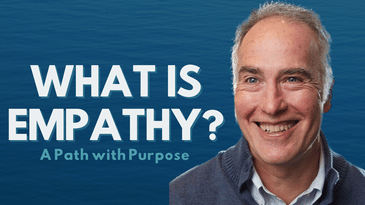
In this episode with Enrique Martin, we dive deep into what he knows to be true about being empathic with others.
This conversation felt like a masterclass in empathy where Enrique lays out the goods in front of us. Enrique has such a wonderful way of sharing the immense knowledge he’s gathered along his journey and I am very grateful for his patience and empathy towards me every time we gather.
In this episode, Enrique answers the following questions:
- What is empathy?
- How is empathy different from sympathy and compassion?
- What are some behaviors of empathy?
- How to show empathy with someone?
- What is the impact of being empathetic?
Enrique shares his definition of true empathy is when we can sit with total respect of the other person, without judgement, acknowledging that they are a legitimate person who is creative, resourceful, and whole, and feel with them.
He pulls apart the differences between empathy and pity or sympathy, saying that pity and sympathy carries with them a judgment of being superior over the target of these emotions.
And Enrique shares the journey to being more empathetic with others starts with being more empathetic towards ourselves. As he says, “to be able to sit with ourself, with total respect for ourselves and not being judgmental, and acknowledge that we are a legitimate person.”
If you have not ever done that, try it. What a gift that feeling is when we’ve done that. And what a gift Enrique is sharing with us in this episode.
What I know to be true about the episode: Enrique is a wise soul who had done a lot of work to understand these principles, and while what he says is simple to grasp, it is not easy to achieve.
What I learned from the episode: As someone who has spent a lot of time trying to “be helpful” by giving advice and engaging in problem solving, this conversation has helped me dive deeper into the realization that the greatest gift at the time might not be “to help,” but truly “to hear and feel with.”
Books the Enrique references in the episode:
- “Ontología del Lenguaje” by Rafael Echeverria
https://www.abebooks.com/book-search/title/ontologia-lenguaje-ontology-language/author/rafael-echeverria/
- “Zen and the Art of Motorcycle Maintenance” by Robert Pirsig
https://www.harpercollins.com/products/zen-and-the-art-of-motorcycle-maintenance-robert-m-pirsig?variant=40827304509474
If you like the conversation, please share this episode with one other person. Thank you!
What Do You Know To Be True? is also available on the following platforms:
Apple: https://podcasts.apple.com/us/podcast/what-do-you-know-to-be-true/id1708762851
Spotify: https://open.spotify.com/show/4fJ9ME5AzOhfEZtFGCH2lA
Amazon Music: https://music.amazon.com/podcasts/97817e1d-596b-4c79-8414-1aa5945b5efd/what-do-you-know-to-be-true
Music in this episode created by Ian Kastner.
"What Do You Know To Be True?" is a series of conversations where I speak with interesting people about their special talent or superhero power and the meaningful impact it has on others. The intention is to learn more about their experience with their superhero power, and in doing so a maybe learn something about the special talent in each of us that makes us unique.
"What Do You Know To Be True?" is hosted by Roger Kastner, is a production of Three Blue Pens, and is recorded on the ancestral lands of the Duwamish and Suquamish people. To discover the ancestral lands of the indigenous people whose land you may be on, go to: https://native-land.ca/
Transcript - Empathy with Enrique Martin
Enrique: To be able to feel empathy to others, the most important learning is to start feeling empathetic with our own selves, sit with our own selves, suspend judgment, and then trying to Expand that space with the other.
Roger: Hi, I'm Roger Kastner and welcome to the What Do You Know To Be True podcast. In these conversations, I talk with ordinary people about their extraordinary skill and the meaningful impact it has on others. The intention is not to try to emulate or hack our way to a new talent. Instead, I'm interested in what inspired them to develop this talent, how they think about their superhero power, and what they recognize as the impact it has on others.
The intention is to learn more about their experience with their superhero power, and in doing so, maybe we can learn something about the special talent in each of us that makes us unique and the impact we have on others. This conversation is with Enrique Martin. Enrique is a fascinating dude. And when it comes to the mind body connection, whether on the mental side with spirituality, consciousness, meditation, or on the physical side through yoga, running, swimming.
Mountain climbing, Enrique, not only has something to offer about these topics is likely to have read the book or multiple books on it in this conversation. We cover how he becomes inspired to learn more about empathy and the approach he uses to be empathetic with others and that he uses on himself.
And what he's learned to be true and not true about empathy. And in this time where we're facing epidemic rates of anxiety, depression, loneliness, and obstacles to wellbeing, this is a topic that feels so timely. And I'm so grateful to Enrique for joining me to share what he has learned and experienced about being empathetic for others.
If you're ready, Let's dive in.
Hey, Enrique, welcome to the pod. Hey, Roger, great to be here. Good to see you. Good to see you too. And I'm so glad to be here with you. I know you to be many things. You're well read, you're humble, thoughtful, engaged, you're smart. And yet, We're here to talk about the thing that you give to others. And that's empathy and really excited to be having this opportunity to learn more about what you know to be true about empathy.
But let's start off going back a ways. And was there an event or a role model who inspired you to want to be more empathetic?
Enrique: There are many people that influenced me to come up with this. Um, scale that I consider one of my superpowers and something that I, I. I feel very well about it. Um, the person is Fred Goffman, is someone that I met back in Buenos Aires.
I was born and raised in Buenos Aires and 25 years ago, I've heard about the person who was a coach and, was an Argentinian that studied in MIT and has a doctorate. The PhD degree in economics and I say, “Hey, I need to know that person how this whole coaching works.” And I saw him in action and I say, “Hey, I want to do the same.”
And one of the questions that I asked him about, “Hey, how are you able to do that?” That type of connection, that type of impact on the other person. And he told me that the secret, his secret was empathy and that empathy and compassion was at the core of an effective coaching conversation. And I say, “Hey, there is something there, something that I truly wanted to learn.”
And I began my own coaching journey. Preparation and training and, I study a bit with him and his organization at that time was, um, leading learning communities. Then he founded excellent, we continue working with him and I read many inspired, very inspiring books. One of them was written by Rafael Echeverria.
It's a philosophical book, but it was a before and after for me. I mean, I originally thought that our perception of reality was simply like having an homunculus, a little. person inside our heads, looking through the windows of our eyes and hearing what's going on outside and passively receiving to what's going on in the world.
And through this book, Ontology of Language, I learned that probably the world that we perceived, probably not, that that's actually part of the thesis of the book, is 50 percent created 50 percent perceived. And I was very curious about, okay, what is all this creation that the brain does? And what is the role that language play and other people play on this mutual understanding of what is reality?
And that led me to be very intrigued about philosophy and many other studies. And I began my coaching certification and my preparation to become a coach and someone who can drive very effective relations. Especially in the working in the professional setting, that is, it was not back in those days a very common skill and, that proved to me to be very rewarding, both in terms of my own career, but in terms of my own wellness and preparation.
So all started by simply listening to someone who was an inspiration to me, and that. That was the kickoff of a long journey that, hey, after many years, here we are speaking about the same concept, empathy.
Roger: As you were walking us through that journey, it, it actually kind of reminded me a little of the story of Siddhartha and this sort of this discovery or this, this exploration or this desire to want to learn something so deeply and looking for something more. And yet I think you said it at the end, it was, it, it, it comes down to.
Listening. It comes down to being present. It comes down to just being in that same space with someone. And it's probably much more complicated than that. But it, it, it reminded me of that journey. Do you think of your Of course, you don't think of your journey as Siddhartha and on the path to, um, instead of enlightenment on the path to empathy, but do you see some similarities there too?
Enrique: Yes, I see a lot of similarities, lots of differences. I mean, not necessarily you need to be enlightened to, um, The empathetic, right? yeah, this is a huge difference, but yeah, it's a journey and it's a journey where there are so many things to learn, but way more things to unlearn, which is. Part of the common elements together with enlightenment.
Right? But that's my own understanding. I am not enlightened. I don't aspire to be, but given all the readings that I do, yeah, I think there is a lot of things that we need to unlearn and, same thing with, Empathy. And there is a lot of, um, humbleness that comes with it. I mean, it's not that there is no certainty.
Yes, there is a place for certainty, but it's more to, um, take the other person as a legitimate other. And what I, what I mean by that is your views. Are as valid as my views, but that requires total respect, total respect to the other person. And that's one of the gates to empathy. I mean, I am not a philosopher, but my way to define empathy, and I'm not, I love reading about neuroscience and the many definitions, but I, it's not that I have a professional definition.
However, having said that, my, my own definition is, empathy is feeling with you. And the key word here is with, um, there are, there are similar things that comes with empathy, like, sympathy. Sympathy is, I feel for you, I, I feel sympathy for what's going on, what you are saying. But this is, this is not empathy.
Empathy is about feeling with you, feeling together. And to get to that point, it requires total respect for the other person. Someone who is complete and whole, and doesn't require me to fix you. I mean, this is total respect, whether you are telling me about your truth, your problems, your feelings, your regrets, your history, whether you are right or I think you're right or wrong, this is when judgment, it comes and start playing barriers.
So the journey to empathy comes to, are we capable to actually respect ourselves? In the same way and sit with ourselves with the same level of respect without judgment. It's like a meditation. And if we are capable to sit with ourselves with this high degree of respect and this high degree of.
Connection removing this level of judgment or perceiving judgment as it is just a thought that comes bother our minds shake us up and go. But we need to take a judgment for what it is. I mean, don't don't take and don't get captured. By our own judgment, if we are beginning this journey with ourself, which is, by the way, not an easy thing to do.
Good luck. If you sit with yourself and you can stay without judgment for just a few seconds or minutes and a few seconds is a very challenging. It's a very challenging task. If you are capable to do this, you have begun the journey. And that's one of the gates to empathy is. Filling with the other person in total respect.
With it to the other person as a valid other, which is totally opposite to what we typically do and in a professional setup when we encounter with someone that, hey, I, I had so many of these conversations where people come to me and say, hey, this, listen, this is going on, um, and they start talking and sometimes I don't see.
I don't even say a word, but they finished the conversation like in a totally different mindset because they felt, listen, they, they were feeling the connection. We were feeling together. I was feeling with the other person. That was a long answer.
Roger: It was a pretty powerful answer. In fact, it answered a couple of the questions that I was, um, thinking of, like, one, how do you define?
Empathy, and I think you just did, really well about, um, sitting with others with total respect, um, with non-judgment, um, and, and being able to feel with them. Um, you did also talk about some of the. Challenges in sitting with nonjudgment. And I loved how you started talking about that. You have to be able to do that for yourself.
You have to be able to sit with yourself with, um, total respect for yourself with nonjudgment. And, um, although you did make it clear, that's. That's challenging to be able to do that for, for, any amount of time, but to really understand those, um, what it's like to feel with that other person, which probably means you need to be, um, in touch with what you are feeling in that moment.
So it was a nice, it was a nice framework about how would you approach when you, when those moments that you think will be Um, where it would be really helpful to be able to provide, to show up with empathy for the person you are having a conversation with. Are there any conversations that you would not approach?
With a sense of empathy,
Enrique: probably not that there are certain conversations that probably I may be not prepared to. I mean, it's a journey and I don't say that I am prepared to face everything with empathy. I am not, but I know that when I am able to connect with the other person with empathy, I am much more powerful now.
Now that you mention and you ask me that question, not necessarily. Empathy can be the recipe for everything. Sometimes we can go a bit farther than empathy and move into compassion. Compassion, in my own definition, is keep with empathy, keep with the total respect for others. To the other person as a legitimate other and create some space to provide some extra help.
This extra help comes again with the total respect to the other as a legitimate other. And we asking permission and we. Providing some extra perspective, it's like, moving to in a different jargon is moving from coaching to advise, but compassion give compassion provide us with some space to actually, even though we are feeling with the other person.
If the other person is totally depressed or in tears, breaking down in tears, not necessarily compassion is our secret weapon to maintaining the connection, but at the same time offer something other than breaking down in tears. Sometimes we can do that move. Sometimes the other person as a legitimate other person just need to be.
connected with someone on that breakdown. So here is the difference. Or sometimes what the other person need is, but again, yes, start with empathy at least for a few seconds. And then you go into a different powerful mode that probably the other person needs some tough love. But again, that tough love cannot come up without previously getting that level of connection with empathy.
So empathy is part of, The dynamic between two people or a group of people, maybe, I, I am talking one on one because that's my experience or about working with empathy, but it can happen in groups or in one person to many, many to one person or many to many, but yeah, empathy is a key ingredient, but not necessarily we need to keep empathy.
All around 24 7 empathy is like in chemistry. There are certain substances or certain reaction that cannot happen by themselves. They need an extra ingredient. Empathy is that extra ingredient that sometimes.
Roger: Three years, the right reaction in your professional career as a coach, um, the work that you do with leaders, there's obviously a need to show up with empathy and those conversations.
And I started thinking about, okay, what, what conversations would you not? Part of the gift of empathy is just being there and being someone who can listen. And like you said, feel with them to know what it's like to be you. In that moment with them, um, as you said, it's a very powerful thing to be able to give.
Um, but you also said that when you are in that space to be able to be empathetic, that it makes you more powerful. Um, I was hoping you can, we could pull on that string a little bit to understand powerful to do what
Enrique: I did mention that in the context of a coaching conversation and coaching conversations.
Have the aspiration to a influence the other person positively, um, and hopefully guiding or leading or inspiring the other person to get the life that they want in a more effective way. More effective way can be faster, more effective way can be more connected with their, their own value system. Um, get them more fulfilled.
overall life that sometimes they are, it's not evident for them. How can they describe it? And empathy is a key ingredient for that impact during the coaching conversation. Sometimes those that comes to you begin the conversation in tears and end up the conversation with hugs and smiles. And that's an indication.
That's a definitely an indication that the provided something of value. And on my end, I feel powerful because, well, that's one of my definition of power. I mean, I, I truly enjoy having an impact, a positive impact on other.
Roger: What would you say that empathy has taught you? And what have you learned from empathy?
Enrique: Especially when I began my to have A grasp on empathy and I start sitting with myself and I start, respecting myself without judgment and, um, be empathetic with my own self was that the way we define ourselves is so not true. Let me say that way. I cannot find a different way to define it. and similarly, the way that others define themselves is so not true. We are. All mess up in the way that our own thoughts, our own emotions are creating its own narrative, its own story. And sometimes, all that is required to break the spell, the spell of words, the spell of language, especially language.
Language is such an influencer on all of us, all of us, so. In every single second of our lives are living through stories, and there is always a narrative and a story on our minds running our feelings, our emotions, our state of mind, our posture, our way of breathing, our metabolism, and all that is required to break that story and that fake definition of ourself is a grasp of empathy.
And connection. So true connections, true connections has such an impact on our lives and the life of others. And that's why I consider empathy one of my superpowers, because it had an impact on me on my own, um, journey to develop myself, to have. My own understanding, which is not final and will never be.
That's part of being alive, and that's part of the beauty of this. But I, I see that I am more relaxed, happier today. That years ago when, I was much more judgmental. I am a done deal. Of course not. That's, again, that's the beauty of it.
Roger: I love how you're bringing in. That it's, you know, still a journey, that it's still work, that, you know, it's, it's something that will not end.
So it's a journey, with, with no, there is no achieving the destination. It's just ongoing work. Um, acknowledging the stories that we're telling ourselves are imprecise. Um, recognizing
Enrique: that judgment is just judgment. It's not the truth. Breaking that spell. It's like having a compass. Right. That it's, it's a constant reminder that the days where you feel trapped in judgment, the days where you cannot be empathetic with yourself or with others are the worst days.
And that compass. Tells you exactly that when you are, when you feel more connected with yourself, more empathetic to yourself, more empathetic to others, more in connection. That connection triggers a much positive outlook. Sometimes you don't need to have a conversation sometimes. I don't, hey, I don't have words for this.
And if you push me, I will give you a very poor answer. But sometimes if you are in line in a Starbucks going back to the coffee conversation, and you are simply waiting, and there is someone in front, and you say, hey, let me pay for that. Why you do that? But the effect of that, it's, it's like, I don't know, it's such a stupid thing, but it has an impact or what is, and I know that there are some neuroscience here, but sometimes you help another person in whatever form and the impact on you is the result of that connection.
When you do a donation and it can be a. Much larger donation, but you missed the connection. The feeling is not the same. It, I'm sorry to say, but that was not an empathetic. Donation and the feeling it's on the opposite side. I mean, you can have a true connection and making a smaller contribution, but having a much bigger impact on the other person and on you rather than making humongous donations or contributions without connections.
And this is a poor from an experience standpoint in both sides. It looks and it feels transactional.
Roger: What's resonating with me is this idea of you're in line in the coffee shop and the person in front of you, you don't know what, what their story is. You don't know what they're experiencing. You don't know what they're going through.
Um, but yet by offering to buy them that coffee. What you're saying is, you know, you're recognizing the humanity in them, you're recognizing they're a legitimate person and that you feel the need or the desire, the want to do something nice for them to try to brighten their day. Um, and, um, I could see that being not only a very positive feeling for you, but what you're giving them is that level of of the recognition that positivity and the likelihood that that person is going to go out and do something also positive for someone else, um, for no immediate obvious gain other than the feeling of recognizing the humanity in someone else.
Enrique: Yes, indeed. And let me give you an example. And it's not my own example. It happened to my wife. I was going to the supermarket with my wife and there was a person paying and she was struggling to find the coins and the coupons and everything. And, um, My wife offered to pay for that, um, and the person said no, and what happened after is that the person told my wife, her full story, but it was the respect that my, my wife had two folds first on trying to help, but that was not the help that the other person was in need.
The other person was in need to be heard and that totally transformed our day. So it transformed my day. I mean, I have just witnessing my wife having that, um, the power of second hand and our powerful conversation. And it was not so much a powerful conversation. It was powerful. Listening, powerful empathy.
Roger: So switching gears a little bit, you shared, as you were answering, one of the earlier questions about, empathy one on one and empathy in groups and with audiences. Um, you would, you had told me before that you believe your superhero power of empathy is limited to the one on one interactions and, um, it, that it.
It diminishes, when you are in groups that it's, um, something that doesn't feel like it's part of, your, your superhero strength is to show up with the empathy for groups. And that got me thinking, what does, what does empathy look like, um, in groups? My 1st thought is, um, 1 on 1. In having respect for that individual and seeing that they're a legitimate person and sitting there feeling with them, um, get that in a group of six people, 60 people, 600 people.
Um, to me, that just feels like way too many signals. And you could go through, um, you know, an overdose of, of empathy that you can't, you can't figure out how to function. And I, I'm sure I'm not thinking about that correctly, but could you share with me what, what you think? empathy in groups looks like?
Because I'd be interested in understanding that a little bit more.
Enrique: By creating a narrative or creating a common energy or creating a ritual, um, a ritual can be movement, a ritual can be singing together, a ritual can be many things, but they, they can create a sense of group of identity. And by, by creating that, And being connected with that group identity, they, they can do wonders.
Am I able to do that? No, I see some others that are amazing at that, but me, no, I, I, my superpower is more one on one when it comes to groups, I am. Deep in learning, learning mode, still.
Roger: Mm hmm.
Enrique: What do you know to be true about empathy? The more authentic, the more, um, you get rid of, of everything that is not authentic and real.
The more you get rid of all those things, The more empathetic you can be for that. You need to respect the other as a legitimate other, and that is also one of the main gates to do that, is to fill with,
Roger: yeah, I'm just steeping in the deepness of that. That feels very profound, simple, probably not easy.
Enrique: not the same thing it can be.
Roger: There are many things in life that are simple and not easy. What did you believe early on about empathy that you've come to learn is not true?
Enrique: Well, I had a confusion between different understanding of what empathy really is. and the confusion was between feeling pity or sorry for others. Um, sympathy, empathy.
Compassion. And they, they, they are, they are all different. They, they, they, these are description of different things. Um, we feel pity or sorry for others when we, when we feel superior, when we feel that we are in a different ball game, right? And, that, that we are in a different narrative and, um, this is so not true.
And, there is a lot of judgment. there. And by the way, there is zero connection. There is the other person and me over here feeling sorry or pity for the other person. That's zero connection. Empathy is not feeling pity, sorry, or whatever you want to the other person about the other person. This is when there is no connection.
This is about the other. The other definition is sympathy, which is Feeling for the other person. I, I am feeling for you that, hey, this or that I, but again, there is. No interest. And sometimes we get so confused because this is part of the automaticities. I can, for example, now I can have an interpretation that you are paying attention to me.
Why? Because I see that your eyesight is focused on the screen. You are smiling. But it's, I need to own that this is my interpretation. And the only way for me to know how you are feeling is to ask that I, when we confuse our interpretations and our judgments for reality, this is the first barrier to move from sympathy.
To empathy when we really want to connect with the other person as an authentic and valid other, we need to ask and we need to suspend our judgment. That's the gate to empathy and sometimes empathy. Can be also overwhelming and can have faces sometimes. This is more an art than a science. But after feeling together with you for a while, I that's my learning and I I own this.
Sometimes we need to move from empathy to compassion and that needs to create some space that after feeling With you and maintaining the connection, I can move one step forward and by way of creating some space, maintaining the connection and keeping the level of respect, I can do something together with you and make a suggestion as a suggestion, not the direction and that's the flow.
So what I learned about empathy was. Hey, there is a full range that goes from, um, feeling about others, feeling for the other, feeling with the other, and compassion. And that spectrum, that continuum, has its own nuances. And the key gate is, That level of connection that this is that level of suspending judgment.
That's why the 1st gate that I, I think we need to have in mind is. To be able to feel empathy to others, the most important learning is to start feeling empathetic with our own self, sit with our own self, suspend judgment to get to know what is true about ourself, and then trying to expand that space with the other.
Roger: Yeah, it's a cliche, but cliches are true most times around. We have to adjust, you know, put on our oxygen mask before we adjust the oxygen mask of others.
Enrique: Easy to say, easy to use it as a cliche. Good luck, um,
Roger: having that as a practice. I, I fortunately I've never been on an airplane where I've had to put on an oxygen mask.
I imagine it's terrifying in that moment when you have to do it. Um, and it's not as simple as just saying, Yeah, put on your mask, adjust the straps. Are you ready for the lightning round? Let's go for it. So fill in the blank. Empathy is Who in your life provides empathy for you?
Enrique: My daughter.
Roger: Is there a practice or routine that helps you grow, nurture, or renew your ability to be empathetic?
Enrique: Meditating.
Roger: A favorite book or movie you recently watched that you would recommend that has empathy as a theme?
Enrique: A book that is, um, that has helped me to reframe my
Roger: past.
Enrique: World map is
Roger: ontology of language. What is one thing that gets in your way of being empathetic?
Enrique: Disconnecting with my own self.
Roger: And what is the first step of being empathetic that you suggest to others?
Enrique: as an exercise, I could go under the sink. Just look at what is under the sink and write five pages about what you saw. Just be curious and stay there.
Roger: Hmm.
When I think about going under the sink, I start thinking about having to do plumbing as my father-in-Law taught me anytime you're touching the plumbing, it's gonna take four times as long and involve at least, two trips to the hardware store. So you, you might've just triggered a little bit of an anxiety attack for me and thinking about looking at the sink and what that involves and yeah, that's something you wanna start first thing Saturday morning because you might need the whole day and maybe the whole weekend working on it. But, but you weren't saying fixing the plumbing, just writing down what you see.
Enrique: By the way, I acknowledge that this is a wacky exercise, but, hey, this is I, I love it.
Roger: I was just putting myself under the sink with a different intention, but the idea of and it could be anything.
Right? And it's that exercise of, you know, the five pages of writing down what you saw.
Enrique: There is an exercise in another book, Zen and the Art of the Motorcycle, Repairment, I think it was. The author was, um, trying to learn how to write. And one of the exercises was, Standing in front of a wall and just making a summary of about what he's was seeing was perceiving in the wall and he was a stack and he couldn't progress all of a sudden, someone who was working with him on that just say, Why don't you change your focus?
And instead of looking at the wall, just take a look at what is miniscule. In the world, and all of a sudden he was writing like 10 pages about that, that just that change of perception can trigger a totally different reality.
Roger: You're the second. What word or phrase describes what empathy feels like when it's had a positive impact feeling grateful.
So if a listener wanted to ask you a question or follow you, where would you point them to?
Enrique: The social network that I am more active at is LinkedIn. My name is Enrique Martin. Just make a connection and let's engage.
Roger: Well, Enrique, like every conversation I have with you, I always learn something. I always feel a deep connection with you.
And I really appreciate you taking time to share with us what you know to be true about empathy. Likewise,
Enrique: Roger. Good talking to you.
Roger: Good talking to you too.
I am grateful for the lessons that Enrique shared with us today. I learned that having true empathy for someone is when we can sit with total respect of the other person without judgment, acknowledging that they are a legitimate person who is creative, resourceful, and whole, and feel with them. I learned that empathy is different than pity or sympathy, which carries with them a judgment of being superior over the targets of our emotions.
And I learned that the journey to being more empathetic with others starts with and continues all along the journey, by being more empathetic towards ourselves, to sit with ourself, a total respect for ourselves. And to not be judgmental and acknowledging that we are a legitimate person. In other words, adjust your oxygen mask first before attempting to help others.
And as we discussed, it sounds simple, but it sure ain't easy. Coming out of this conversation, the reflection question I have for myself is, what judgment do I have for Myself or others when I'm applying my talents in service of them. And am I going into those situations from a position of empathy or compassion, or is it from a position of pity or sympathy?
If you're not sure what your superhero power is, one of the easiest ways to figure it out is to ask a trusted friend or colleague. As a heads up, they're likely to going to ask you what you think their superhero power is. So be ready with a response in advance. And thank you all for listening in. If you like this pod, please do us a favor and give us a review or click that like button, whichever platform you're on.
Thank you for doing that. It's the best way to help others discover this podcast. What do you know to be true is a three blue pens production. I'm your host, Roger Kastner. We are recording on the ancestral lands of the Duwamish and Suquamish people. To discover the ancestral lands of the Indigenous people whose land you may be on, go to http://native-lands.ca.
Okay, be well friends.