
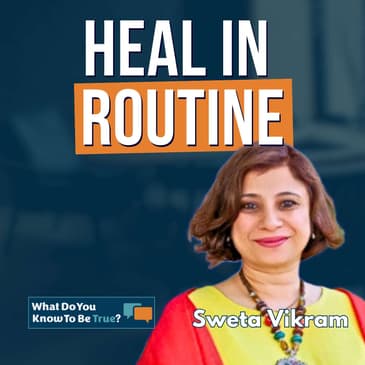
Exhausted and out of balance? Feeling burnout? You’ve hit the metrics. You’ve secured the title. You’ve done everything 'right.' So why does winning feel so draining? If you feel like life is rushing by while you're stuck on a hamster wheel of productivity, you aren't broken—you're just out of rhythm.
In this conversation, Ayurvedic Doctor and Corporate Wellness Expert, Sweta Vikram reveals why 'time management' is failing you and how to finally align your energy with your impact." It's about leadership effectiveness and how to increase impact as a leader. Sweta says the path to effective leadership is through finding balance, exploring our true self, and showing up with more kindness.
For leaders drowning in chaos and responsibility, Sweta offers a lifeline: "Burnout happens in chaos, healing happens in routines." She explains how high performers and executives can prevent burnout by understanding their natural rhythms and creating sustainable practices that honor both ambition and wellbeing.
Drawing from 5,000 years of Ayurvedic wisdom, Sweta shares how self-awareness and presence can transform leadership from performative to profound.
This episode challenges the traditional leadership playbook that prioritizes doing over being, competition over compassion, and performance over presence.
In this conversation, you'll discover:
➡️ Why "healing begins when people start to feel visible" and what this means for your team
➡️ How to recognize signs of imbalance in yourself and your leadership style
➡️ The difference between being kind and being nice—and why it matters
➡️ Practical ways to pause, reflect, and show up more authentically as a leader
➡️ How ancient Ayurvedic principles apply to modern workplace challenges
Whether you're a proven executive, an emerging leader, or a coach supporting others, this conversation offers a refreshing perspective on what truly makes leadership sustainable and impactful.
Subscribe to What Do You Know To Be True? for more conversations that unlock your leadership potential.
In this episode, Sweta answers the following questions:
➡️What is Ayurveda?
➡️How to be more valuable as a leader?
➡️How to make people feel seen?
➡️How to be more mindful as a leader?
Resources mentioned in the episode:
➡️Sweta’s Website: https://www.swetavikram.com/
➡️Sweta’s LinkedIn: https://www.linkedin.com/in/swetavikram
➡️Sweta’s Instagram: https://www.instagram.com/swetavikram
Music in this episode by Ian Kastner.
39:42 Lightning Round
Music in this episode by Ian Kastner.
What Do You Know To Be True? is a personal development and leadership podcast for professionals discovering, building, or already living into their purpose and possibilities.
Each episode is a real conversation with a guest who's navigated their own reinvention: from discovering a talent built out of something difficult, to now using their superpower in service of others. Their stories offer new perspective, validate what you already know, and inspire your next move. Wherever you are on that path, these conversations are for you.
Want more info about What Do You Know To Be True?
➡️ Check out the site: What Do You Know To Be True?
➡️ Subscribe to the What Do You Know To Be True? newsletter to get insights into each conversation: https://rogerkastner.substack.com/
Each conversation gives you something real: a guest's honest story, a practice or perspective you can actually use, confirmation you're on the right path to reinvent yourself, and you're not alone.
"What Do You Know To Be True?" is hosted by Roger Kastner, is a production of Three Blue Pens, and is recorded on the ancestral lands of the Duwamish and Suquamish people. To discover the ancestral lands of the indigenous people whose land you may be on, go to: https://native-land.ca/
Keywords
#burnoutrecovery #burnout #emotionalintelligence #ayurveda #empathy #personaldevelopment #possibilities #reinventyourself #superpower #leadershipdevelopment #rogerkastner
Transcript - Does Your Leadership Style Make Others Feel Seen? A Reflection for Mindful Leaders - Sweta Vikram
[Roger Kastner]
Feeling seen and heard is one of the most basic human needs. Almost all of us crave that feeling of being seen, of being recognized, and to belong to something bigger than us. And yet, when we're so focused on our performance, on our status, and our responsibilities, being able to provide that feeling for someone else can seem like a struggle, if we're even aware about someone else's needs in the moment.
For Sweta Vikram, however, making others feel seen is her superpower. As an Ayurvedic doctor and a corporate wellness expert, she knows her first steps in working with clients and leaders is to make them feel seen. That is how she's able to earn their trust before she's able to bring the benefit of this 5,000-year-old medical practice.
[Sweta Vikram]
Ayurveda is made up of two words. Ayur means life. Veda means science.
So it's the science of life. So it becomes really intuitive once you start to live in alignment with yourself and in alignment with Mother Nature. So very often, like I tell people, Ayurveda is not asking you to move to the Himalayas inside a cave and do headstands.
It's living your life where you are as a modern yogi. And I think we are all yogis. The minute you start connecting your mind, your breath, your body, we all become yogis.
[Roger]
And Shweta knows the benefits of finding balance is not limited to her clients. It's something that they can take out into the world.
[Sweta]
So really helping people feel visible in their own life. Once we get to know ourselves, the Jekyll and the Hyde and everything in between, we are just kinder to everybody else. We are healthier.
I know I'm never going to be perfect because that's never the aim because there's nothing called perfection, right? But because I know that so well about myself, I'm not expecting my partner, my friends, my family to be that either.
[Roger]
Hi, I'm Roger Kastner. I'm the host of the What Do You Know To Be True podcast. The invitation in these conversations is to become inspired from our guests, to discover our own superpowers, to unlock our potential and possibilities, and make even more meaningful impact in the communities we serve.
If you're ready, let's dive in. Hi, Shweta. Thank you for joining me today.
I'm grateful to be here with you. And I've been looking forward to this conversation.
[Sweta]
Hi, Roger. I am so excited to be here. It's raining in New York.
And I was telling you, I am a solar recharge person. So a warm, heartfelt conversation is another way of warming up a soul, right?
[Roger]
Oh, I love that. I'm so excited to learn more about your superpower of making people feel seen. And you've just given us a great example of that.
But first, let's get to know you. You're an Ayurvedic doctor, a trauma-informed yoga teacher, an award-winning author, a mindfulness coach, a corporate wellness speaker, an adjunct professor, and the host of the Grounded Leader podcast. And I'm sure there's more.
What else would you like for us to know about you?
[Sweta]
In an informal way, I can break into a shimmy anywhere. It takes very little for me to find a reason to dance and find absolute joy in it. I also love to cook and host and go on long hikes with my husband.
But really building that community where people feel safe, we feel nourished. And it's not about numbers. So yeah, that's very important to me.
How are we taking care of each other in the community? How are we taking care of ourselves? Because you can't pour from an empty cup.
[Roger]
And we were just talking before we hit the record button about the weekend that you just spent, the event that you had with others of coming together for art, for food. And I love how there's all these rituals that you are creating, that you're making space for letting our humanity come out. And I'm sure that's part of your superpower.
I want to learn a little bit more about Ayurveda, because I think for us who grew up here in the Western culture, we don't have a lot of exposure to this. And yet, as I've been listening to your podcast, a lot of the things that you are mentioning as practices and rituals sound very familiar. So I'm sure some of those are seeping into our Western culture.
And so for someone who's, this is their first time hearing about Ayurvedic medicine, how would you describe this 5,000-year-old practice?
[Sweta]
I love that question. And I love your word choice, familiar. It is because Ayurveda is made up of two words.
Ayur means life. Veda means science. So it's the science of life.
So it becomes really intuitive once you start to live in alignment with yourself and in alignment with Mother Nature. So Ayurveda tells us we are a miniature of nature. And much like Chinese medicine, it looks at the elemental system.
There are five elements that we look at. And three doshas. And doshas, let's call them our DNA, our blueprints.
So we all have a little bit of each of the three doshas, which is Vata, Pitta, and Kapha. And I'm just saying these things. I won't be quizzing anyone.
But so how do we determine, like, what dosha am I? Please don't take online quizzes because it's really unsafe. You might be responding to your imbalances or balances you might not know.
And then we start with the self-treatment. You could really harm yourself. So invest in yourself and talk to an Ayurvedic doctor.
It's just beautiful. So at the time of conception, Roger, whatever is the primary dosha in the mom, biological, and primary dosha in a biological dad, when they come together, that's the combination. So if you're saying Vata, Pitta, and Kapha, somebody could be just Vata predominant.
But most people are a combination of two, which I believe, I'm that Indian who doesn't do math very well. It could be seven combinations. But then there are also people who have equal amounts of Vata, Pitta, and Kapha.
But each of these doshas have 10 pairs of opposite qualities. So let's just say you are Vata, Pitta, and I'm Vata, Pitta. We're not going to be clones of each other because you might have some of the Vata qualities more dominant than I would or in out of balance than I would and vice versa.
So that's why healing is customized and unique, according to Ayurveda, because it's all for the season. We are in Vata season. So I'll speak a little bit more to that.
It's a combination of air and ether. What does that mean? And again, geographic location makes a difference because I live in New York City.
The air here is very dry. I love it. It's great for my hair, but it's too dry right now.
And it's like frizzy. And so this is Vata, too dry, right? And like increases like.
Now, if I were to eat foods that are very dry, like dried fruits, which is nuts or popcorn or potato chips, it'll increase dryness. Doesn't mean my hair will get drier. My gut will get drier.
So this is the season when people say, I feel constipated or my anxiety has gone up because air and ether, when we are out of balance, it's moving up. Anxiety is never I'm anxious. Anxiety is this.
It's upward moving, right? So one of the qualities of Vata is it's mobile. There is speed.
It's fast. So you see how nature is telling us like the antidote is slow down. Instead of raw and cold foods, mother nature has brought us beautiful goats and pumpkins this season.
And they're so nourishing and grounding. So it literally is the science of life. And I say this to my clients all the time.
You know, we've all been there. I'm not judging anyone. I've been there too.
Like until I really knew what it felt to feel great, I thought feeling average was status quo. And that's how you go through life. But then when you start to sleep for those eight hours and then one night, a month later, you sleep for five hours and you see how your productivity changes, how your mood changes, your emotional balance changes, like, oh, that's what you meant.
Or for someone and Ayurveda doesn't judge vegetarian, vegan, everything is food is medicine. So I have clients who are like, but I have to have a drink, you know, during the holidays. So I'm like, sure.
But can you make it one instead of four? Oh, that's an option. It's a way of life.
And I said, there'll still be an impact. And next day they're like, well, yeah, I didn't feel great. So now I know why you said, like, maybe cut down.
So again, there's no judgment. So we're just looking at what the imbalances are, what the health looks like. An absence of disease doesn't mean presence of good health.
What are we digesting? How are we in the world around us? How is our emotional well-being?
You could be, a person could be like doing the triathlon. But if like their family members walk around on eggshells around them, that person is not healthy. So it's the mind-body consciousness connect as well.
And the last thing I'll say, the gut biome connection. You know, now Western medicine are talking a lot about like, you know, our mind and our gut health because it's connected because our gut is called the second brain. And that's because over 80% of serotonin is secreted there.
Ayurveda figured this out 5,000 years ago. And that's why it said the mind and the body are connected. When you think about it, when we are having a low day, how often do we say I'll eat something healthy?
Your hand goes towards processed food, junk food, right? And then when you eat that, either you feel low, unmotivated, depressed, anxious, different array of mental health challenges, right? So what we feed will impact how we think and how we think will impact what we feed ourselves.
So it's truly the science of life and you will start to notice the difference right away.
[Roger]
So Ayurveda has benefits for everyone. You know, as you said, the science of life. And in your work, you're bringing Ayurveda to the workplace as a public speaker, a coach and the host of the wonderful podcast, The Grounded Leader.
In that work, you're focusing on high performers and leaders. So why is Ayurveda especially relevant for high performers and leaders?
[Sweta]
High performers and leaders, there's a stereotype of what success should look like, what your work-life balance or lack thereof should look like, what a leader should look like. And empathy is also selective in many rooms, right? So Ayurveda, because it's the science of life and because it also focuses a lot on emotional and mental wellbeing, we can't exclude that from the workplace.
I'll give an example of grief, for instance, right? We get what, two or three days bereavement leave in the United States. For someone who might have just lost their loved one and is back at work, right?
And maybe they're the kind of people who are like, I don't want anybody to know. And now they're trying to be high functioning. Can you imagine what the environment would be around their peers, their managers, their colleagues?
And Ayurveda would come in very gently, very softly. They're like, maybe just talk to your manager and let them know you're going through this and how you would like support. It doesn't make you less than to ask for help.
So very often, like I tell people, Ayurveda is not asking to move to the Himalayas inside a cave and duet stance. It's living your life where you are as a modern yogi. And I think we are all yogis.
The minute you start connecting your mind, your breath, your body, we all become yogis. And then the burnout rate is so high amongst leaders and high achievers.
[Roger]
I did hear you recently say that burnout happens in chaos, healing happens in routines. And when I heard that, it just stopped me in my tracks and I had to write that down. I loved it so much.
[Sweta]
Because we've been told. So this is the, all the doshas that we talked about, pitta dosha. So with pitta, fire and water, they're two elements that it's made of.
So when in balance, they are world leaders. They are great orators. They're extremely successful and ambitious people.
So you're C-suite, you're high achievers, right? But in out of balance is when they get the burnout. The burnout happens, another imbalance, sign of imbalance is they get very critical of others and themselves.
Also very judgmental. Now our way that is just telling you, okay, this is coming up. Let's empower you to start recognizing these signs.
So that was the other is high burnout rate, toxic environments, like a pitta out of balance can make an environment very, very competitive. Vata out of balance could be scattered brain completely, right? So lack of focus.
You've done one thing in the manager next day, but I didn't ask you to do that. So I think all of these conversations, I was like, we need to bring this ancient science. We'll bring the diet and lifestyle separately.
But this mindfulness, the self-awareness, I don't think many people realize what they show up as and who they show up as at the workplace. And just that awareness could make the environment so much more nourishing and softer.
[Roger]
As you were talking, I was thinking about how much of what we hear about leadership from certain books or certain podcasts, we get this idea of what it takes to be a leader. And yet those are the same things that I think create imbalance. I think there's something about this without some help and understanding, like how to be human and a leader.
We find ourselves or we see other leaders out of balance because of this ideal of what it means to be a leader and the actions of the leader. And it's a lot of doing and not being. How would you respond to that?
[Sweta]
I think I'll give you an example from yesterday. So last afternoon, I was at a friend's. Two people came together, had this brilliant idea.
Let's do an art thing. And one of them is a chef. The other is an art facilitator.
And you showed up, you painted ornaments. Some of us, including me and only me, wrote poems because paint and I are not best friends. And it was just lovely because the diversity in the room just blew my mind.
So the lady to my left was an older African-American lady, just the softest. And she was so dedicated to art. I kept focusing on her work because her energy was so gentle.
And then we played a game where with a chopstick, you had to pick up a chocolate and pass it. And the person to your right would pick that up from you. It was supposed to be a competitive game.
And I don't do well in competitive environments. So I'm telling that lady, I don't care if you drop it. I still want to be on your side.
And to me, that is being a leader, just reminding someone you don't have to be aggressive to perform. And so what if we don't win this? We are winning because we having joined.
So shifting that perspective of what victory means, what success means, the stuff still got done. Everybody made beautiful artwork. Everyone had a great time.
But it doesn't have to be like beating your chest or saying, I did better. No, it doesn't matter. And I think to me, that shift is very necessary for even and many of the leaders to your point, Raju, might not even be aware that they're bringing in these habits into the workplace because we're emulating what we've been told, what we've read, what we've seen, what the shows tell us, like including this is how you dress up when you're a leader.
And, oh, if you're kind, that means people will walk all over you. You can be assertive and kind, right? And if you know yourself really well, you don't need to be vicious and wild.
So I think these stereotypes really need to be melted and put away somewhere in our garbage can. If people are willing to listen to you without you really telling them you need to listen to me, to me, that's a true leader. And that comes from compassion.
That comes from humanity. I overheard my husband once say something, and he'd be so embarrassed I'm talking about this, but that's a marriage contract. During the pandemic, we're working out of a New York City apartment, so I just happened to walk in when there was a call going on and someone was apologizing where, I'm sorry I was late to this meeting.
And he said something, and he's a very kind man. He said, never apologize for taking care of your family. And people are willing to work late for this man, go out of their way, because he knows how to be a leader.
He knows how to lead without being a jerk. And I think that's something that needs to really shift, that kindness is a very attractive quality, and kind and nice are different. They're two different words.
Nice means just saying a yes to everything. Kind means no, being empathetic. It's not just sympathy.
It's really, I understand what you're going through, even if I'm not in your situation. And I think that's what leadership in many ways is lacking. People do these trainings, they come back a week later, and they fall back into their old patterns and habits, because we don't have environments that nourish the new behavior.
[Roger]
Well, it's no surprise that your husband is a great leader. He's got an inside coach. I'm grateful for that, thank you.
So in these conversations, we're exploring superpowers and the relationship between them and the building blocks for living into our possibilities. One of the building blocks is well-being, which I'm learning is this combination of our physical, mental, emotional, social, and spiritual fitness, which, as I'm learning from you, is all the basis of Ayurveda, that balance. And so I'd love to hear a little bit more about the relationship between your superpower of making people feel seen and well-being.
[Sweta]
So I think it was Dr. Gabor Mate. I attended his talk, which was, it was in my bucket list, and I never even thought that list could be met because I never assumed he would travel to New York City to give a talk, but I heard him earlier this year. And he said healing begins when people start to feel visible.
And that, to me, in my practice is so true. And some of my mentors, whom I really respect and look up to, Ayurveda, 70% of the diseases, and they don't mean this lightly, can start to rework themselves if we just hold space for people to talk. And I've seen that in my own practice.
This big disease, of course, you need to do your medication, all of that, but where did it start? Can we look at the root? Sometimes it could have been death of a loved one.
Sometimes an end of a relationship. Other times it was a bad work situation, or they had to move geographically across the country, thing that they were not prepared for. All I had to do was just listen to them because everybody else has told them, oh, this is, what a great opportunity, you guys.
And so where is the space? If somebody is with a family, and one partner gets this great opportunity to move across the country, and kids are going to go to the best schools, and you're going to have this big house and all that, we didn't even ask the partner, yes, you're supportive and you're moving, what does this mean to you? Yes, you're supportive, but what will you miss out on?
So it's seeing them, not just seeing like, oh, your life is such a prize, you get to do all of this. It's price for the, yes, it's great for the family, but we can't stop becoming individuals just because we are part of a family. So it's on a big scale like that, but even the homeless people I see on the street, I will always respond to them.
And I think I share this story because it just blew me away. There was an unhoused homeless gentleman, a few months ago, he was just, I was going to the gym and he said something, and I was like, sorry, sir, not today. And he said, you have beautiful hair.
I was like, thank you. He said, no, thank you, you saw me. I said, and you saw me.
So he was just like, it was just such a beautiful conversation at 6.30 in the morning, which both of us had not planned. But that's the beauty. It's not just me seeing others.
I am not expecting an unhoused man on the streets to say something so kind. And it wasn't like a weird, creepy statement. He said something very specific about my hair color.
And I was like, you really made my day. And then I told my husband and my friends later, I was like, what a sweet thing to say. Everyone has something to say.
So that language really matters. And that confidence that a person has where they feel like, oh, they see me, they know me, they hear me. I'm not just this one other invisible person on this planet.
And I think the world would be so much kinder if we saw people. We have our blinders on, we are burnt out, and we don't see anything beyond our struggles and our own traumas. And I'm not diminishing any of that or dismissing any of that.
Each of our struggles are very important, but that doesn't mean we don't see what else is happening in the universe.
[Roger]
What makes sense to me in this is when we see the humanity in others, we connect to that humanity, which in turn recognizes the humanity in us. Absolutely. So what or who inspired you to have this superhero power of making people feel seen?
[Sweta]
My dearest dad. He was, oh, he's so special. I mean, and even when I was in school, elementary school, then high school, all of that, my friends would say like, if I ever get married and have a daughter, I'll bring her up the way your dad has brought you up.
Like girls my age, I was like, you're thinking about marriage and children? They were like, no, we're thinking about parenting just the way your dad has brought you up. I just took it for granted because I'm like, I didn't know any different, right?
It wasn't even granted. I just didn't know any difference. So even when I was really, really young, he would always tell me 10% of your income should go to those less fortunate than you.
And like just this morning, my husband and I were like, where can we donate? It's the holidays, where can we donate for food? So it's so deeply ingrained.
It's not just about I, me, myself. He was incredible. He was an engineer by day, a poet by night, and a social activist somewhere in the middle.
So he was marching for women's rights. And he always said like the difference between us and any other species is we have the ability to communicate. And he would tell me, you have a voice, you're lucky.
Whether I was raised a certain way or it's my personality or my DNA, I don't know a combination of everything. It's like use your voice for others as well, not just you. Because of colonialism, there's certain things about cultures where colonialism happen, which are very unpleasant, right?
But my dad was the type who would take our driver out in India for a meal. They would sit at the same table unheard of, right? Like they would share a meal.
He would buy toys for his kids. He's like, for the birthday, give them this so you can save your money and put it towards something else. So he always thought of like, you know, my parents paid for their helper's children's education.
So I was raised in an environment like if you work hard, no one is going to hand you over things and you do well and then you help others live well. It's not just about you. So he lived a very full life.
And even when he passed away, random people showed up and were like, oh my God, we lost a great human being. So I think I was just been very fortunate to have been raised by him and that like brought up by his values and just the way he saw humanity. He was a part of Rotary and he was doing all of these things for women's rights and eradication of polio and just an all-around incredible man.
[Roger]
Mm, what an inspiration. So Swetha, in this moment, what do you know to be true about your superpower of making people feel seen?
[Sweta]
If I'm having a bad day, don't say anything. Because, you know, words, you can't take them back because you can also make people feel really small and we all have the ability to do that, if that makes sense. So the superpower can be a great thing, you know, where I can hold space and shed light on someone.
But if you're having a bad day, you can also take that away so easily. I love what I do and I'm very grateful for it. But it's very emotionally intense.
It can be very draining because no one comes and tells me they won a lotto. It's always about what's gone wrong with their lives, right? And it starts in the morning and then I'm also an adjunct professor.
It goes into the night. So that's my day overall. So with the superpower to keep it pure, to keep it untainted, just know when to not say anything, just know when to retreat into your shell if you need to recharge.
Because when, you know, my dad was around, Roger, I used to visit him often. That was my recharge station. I don't have that anymore.
So I have to find other ways of anchoring myself or finding that nourishment without, you know, my husband is not just my husband. He's also a son, a brother, a colleague without putting that pressure on him. So I just feel like obviously he's there and I rely on him, but my dad is gone and that part is empty.
So I have to remind myself, I am home and I am home. And what does this home need today before I can tell others they are home as well?
[Roger]
A word that keeps coming up in this conversation for me is balance. Another word is holistic and this idea of understanding how to keep all the parts in balance. And I love, you know, this question, I think usually invokes ideas of, okay, when I'm in my zone of genius or when I'm coming from a place of strength, this is what I know to be true.
And you actually took it a different place, which I love of this idea of, okay, when I'm not, when I'm not feeling it, when I'm not fully resourced, now I know I need to go plug back in. I need to come back to who I am and then I can proceed. But until then, I need, I need space.
I love that.
[Sweta]
Thank you. And I think, you know, we all learn from our mistakes. I've also been that person who used to bounce off a wall.
So when you're younger, that's your way of expressing. And I realize that expression is not resonating with anyone and it's making me sick. Anger is a good emotion, but you can still be grounded in your anger instead of bouncing off of walls is what I've learned.
So it's like that self-awareness is so important. What we started our conversation with that just knowing what your strengths are, but also knowing what your triggers are. And that is key.
Like, okay, that bothers me. And just because it didn't bother me five years ago and it bothers me today, there's nothing wrong with it. We change, our requirements change, our emotional needs change.
So once you're aware, again, communicate that because people who love and care about you don't know that. But I look at change as you're working on yourself. So transformation is an end result and not everyone would be happy with it.
And that's okay too. You can go from A to Z and expect everybody to come hug. You know, that's okay.
Everybody's hurting a little bit. Everybody's happy. Everybody's lonely.
And once you accept like the proportion of each of these emotions go up and down, depending on the day you're having, I think you're at peace with yourself.
[Roger]
So Sveta, what did you believe early on about your superpower that you've come to learn is no longer true?
[Sweta]
I used to believe everything is forever. And I don't mean to be a pessimist, but I have become a little bit cynical in a heartfelt way after losing my dad because I realized not everything is forever. And I'm not talking about mortality or immortality.
The people you helped feel visible disappear on you. When you're going through grief. And that was very difficult for me.
That transformation of that emptiness of where I've always been called the energizer bunny or this happy person. And when I wasn't that person, people didn't know what to do with it. So that's what I mean by, you know, like you can help others feel visible.
So what I've done is I'm still working on it, working on my expectations. No, I didn't do this expecting an outcome. I just thought it was a given because we've known each other X number of years.
But then I'm also reminding myself what I've done. And my husband reminds me more of that. Like, don't do it with X, but don't do it otherwise.
He's like, you do do a lot in your relationships and not everyone that's become their normal of expecting something from you because you will always make people feel visible. But if they're making you feel invisible, it's not intentional. Some people just don't know how to do.
It's not their superpower. So I'm learning, I'm trying to embrace all of that, but it can feel very lonely when you're going through the transformation of like, where did everyone go, right? And then you go through this, like, I felt used, and then you realize, no. Look at the banyan tree, look at the bamboo tree.
The bamboo tree reacts to whatever's happening in the environment, but the banyan tree is stable. So aim to be the banyan tree. Storm comes, it's still stable.
Someone waters it, it's still stable, and that's my goal. Someone else's good or bad behavior shouldn't change because everything is transient. That groundedness, that I am home has to be within, because people who are really nice to you today, tomorrow they might be going through something and they lash out, and then you're wondering, oh, did I do something wrong, that relationship didn't matter?
No, no, no, all of that matters, but everything is an episode. This episode is over, tomorrow is a new episode. This is home, you are who you come back to.
[Roger]
So many things in that response I wanna speak to. I love the idea of the comparison of the banyan tree and the bamboo tree. You made me think about several years ago, a friend of mine lost her mother, and she was saying like at work, people avoid her.
No one knows what to say to her, so they just don't say anything. And for her, she actually said, just come and ask me how my day is going. And it was such a beautiful lesson that now the thing I do when I'm talking to someone and I don't know what to say when they've lost someone important to them, I just ask them the question, hey, tell me one of your favorite stories about the person.
And they just light up. It's like a moment, it's a lifting moment for them, and they get to go back to this wonderful memory, and they get to connect with the emotions, and they get to share, and I get to feel those emotions. And it's a beautiful experience, and they feel this idea that we can hold joy and grief at the same time.
And asking that question seems to do that for people. And it's the same thing of when I'm walking down the halls at work, and people don't wanna make eye contact, and I just say hi, and all of a sudden, they look at me, and then they smile, and the blood is flowing back again in their bodies. And it's just these little ways of connecting, these big ways of connecting, I think has such an impact on people.
You're also talking about this idea of impermanence. And what I'm coming to learn is that we're constantly changing. Like you and I are different than when we started this conversation.
It's something so powerful in being able to just recognize and accept that, and then understand, someone who I started a friendship with 10 years ago, we keep changing. And sometimes, we just go in different directions to the point of, okay, well, maybe the relationship is no longer what we thought it was, and either we can recontract, to technical of a term, but reestablish a friendship, or just be able to let it go because it's changed. It's no longer that thing that we thought it was once.
[Sweta]
Yeah, no, that's absolutely beautiful. And I think what a kind thing to do, and what a compassionate thing to do for someone who's grieving, to ask them to share a story. I've found a lot of good people.
They were some of the people from my old life. They've still stuck around. And but they also found good people because everyone goes through similar experiences, and then you bond and build your own community.
It's like, again, going back to, I see you. I see your grief has been dismissed. I see you've been told, timeline, oh, this is the second Thanksgiving.
You must be doing better. We've had people tell us like, oh, you're so strong. Yeah, and so, and I said, remember saying to my husband, and that's called dismissing somebody.
You didn't even, that person didn't even hold space for me to say, I'm not doing okay. So it's a check in with a check mark and move on. So what you offered or you offer is so humane that you making them feel visible and you making the deceased loved one also visible in front of them.
So it's nuanced, it's layered.
[Roger]
I've heard it a couple of times in different movies or stories where people say, you know, people die twice when they actually die and the last time we say their name. And so asking for stories, I think helps brings that back. So Sweta, what's next for you and your superpower of making people feel seen?
[Sweta]
So I am actually working on a new book and it's all about Ayurveda and stress management. And so the way it ties into my superpower is this book will empower people to start recognizing, start seeing themselves. You know, they've been seen by their managers, they've been seen by their partners, their parents, their children, their neighbors, but no, you start seeing, I put an examples, like there's a party happening.
How does Vata imbalance do the job? How does Pitta imbalance show up? Like you're traveling, how does Kapha imbalance show up?
So really helping people feel visible in their own lives. Because I'm like a big believer, Raja, once we get to know ourselves, the Jekyll and the Hyde and everything in between, we are just kinder to everybody else. We are healthier.
And I don't mean just physically, emotionally, mentally, because you start to also, I know I'm never gonna be perfect because that's never the aim, because there's nothing called perfection, right? But because I know that so well about myself, I'm not expecting my partner, my friends, my family to be that either. Because what's perfect to me is imperfect to them.
So the more you get to know yourself, the more I think compassionate, the more I think about myself. is that you are compassionate, you are with others, whether it be in your professional space or at home.
[Roger]
What I've recently learned about this topic is this idea of like, we have parts of us that are searching for something, that think we are missing something. And so it looks for it outside, externally, whether it's in friends, whether it's in a lover, whether it's at work, we're looking for these things that we think are missing from inside and then once we turn inside and understand our relationship with ourselves, with our true self, with those parts and realize, oh no, that sense of value, that sense of strength, that sense of love, those are the things that emanate internally. And my part was just looking in the wrong direction.
Instead of externally, it should have been looking internally. And now that I've found them, I no longer need to go and find validation in my work. I don't need to go find love and acceptance from a friend.
Of course, I enjoy feeling that, but I know I'm already accepted and loved. I know I'm already valued and that's from the work of going inside.
[Sweta]
I absolutely love that because it's so empowering and with the holiday season around the corner, people need to hear this message that you shared. Because for me, using the superpower on a personal level is, we've been trying to do this especially for a long time, but especially because my husband and I, we lost our dads unexpectedly two days apart. So we've known grief on a very complicated level, like two grieving families and all of that.
And I said to him, I would like to celebrate the holiday, sure, with friends and family who are celebrating, but also with people who don't have a family necessarily, or who might be grieving. And they don't feel seen. And so today we have a friend over who lost a husband a few years ago, and we are celebrating a birthday.
And it doesn't have to be something crazy. It's garlic bread, salad, and lasagna. And I'm going to make a halwa.
My mom used to make semolina halwa on birthdays because she was like, that's one thing you have aside from the cakes. I was like, I'll bring in my tradition. And her husband loved Italian food.
So, you know, we're going to make some Italian food. So it's just not making, not doing this big talk about, I see you. No, no, show me.
We want to show people that I see you. And I think birthdays, anniversaries, holidays can be very, very complicated. And I don't think anyone ever stops grieving.
At our stage of life, everyone is grieving something at some point. So building those communities where, like you said earlier, grief means joy. And it's a combination.
And I'm very cognizant of the fact that until my last breath, I am going to be straddling these two emotions. I'm going to miss my loved ones, but I'm also going to celebrate them. So can we create space, whole space for people who are in a similar boat, who, you know, it's not that my friend wouldn't know what to do today.
She wouldn't do anything. She would just go to bed. But like, I'm going to cook dinner.
Can we make moments special for other people and not tell them, oh, happy birthday, you mean so much to me. No, just come over. We'll have a homely meal.
So that's the other thing I want to do is really show people that they are visible to us.
[Roger]
And I think, I mean, I think we could do this without being in connection with ourselves, but I think if we are better able to, once we do the investment of seeing ourselves, then we're more resourced and able to see others in a very authentic, holistic way. Oh, I'm, I'm, I'm loving this conversation, Sveta. It is time for the lightning round.
Are you ready?
[Sweta]
I think so.
[Roger]
I know you are. Okay. Fill in the blank.
Making people feel seen is. My superpower. Who in your life helps you feel seen?
My husband. Is there a practice or routine that helps you grow, nurture, or renew your ability to make people feel seen?
[Sweta]
Yes. Pause. Pausing on a daily basis.
And then reflecting. Say a little bit more about reflecting. So, you know, just the pause can be good because it helps you reconnect.
But when you reflect in that pause, you also connect with what's not working. And growth comes from getting into those dark, uncomfortable places. It can't be, oh, I paused and I watched Netflix.
So yes, you rested, but you didn't really pause. Where was the work of reflection in there?
[Roger]
That reflection becomes so important. It's like, okay, there's, there's all this content that you can learn, but in your experience, what did you learn? And that reflection just makes it resonate a little deeper.
Well, how do you make meaning from the things that came up in the pause? Love that. Is there a book or movie you recently consumed or watched that you would recommend that has making people feel seen as a theme?
[Sweta]
I love holiday movies. If they were on throughout the year, I would watch them. I love family and happy stories and things like that.
Right. So there's this movie, I think called Christmas Contract. It's an older movie, but it's, it's beautiful because it reminds you of when people really see you, they see you despite the good and bad.
And what I love about this movie is everybody's a good person. Like people make mistakes. That's being, that's called being human.
And so the takeaway was when people make mistakes, don't just say they're bad people. They made bad choices, very different. My husband said, he's like, Oh, the parents remind me of your parents.
They just seem to be happy and celebrate everything. So that was a beautiful compliment to hear. But even if you don't have the many loved ones that you once knew to be family, you can create family at any stage of life, right?
And you figure out what nourishing family means to you. And then you feel visible because you're not, it's not performative. Just because you lied once or you made a mistake once doesn't mean you'd become a bad person.
You just made these choices because you're also trying to protect the people you love. So I thought that was really beautiful takeaway.
[Roger]
Thank you for sharing. So what's one thing that gets in your way of making people feel seen?
[Sweta]
Overwhelm sometimes, because you know, I do many things professionally and personally, and then I can feel the burnout happening. And if I haven't paused and reflected, I can't make people feel visible. So what I'm trying to do now is I'm also Indian.
So we have 5 million gazillion obligations socially. So we've just really started to scale back on that. You know, we can't go to every gathering and that's okay.
It doesn't make me so, you know, I had to come to terms with that. And then I had to explain to my husband, it doesn't make us bad people. We can still send a beautiful gift and a card and call, but not being able to attend everything doesn't make us bad people.
So learning to accept who you're becoming is also helping me understand that, oh, I will not help them feel seen. If I feel like crap, I really didn't want to be here today. I wanted to be somewhere else.
So you can make somebody feel seen by another gesture. So also adding dimensions to what visibility means. It doesn't have to be physical presence.
It can be emotional presence as well.
[Roger]
I love that response. So if an audience member wanted to ask you a question or follow you, where do you want to point them to?
[Sweta]
Come join me on Instagram. I'll share pictures of truffle fries that I eat. You can find me on Instagram, LinkedIn.
But also I offer a free 20-minute discovery call. So just go to my website and schedule a call. If you're curious about Ayurveda, you're curious about your health goals and you're looking at holistic ways to navigate them, just go to my website and book a free call.
[Roger]
Wonderful. And I'll put all that in the description so everyone can find you on Instagram, LinkedIn, and find your website. This has been such a fulfilling, regenerative, lovely conversation.
It was everything I thought it was going to be and more. I love the way you show up authentic, the way you show up as your true self. I love this advice of the pause and the reflection of how important that is.
There's so much goodness that you shared with us about your superpower of making others feel seen and ensuring that you're seeing yourself. So good. Thank you so much.
I really appreciate this conversation.
[Sweta]
Thank you so much for inviting me to be on your podcast. This felt like talking to a friend who's aligned in what they want out of life. Just in terms of humanity, not personally, professionally, just what does being a human being mean?
I felt like we were so aligned in how we define what a human being means. So thank you. My week is off to a great start.
[Roger]
And there you go, making me feel seen. Thank you very much. This has been a pleasure.
Take care. Bye-bye. Thank you.
Bye. Thank you all for being in this conversation with us. And thank you, Shweta, for helping us understand our Yuveda a little bit more and the benefits of being more centered and present in the moment.
The question I'm asking myself after this conversation is, in what moments am I caught up in my own head when I should be more present and helping others feel seen and heard? What Do You Know To Be True is a Three Blue Pens production, and I'm your host, Roger Kastner. We're recording on the ancestral lands of the Duwamish and Suquamish people.
To discover the ancestral lands of the indigenous people whose land you may be on, go to native-lands.ca. Okay. Be well, my friends. And as always, love you, mean it.