
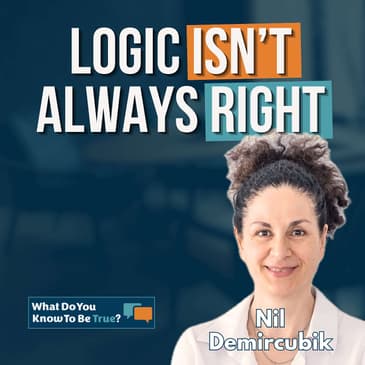
You know when you are overthinking and second guessing a decision, and then once you make the decision you realize your first instinct was right all along? And then there are the other times when you realize gut was dead wrong. That's the paradox of intuition: it's powerful, but it's not always right. And most advice about it falls into one of two camps: "always trust your gut" or "stick to the data." Neither is the full picture.
In this conversation, Nil Demircubuk makes the case for a third option: discernment. Your intuition is ready but it's one input, not the only input. The real superpower is knowing when to trust it, when to lean on logic, and when to go get more information before you decide.
Nil is an Intuition Facilitator and author of “Down to Earth: Demystify Intuition to Upgrade your Life,” and she although she came to learn her superpower was intuition, her education and vocation were deep into analytics and logic.
Nil introduces "priming" as a practical method to access your intuition on demand, not as a replacement for rational thinking, but as a complement to it. She breaks down how to tell the difference between an intuitive hit and a fear-based story, and offers a framework for making decisions that draws on both your inner knowing and your analytical mind.
If you've been second-guessing decisions you used to make with confidence... if you're tired of going in circles when the stakes are high... this conversation is an invitation to stop overthinking and start discerning.
What you'll take away from this conversation:
☑️ Why "trust your gut" is incomplete advice…and what to do instead
☑️ The priming method: how to intentionally access your intuition on demand
☑️ How to tell the difference between intuition and fear-based thinking
☑️ When intuition is the right input — and when logic or more information is what you actually need
☑️ A simple experiment to try after this episode to strengthen your discernment muscle
In this episode, Nil answers the following questions:
☑️What is intuition?
☑️How to develop intuition?
☑️How to stop overthinking?
☑️How to reduce anxiety?
Resources mentioned in the episode:
- Nil’s Website: https://nildemircubuk.com/
Music in this episode by Ian Kastner.
What Do You Know To Be True? is a personal development and leadership podcast for professionals discovering, building, or already living into their purpose and possibilities. Each episode is a real conversation with a guest who's navigated their own reinvention: from discovering a talent built out of something difficult, to now using their superpower in service of others. Their stories offer new perspective, validate what you already know, and inspire your next move. Wherever you are on that path, these conversations are for you.
Each conversation gives you something real: a guest's honest story, a practice or perspective you can actually use, confirmation you're on the right path, and you're not alone.
Want more info about What Do You Know To Be True?
➡️ Check out the channel: https://www.youtube.com/@WDYKTBT?sub_confirmation=1
➡️ Subscribe to the What Do You Know To Be True? newsletter to get insights into each conversation: https://rogerkastner.substack.com/
"What Do You Know To Be True?" is hosted by Roger Kastner, is a production of Three Blue Pens, and is recorded on the ancestral lands of the Duwamish and Suquamish people. To discover the ancestral lands of the indigenous people whose land you may be on, go to: https://native-land.ca/
Keywords
#Overthinking #intuition #logic #overthinking #howtodevelopintuition #decisionmaking #personaldevelopment #leadershipdevelopment #reinventyourself #RogerKastner
TRANSCRIPT - Overthinking Decisions - When To Trust Intuition vs Logic - No Second-Guessing- Nil Demircubuk
[Roger Kastner]
You know that advice you've heard throughout your life of trusting your gut, meaning your instinct or your intuition? Sounds great, but when you're feeling stuck, when you're overwhelmed, when you're anxious and stressed, sometimes it's hard to hear your intuition. And if you're like me, after you've finally made that decision, you come to learn that your original instinct, your intuition, was right all along.
And today's guest, Neil DeMirchabach, says that's the power of intuition. It's her superpower, but it could be your superpower too, once you learn how to use it and when not to use it.
[Nil Demircubuk]
Getting to know intuition takes a lot of practice. And as you get to practice, you also learn when you can rely on it more and when you need to be a bit more cautious. I do not plainly, unconditionally say, trust your intuition.
[Roger]
Welcome to “What Do You Know To Be True?” I'm your host, Roger Kastner. These conversations are an invitation to learn more about becoming your possible self through the experiences of others who've been right where you are.
In today's conversation, Neil shares with us how we can stop overthinking and start tapping into our intuition to know how and when to use it and the limitations of it and how it can become our superpower as well. If you're ready, let's dive in. Hey, Neil, thank you for joining me today.
I'm grateful we get this opportunity to be together.
[Nil]
Thank you, Roger, for having me here. I'm very excited.
[Roger]
Yeah, and I'm excited to learn more about your superpower of intuition. But before we get too far, what's important for us to know about you?
[Nil]
I strongly, strongly believe and I am very convinced that everyone has intuition already and all I'm really doing is showing that, hey, you have it, why don't you use it more? And here are some fun ways, interesting ways that you can really utilize it.
[Roger]
When we first met, I asked you about your superpower of intuition and you responded by saying, no, no, no, it's not my superpower, it's everyone's superpower. So let's jump right into intuition. How do you define it in a grounded and practical way?
[Nil]
So sometimes describe it this way. Imagine you had a companion with you that kept track of everything you learned, everything you experienced throughout your life, everything. And let's say you have a big decision to make.
You're going to move into a new, you're going to move to a new town, you're going to take a new job or you're going to change to a different position. Would you ignore that friend or companion or would you turn and ask at some point, what do you think about this? So intuition is that friend.
So just turn and ask. You don't want to know what it says, but turn and ask, it's good information.
[Roger]
Just like when we ask a friend and they give you a piece of advice, like, nope, not going to do that.
[Nil]
In its most basic form, intuition is based on coming from your unconsciously and subconsciously stored information and experiences, all your knowledge and experiences throughout your life. And sometimes we could be trying to tap into our intuition in a situation. We just don't have enough data in the subconscious or unconscious for the intuition to say, this is what you do in this situation.
It's just like taking a truck driver and making them make a decision on flying an airplane, for example. You can't do that, right? So I actually use a method that I call priming to help people I work with tap into their intuition.
And it's also the method that I describe in my book, Down to Earth, Demystify Intuition to Upgrade Your Life. Priming is all about calming your conscious thinking and your emotions so that you make space for intuition. That word, actually, priming came from one of the scientific studies I really love that was done in 2003 by Annette Bolt and Thomas Gershkin and Julius Kuhl.
First, they did the experiment by priming people, they called that priming, priming people to be happy or in a good mood before the experiment. And they gave the puzzles and people were solving them really easily, very quickly, in two seconds. But when they were asked to explain how they solved it, they couldn't come up with any explanation.
And that was the scientist's way of showing, saying that they were using their intuition, they were solving these intuitively, it wasn't conscious reasoning, it was, I just know this to be true. Then they tried it again with by putting people into a negative mood before the experiment, and they started failing at the new puzzles, the puzzles they were given. Then I looked at other studies and I saw more and more that when people are in a good mood or in a relaxed state of emotional being, then intuition comes forward more easily.
And I've also seen many studies where the conscious thinking, the mind chatter is quieted down, intuition comes forward more easily. So I come up with different ways for my clients, my students to get into that state and show them that in that stillness of mind and emotions, when they drop a question into that stillness, intuition comes up and gives a response.
[Roger]
And what's the biggest misunderstanding that keeps people from trusting their own intuition and developing their intuition?
[Nil]
One of the ways I differ compared to my teachers, some of my teachers, and many of the intuition teachers or facilitators out there and books out there about intuition is I do not plainly, unconditionally say, trust your intuition. In my world, it's important to know your intuition, tap into your intuition, because it's always great, great, useful information. But it is very important to know the context, the situation, is your intuition really tapping into valid information?
Or is it tapping into some similar situation where this really doesn't apply? Getting to know intuition takes a lot of practice. And as you get to practice, and as you keep track of how your intuition is coming up, how it's coming active and alive, you also learn when you can rely on it more and when you need to be a bit more cautious.
And no matter what, I always say, listen to your intuition, also listen to your logic, your reasoning. Also go do your research, if it's a big decision, also talk to experts, if you can, especially when it's a decision where the cost of you going with your intuition and being not on the right track has a high cost. So yeah, what makes people derail from that is putting too much expectation on intuition being 100% correct all the time.
That makes people either shy away from it, because now what if I'm misunderstanding my intuition? But when we put that caveat in, take your intuition, take its input, but always look at, does it make sense? Always look at all other factors before you make a decision or take an action.
[Roger]
I love that advice of thinking of intuition as a data point and not all the input you should pay attention to or not pay attention to it at all, but it's one of the pieces of data that you need to consider. And then I imagine there are places where, I know I felt this for myself, where there's some places where I think my intuition is really good and some places where it's like, I know I can't trust it. I'm curious about how do you get better at discerning and identifying when your intuition is really good and where it might need to be worked on.
[Nil]
As people practice and learn, one of the things we need to also figure out is how to sometimes interpret what your intuition is saying, because intuition sometimes doesn't have a direct language. It would give you just a shape or a symbol or a color or something. You would think of, let's say, going for a trip to some place you've never been to, and all of a sudden you'll get this color green.
Does that mean go? Or does it mean it's a really lush and green place? It could mean many things.
Whenever anything like that happens in my sessions with people or when I'm teaching, we go into, we take that and we just take a note of that. Then we go deeper into that. Okay, what does green mean to you in this moment in your life?
What does green mean to you? What was your intuition trying to say? That's one part of it, for example.
[Roger]
Now that makes me think there's a period of noticing the intuition, trying to interpret the intuition or the intuitive hit, and then coming back and reflecting, hey, did that match the actual experience? Is that part of the practice or is there another practice that you use with people to help them improve their intuition?
[Nil]
We explore this priming a lot together because it's a very personal thing. Different things prime different people. Some of the people I work with respond really well to guiding them through a visualization or imaginary scene, like taking them to their happy place or making them close their eyes and imagine they're doing their flow activity, the thing where they lose their concept of time and place, and totally taking them away from the continuous mind chatter and the current emotions and really getting into that stillness and relaxation. Anytime we notice, okay, they're there, drop the question.
We repeat this process. Not only we repeat this process during, I mean, for different things at different points in their day or in their life, but we also repeat it in the moment for the given situation. For example, let's say someone's thinking about they just received a job offer and should I take this job or not?
One way to get into that could be, of course, this is after they've already considered, they've done their research, they've talked to people, they know what the job is about. Then it's about sensing into what their intuition is saying also to get that input as well. One way we do that is close your eyes, imagine yourself in this place, imagine yourself in a meeting with the people who interviewed you, you will be working with, and just go through it, just go through the day.
What do you say? Pay attention to your body, pay attention to the sensations you're picking up. Some people may say, oh, I'm not good at visualizing.
Don't visualize, do you use all your senses in that imagination, in that scene? As they're doing that, they're also relaxing and calming down, but they're also noticing, oh, something made me really concerned here. Okay, let's pick that up and let's breathe, let's pay attention to your breathing.
Prime again, we do that, prime, prime, prime, prime. Let's go into that calm space again of mind and emotions and let's explore again. What was there?
What was the concern? What did you notice? Again, pick that up, capture the first thing, because another thing about intuition is if we don't capture the first thing we get after we ask that question to ourselves, our intuition, the conscious thinking mind jumps in very quickly and starts writing stories.
But then this can also happen, and then this other thing can also happen. So yeah, prime, prime, prime, try, try, try, ask again, and see what you get. There are many signals intuition gives us, saying that I am your intuition.
One of them is if you get, let's say, if you get a yes on a question, should I take this job? Yes. Prime again, do something calming for mind and emotions, ask again.
If it's intuition what you got, typically it will persist. It'll say yes again. And then you'll prime again, you'll go for a walk, maybe you go out in nature and that relaxes you.
In that very still moment of mind and emotions, ask again, is this the right job for me? You get a yes. So if it persists, then it's a good sign that it's intuition because conscious thinking mind, especially in a situation like that, it would go, yeah, no, maybe let's think about it more.
So yeah, that's not a bad thing, but knowing what's intuition and what's your reasoning is a good thing so that you can put them together and decide what weight you will give to each.
[Roger]
And I want to introduce a third actor into that. There's the conscious thinking, there's the intuitive thinking, which I'm also curious about. I think of intuition coming from the gut, this idea of the gut instinct.
So I'm curious about to see if that's right. First thing I want to go to is the third actor, or maybe there's more actors in this. There's the conscious thought, there's the intuitive thought, and then there's those repeated stories that we tell ourselves.
And then there's probably our parts that get activated in different situations that are trying to protect us. And so there's the fear coming up, there's the repeated stories that are also probably trying to protect us. There's our conscious thought and then the intuition and being able to separate those things.
What I'm hearing you say is it sounds like a lot of mindfulness practice to be able to prime yourself, to center yourself, to try to quiet the noise, to hear what's the head saying, what's the gut saying, what's the heart saying, what's the six-year-old Roger saying, that repeated story, and be able to discern those pieces. Am I following? Does that sound about right?
[Nil]
Yes, there's a lot of mindfulness. But I wouldn't want that word to scare anyone who is not into practicing mindfulness or meditating, because we're talking about mindfulness not in the sense of go to a retreat for 10 days and just get totally quiet. It's mindfulness in the moment, being really aware of what's going on in your body, in your mind, in your awareness, all of that.
It's very, very important. And the more you pay attention, the more you're alert and awake about it, about what you feel, about what you sense, what you think, what your intuition brings forward, what might be a fear, the more you're aware, the better all of that discernment gets.
[Roger]
In these conversations, we're exploring our experiences with our superpowers to better understand the building blocks of living into our own possible self. And I believe one of those building blocks is adaptability, which I think is a combination of resilience and learning agility, mindfulness, self-leadership, all that good stuff. What have you found to be the relationship between your superpower of intuition and adaptability?
[Nil]
It's been very helpful, especially when it comes to social intuition or intuition on people, adapting to situations when I'm in a new environment, meeting new people, tuning into what I'm sensing about these people, what is being, listening to what's being spoken, what's being shared, but also paying attention to what I'm sensing here. Am I sensing some tension here? Am I sensing some uneasiness about meeting me?
Or what can I do? How can I, how can I create a safe space so we have a better communication here? So all of it, it definitely helps, yeah.
[Roger]
What or who inspired you to have this superpower of intuition?
[Nil]
I had it very strong when I was a kid. It was very, very strong. I would just easily make up games, just follow my, one of the things intuition really brings out in us is creativity.
So I was a very creative kid, could just spend hours just making up a game and playing on my own. But then over time as growing up where I grew up, back home in my home country in Turkey, I and people around me started noticing, oh, you're good in math. You gotta be an engineer.
I followed that path and no regrets. I loved, I love studying engineering. Then from engineering, I went to grad school and studied, did my PhD in economics.
Then from there, I went into finance and data technology and finance. You can see there's a very analytical side of me having the front stage kind of life going on, but somewhere in there, something happened in my life. I was in a multi-vehicle pile-up and had a severe head injury.
And that really seriously gave me the jolt. It was, first of all, you know, it makes you reconsider all your life and all of that, but beyond that as well, some months after that accident, I started having episodes that looked like seizures. I would just go into convulse, my body shaking, convulsing, and I couldn't think of anything in those moments.
I couldn't feel anything in those moments. It's really totally takes you into the moment. You're just there, just living whatever is happening to you.
Right after the shaking would finish, I would have this pristine stillness in my mind, in my emotions that the storm, after the storm comes. Not in a way that I would wish for it to happen, but it was just in those moments. Then I started getting really great ideas, hunches about things, people, problems, solutions to problems.
First, I thought, what is this? Because it wasn't, it didn't seem, it doesn't seem to be coming from my usual, if this then that kind of reasoning and analytical thinking I was so used to by then, but I decided to get curious about it. I started to really explore it.
I found teachers, several teachers. I read everything I could read, looked into research, scientific research, and I basically came to the conclusion that this was my intuition coming forward. This was not something coming from out there in the ether coming to me, but it was myself, my inner wisdom, my inner intelligence coming out and speaking to me and saying, hey, hear me, hear me out.
Now I have an opportunity to show you. Then it became over the years, as I also learned and experienced different ways of learning, teaching and all that, then it evolved into, okay, how can I repeat this experience without having to go through that shaking, which thankfully doesn't happen so much anymore. It's almost, you know, never, and I figured out that priming, yeah, priming, I can go into that space without something physical happening to me that makes me, you know, have to go into that space.
I can intentionally go into that space. I can show people that they can intentionally go into that space so they can turn their intuition on, like they have a toggle, and they can turn, then after they receive what they receive from their intuition, then they can turn their logic on and put everything together and hopefully make a more informed decision.
[Roger]
What does it feel like when you're working with someone and you help them be able to tap into their intuition?
[Nil]
It's exhilarating. It's really, really so fun because sometimes I get people who are kind of sent to me like a little bit by force and they're, oh, what are we going to do here? You're not going to make me meditate, right?
I don't like meditating. Okay, we try many different things. And sometimes, like somewhere in there, they're even meditating without realizing they're meditating, but we also do it without any meditation and they're just really blown away by, oh my god, oh my god, I got an answer, oh my god.
They would ask some question that had been puzzling them for a long time and about a relationship, about a job situation with their manager or something. And now, boom, clarity and the excitement, the joy. And yeah, I love it.
I love doing that.
[Roger]
Often when I'm coaching with a client and I'll ask them a question and I'll preface it by telling them, okay, don't think about the answer. Just wait for the answer to come up. And I'll ask the question and they're looking at me a little bit like, what do you mean you're going to ask me a question but you don't want me to think about the answer?
And then they do it and the answer comes up and it's like, oh, I didn't know I knew that. Like, no, you did, but it just wasn't in the place you thought it would come from.
[Nil]
Yeah, and that's one of the definitions of intuition that I really like, knowing something without knowing how you know it.
[Roger]
That's so good. So Neil, in this moment, what do you know to be true about your superpower?
[Nil]
As much as I practice, it can sometimes be easy to forget it, especially when I get into the hustle bustle of the day, the busyness of the day. It's very true to stop and just take a breath and give ourselves that break, that permission to go into the moment and just check in.
[Roger]
Yeah, the breath, it's just right under our nose. It's my favorite breath work line. Anyway, I'll be here all week.
What did you believe early on about your superpower of intuition that you've come to learn not to be true?
[Nil]
Very early on is when I was getting all curious and exploring it with my teachers. I really thought that you needed to get into a very deep, deep, deep state of that calmness I was describing, like almost meditative state of it to tap into it. Now I know it's a lot easier than that.
Now I know intuition is so ready to come out and waiting for us to tap into it, that even just giving ourselves that little, just follow your breath here. Just feel your breath moving your body and just let your worries and thoughts go and just focus on that in and out, in and out. Even that can be enough.
[Roger]
Do you think that came from practice or do you think it's always there? We're just ignoring it.
[Nil]
It's both. It's both. One of the things people don't realize about intuition is how much it's already there in their lives.
For example, think about a time when you were eating at a restaurant or at home and you felt your food needed some salt or pepper. What did you do? You intuitively grabbed whichever one you needed.
You intuitively did the salt or pepper shaker. Did you decide, oh my God, did I put one gram too much or two grams too little? No, you intuitively knew exactly.
You could also sometimes taste and it may be off, but most of the time you intuitively know how much to do that, where to stop. I mean, that's an intuitive thing. You're not thinking about it.
You're just doing it. There are so many things we do in our lives every day on autopilot mode that we use our intuition for. We're designed that way.
If we didn't have intuition, we would collapse. Seriously. We wouldn't know how to wash our face.
We wouldn't know how to brush our teeth. We would have to think about everything. I'm also saying this because after the accident, the car accident I described earlier, I went through a period when I had to literally talk myself through step one, two, three.
Some things were forgotten and gone, and I had to relearn and just realize how much you are already using your intuition, taking it for granted. Bring it out more because it's useful information.
[Roger]
For our listeners who want to improve their ability to tap into their intuition, what's one practice you would recommend that they do and experiment, something they could try after listening to this episode? What's one thing you would recommend they do?
[Nil]
In your life, look for, pay attention to what really primes you, what really brings you to that calmness of emotions and mind chatter, whether that's going for a hike or playing with your kids or your puppy or smelling a beautiful flower, whatever that is. Find those things, either find that one thing or find a few of them and start playing with it. Do that thing and right after, prepare a question ahead of time, then set that question aside by either writing it somewhere or recording it on your phone or something so that it's not on your mind going, well, what's going to happen?
What's the answer going to be? Set it aside, go for your walk, play with your dog, do what will really relax you. Then look at it right when you feel, okay, now I'm relaxed, look at it and see what comes up and capture it.
Then also ask your logic, also ask friends if necessary, do your research, then make your decision.
[Roger]
I used to tell my boys when they were younger and they were working on a problem and they couldn't come up with the answer, I'm like, give it to the man in the back of your brain, just like send them the question, go to sleep, when you wake up, you'll have an answer. It sounds very, very similar. I mean, what you were talking about, how I was translating it, was you're letting your subconscious work on it while you go focus on something else.
[Nil]
Yes, exactly. That's actually in cognitive science, that's known as the incubation period and they also call it non-conscious work. So whenever you're working on a, especially on a complex problem and you feel stuck, really leaving it, leaving it and going, doing something totally different, going and playing basketball and then coming back to it.
Now all of a sudden new ideas, new perspectives show up. It's even been shown that if you do the incubation early on, it works even better. I talk about this in my book in the last chapter.
So if you're trying to solve a complex problem, look at the problem, introduce it to yourself, just like, you know, coming up with that question for your intuition and setting it aside, set it aside right away. Do your priming, do your activity that would relax you in both mind and emotions, come back to it and even your first phase of work on it would be more productive.
[Roger]
So what's next for you and your superpower of intuition?
[Nil]
Continuing to teach and spread this excitement about intuition so that more and more people are aware they have it and can learn and practice different ways of tapping into it and making it a tool in their lives so that they can, it's not only just making more better decisions, but also connection. So people understand each other better. When we connect with someone, including our intuition in the communication, we listen differently.
We pay more attention and we are much more open. So our heart opens up, empathy thrives, actually intuition and empathy really, really feed into each other. It's just my hope, my own way, little way of going towards a better day, better world for everyone is to bring these things.
[Roger]
There's something about this path that a lot of us are on around our superpower, where we feel compelled to share it with others, perform it in service of others. I often joke how like superheroes don't get to wear capes because they're only working on themselves. They're actually in service to other people.
Where do you feel or what is that source of compulsion for you to go out and teach this, to write about it, to share it with the world?
[Nil]
It's results. It's results that I had seen originally, initially results that I saw in my life, how much it was really impacting my life, my heart, my happiness, my joy. And then as I started working with people, seeing the impact on them and just expanding, expanding that joy and expanding that empathy connection.
Yeah.
[Roger]
I know this to be true around the compulsion, the feeling, the drive to have to share these powers in service of, to share them and then to be in service of others with these powers. And that's truly what drives it. But I don't think I've been asking people that question.
And I think it's a little bit in the what inspired you to find this superpower, but what continues to fuel you today? I'm also going to guess everyone's answer is going to be somewhat similar in that it produces joy, that it reinforces the value of that superpower for me when it's in service of other people. So maybe it's not a great question, but I'm glad I asked it because I'm, I might be playing with, I might be experimenting with that question to ask, to see if I hear of anything else.
[Nil]
I love the question. So thank you.
[Roger]
Yeah. Yeah. Well, Neil, are you ready for the lightning round?
Sure. Okay. Fill in the blank.
Intuition is...
[Nil]
Our ability to tap into everything that we know, but we forgot.
[Roger]
Who in your life helped you grow your intuition?
[Nil]
My husband's a great supporter and my family, my friends, I have a beautiful social circle, very, very supportive.
[Roger]
What is your favorite practice or routine that helps you grow, nurture, and renew your ability to use your intuition?
[Nil]
Music. Music really helps me prime, whether it's listening to it. And sometimes I would just take a piece of music and tune into just one set of instruments.
I love percussions. Let me just listen to the percussions. So all of that really calms everything.
[Roger]
Is there a favorite kind of music or a favorite song?
[Nil]
Oh, I love classical Bach favorite. Anything Bach is my favorite cello. Yeah.
Yeah.
[Roger]
I was thinking of that. And then I thought, well, maybe we'll get a little... Could it be Bach?
Could it be Tupac? Could it like... Everywhere in between.
Is there a book or movie that you've recently read or watched that you would recommend that has intuition as a theme?
[Nil]
I really enjoyed very recently, I watched Four Letters of Love. I really enjoyed that film. Amazing actors are in it.
Gabrielle Byrne, Helena Bonham Carter, Pierce Brosnan. And there's the character Pierce Brosnan is playing. He has that aha moment when he is at work.
It's not going to ruin the film for anyone. So he's at work and he's in that busyness, working hard, working hard. And he just has that epiphany moment when he just something notices something beautiful.
He's just looking at that. That's another way to prime. Look at something beautiful, notice something beautiful.
And he just loses himself in it. And all of a sudden, he knows what he's supposed to be doing.
[Roger]
What is one thing that gets in the way of you tapping into your intuition?
[Nil]
Getting lost in, I got to do this, I got to do that. I got to run from here to there and finish this and I'm finished that and not giving myself that breathing break that gets in the way.
[Roger]
If an audience member wanted to ask you a question or follow you, where do you want to point them to?
[Nil]
Easiest way because of my strange last name, long last name, Nil Demircibuk. You can find my website easily by even if my website is my name, you can easily go to Nil just three letters, three letters of Nil, Nil.coach. Nil.coach will take you to my website and all my social media links are there. Instagram, LinkedIn, YouTube, Facebook, all of them.
[Roger]
And I know you're very active on LinkedIn. I've seen a lot of your clips and I want to thank Nancy Ankiewicz who put us in contact. So thank you, Nancy.
But ever since she did, I've been following the clips that you've been putting up regarding intuition and they've been so informative. So thank you for doing that. So a little plug for everyone in the audience, you got a lot of social media connections here to Nil that will help you tap into and improve your intuitive hits.
Nil, thank you very much for taking the time and helping us understand a little bit more about something that's already within us, something that we can already and we probably already do tap into, but now have a few practices that we can tap into that intuition a little bit more through that mindfulness, through that priming and being more willing and able to listen to what we already know without knowing it. So thank you very much for sharing your superpower and taking the time to be here with us today.
[Nil]
Thank you, Roger. It's been a pleasure. Thank you so much.
[Roger]
Okay, take care. Bye-bye.
[Nil]
Bye.
[Roger]
Thank you all for being in this conversation with us. And thank you, Nil, for sharing the superpower of intuition and how to know when and when not to use it. What Do You Know To Be True is a Three Blue Pens production and I'm your host, Roger Kastner.
We are recording on the ancestral lands of the Duwamish and Suquamish people. If you enjoyed this episode, you'll love this one about changing your limiting beliefs with Brooklyn Descent and how to stop overthinking and start trying new little experiments with Win Leon. Okay, be well, my friends, and love you, mean it.