
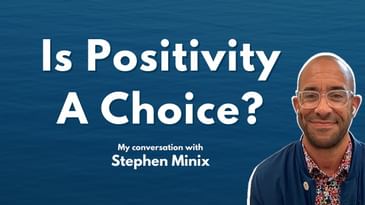
Is positivity a choice?
“Yo! Fired up!”
This is how Stephen Minix greeted me the morning of our recording. And it was infectious and it set the tone for our conversation.
Stephen is the Vice President of Community at UpMetrics, he’s public speaker, a connector, a Girl Dad, and a former high school and college coach. He’s very persuasive in many ways.
But he wasn’t born this way. He learned at a very early age that life is a series of choices and the only thing you control is your choices and response to stimulus.
Deepak Chopra said “To resist or flow is the only choice in life. One leads to suffering, the other, joy.”
Victor Frankl said “between stimulus and response, there is a space. In that space lies our power to choose our response. In our response lies our growth and our freedom.”
Stephen Minix knows this to be true, but he didn’t learn it from Deepak or Victor, he learned it from his namesake, his father.
And with that choice, Stephen chooses to be positive and exude optimism. Not in a fake or toxic way, but in a very authentic way. “My dad taught me the importance of making that choice.”
When asked about authenticity and his superpower of positivity, Stephen said: “If you are going to judge me based on anything, I’m going to give you something to judge me on, which is exactly who the heck I want to be in the moment.”
================
Recommended Next Videos to Watch:
▶️ Four Ways to Access Joy Anytime with Anna Hall: https://www.youtube.com/watch?v=ej7a9sfOE94&list=PLbWfh34FP_dUcAaCrI31z00_fLdphi6b7&index=13&t=943s
▶️ The Surprising Power of Laughter for Your Brain with Jess Brain: https://www.youtube.com/watch?v=zlNyRzDJhvw&list=PLbWfh34FP_dUcAaCrI31z00_fLdphi6b7&index=1
▶️ How Great Coaches Teach More Than Sports with Evan Johnsen: https://www.youtube.com/watch?v=43z425JeF2s&list=PLbWfh34FP_dUcAaCrI31z00_fLdphi6b7&index=3
================
*** Don't miss another episode with amazing guests l- subscribe here: https://www.youtube.com/@WDYKTBT?sub_confirmation=1 ***
In this episode, Stephen answers the following questions:
➡️ What does authentic positivity look like?
➡️ How do you increase your positivity?
➡️ What is the true meaning of positivity?
➡️ Is positivity a choice?
My favorite quote from the episode: “Never beat yourself up. Beating yourself up just results in you being beat up.”
I love this because it feels so true. The lesson too often from beating ourselves up is not to getting better and learning. We often learn to avoid those situations, meaning we don’t grow in that area. That feels like a bad lesson, a bad choice.
Resources mentioned in the episode:
➡️ Stephen’s LinkedIn: https://www.linkedin.com/in/stephenminix/
➡️ Book: “The Energy Bus” by John Gordon - https://bookshop.org/p/books/the-energy-bus-10-rules-to-fuel-your-life-work-and-team-with-positive-energy-jon-gordon/16645186?ean=9780470100288&next=t
Chapters
0:00 Intro & Welcome
4:31 Impact of Positivity on Others
6:15 Authenticity and Positivity
9:59 Inspiration for Positivity
13:18 Hope & Positivity
15:54 Role of Courage in Positivity
16:56 WDYKTBT about Perpetual Positivity
25:19 Personal Asset Map for Positive Thinking
28:34 What’s Next for Stephen
31:39 Lightning Round
35:07 Never Beat Yourself Up
43:12 The Power of “Yo!”
45:55 Outtakes
Music in this episode by Ian Kastner.
"What Do You Know To Be True?" is a series of conversations where I speak with interesting people about their special talent or superhero power and the meaningful impact it has on others. The intention is to learn more about their experience with their superhero power, so that we can learn something about the special talent in each of us which allows us to connect more deeply with our purpose and achieve our potential.
For more info about the podcast or to check out more episodes, go to: https://www.youtube.com/@WDYKTBT?sub_confirmation=1
"What Do You Know To Be True?" is hosted by Roger Kastner, is a production of Three Blue Pens, and is recorded on the ancestral lands of the Duwamish and Suquamish people. To discover the ancestral lands of the indigenous people whose land you may be on, go to: https://native-land.ca/
Keywords
#Positivity #Impact #PowerOfChoice
Is Positivity a Choice - Yes Says Stephen Minix
Stephen: What I'm talking about is hope is the start to action. Because if you just hope things and you don't then marry that with strategy and in my world, possibility and positivity, then the likelihood of momentum and action moving forward, whatever it is, it's not gonna happen. It's just gonna be a thought exercise and I'm done with thought exercises.
Right? And to me, the hope piece is essential as a spark. But it's just the spark. To then drive you to action and positivity with hope, married to Action. Oh man, I can live that all day. That's, that's where I wanna be.
Roger: I hope you came ready for this conversation with Steven Minick and his superpower of perpetual positivity.
Steven brings a bundle of energy to this conversation, and I'm grateful for him sharing his mindset. Practices that enable his positivity tanks to be full most of the time. And he shares three things with us that we can do as our positivity starter set for when we're ready to choose positivity.
Steven's message is powerful, inspiring, and infectious, and he doesn't come at it from a soft and fluffy place. He learned it at an early age and that it all comes down to a single choice.
Stephen: If, if your model is. In someone's darkest hour and darkest days, they're still trying to help the next person be better and live a life.
There's no, there's, there's no deviation from the script that I've been shown, which is whatever you got, put it into the world. Help the next person get whatever it is they're trying to do within reason, of course. And then just keep pushing that into the world.
Roger: I'm excited to share this conversation with you because Steven honed his practices and mindset that empower him to show up on fire and ready to rock.
Stephen: You figure out in your life what makes you better, and for me, what makes me better is taking care of myself and, and also reflecting, but also never beating yourself up. That's, that's my secret beyond most, is I never beat myself up. I also don't gas myself up. I don't tell myself I'm the best in the world if what I just did wasn't the best in the world.
I'm reflective. So like if I tell my kids to give a hundred percent effort to live with the results, then I gotta do the same thing. And a key to that as an adult is reflection. What can I do better next time or what can I do more of? But never beat yourself up. It's just all you do is beat yourself up and getting beat up isn't fun.
Roger: Hi, I am Roger Kastner and I'm the host of the What Do You Know To Be True? Podcast. For over 25 years, I've been working with leaders and teams, the co-create pathways to being better versions of themselves. And these conversations are intended to amplify. Those stories and the experiences of the people who have done just that.
In these conversations, I talk with ordinary people about their extraordinary skill, their superpower, and the meaningful impact it has on others. The goal is not to try to emulate or hack our way to a new talent. Instead, the intention is to learn more about their experience with their superpower, and in doing so, maybe we can learn something about the special talent and.
Each of us that drives us towards our potential and living into our possible self. If you're ready to get fired up, let's dive in.
Hey Steven. Thank you for joining me today. I am grateful that we get to be together.
Stephen: Excited to be here, man. Good morning.
Roger: Hey, I'm excited to learn more about your superpower of perpetual positivity. Be. Before we get too far, what's important for us to know about Steven Minnick?
Stephen: I'm just a guy, I'm just a dad. I'm just a person that believes in like it positive, like leaning into creating space and, and I. Not dwelling on the negative. There's just no point. And so I'm a gardener. I'm a diehard Seahawk fan. I'm a Mariner fan. I'm everything Pacific Northwest as a kid, but I've kind of cut my teeth in Southern California trying to just grow a family.
Um, just be be the light, be the light out in, in space and, and try to help folks do what they want to do. And for me, perpetual positivity helps that kind of just, just, just roll.
Roger: Even before we got talking this morning, you had emailed me with the word and and you wrote, fired up with several exclamation marks and it was infectious.
Just reading it, I felt my energy surge and I thought, okay, strap in Roger. We're about to go for that positivity ride.
Are you aware of the impact your positivity has on others?
Stephen: I'm a lot more aware now. If I'm being honest, look, my positivity comes from a lot of pain and so, so it's not a pollyannaish approach to the world, but it's something that I developed as a little kid that helped me deal with some dark stuff.
It helped me through the dark. So why wouldn't it potentially help others through the dark or, you know, the gray or whatever metaphor we want to use, but like doing things in a way that allows for, um. The possible. That is optimism, that's optimistic. And I think that when you kind of do that, other people maybe give themselves grace to say, yo, this might, it might be a different way.
And I think that yo piece that like, yo, maybe, well, there's a possibility right there. Boom, stop. And I think if you give people those little opportunities by either modeling or, or, or helping them think through it themselves. Now, whatever it is they want to do is a little bit more possible because they are in a positive mindset about either themselves, their resources, their position, whatever it is.
But it's, it's possible. And I think, um, if that helps people, yo, I'm living a life fulfilled for real.
Roger: I love that. That pause that comes after the yo.
Stephen: Yeah.
Roger: Right. I mean there's, there's like an, an awareness of the presence in that yo. And the pause to be able to drink it in and then realize, okay, what is possible in this moment?
What am I not seeing? Sure. It's almost, it, it, it kind of reminds me, it's like the lightning rod from God and maybe, maybe God speaks in, in, in yos in that way. So I was recently talking with Natasha Durkin, or Tash as her friends call her, and she's the author of Fiercely Joyful. We're talking about Joy and Tash shared something with me that was really profound and yet quite simple.
She was talking about the power of authenticity in creating and accessing joy, and that joy is not only amplified with authenticity, it's actually required and maybe. Maybe authenticity is, you know, yo is the sound of authenticity now. Authenticity plays an important role in positivity. I'm reminded that once a client, uh, shared with me after something I had said, he said, I can't tell the difference between the glass half full.
I. Half stupid. And that's a funny line. And I, you know, the client and I got along really well together and that's maybe why he said it that way. But it, and that line kind of does blur the line between veracity and authenticity. But the point was made. I'd love to hear your thoughts about the role of authenticity and the power of positivity.
Stephen: They're directly related, period. Mm. Right. To extrapolate on the, yo, if you ever read what I write on LinkedIn, I always lead with yo. It's not because I, I'm, I'm trying to like, subscribe to some nineties hip hop energy, although that's probably in my soul. Um, I don't speak the king's English. I am who I am.
I talk the way I talk. I show I'm wearing sneakers right now, but I'm an executive, right? You are who you are. You don't get to be an avatar of yourself. And so for me, the authenticity piece. If you're gonna judge me based on anything, I'm gonna give you something to judge me on, which is exactly who the heck I want to be in the moment.
And if I, when I say yo, it drops the pressure in the room for the reader. The reader's like, oh, this is a light, this is a light read. And then I can kind of respectfully banana the tailpipe, get 'em to understand what I'm trying to say. My power has always been in saying the thing without. Shaming folks.
And so when you think about authenticity as it relates to positivity, for me, I Panama, I get Mo, I'm an old high school PE teacher. I move, I think with my hands. I articulate situations. This is all this, this is me. And if you read anything about public speaking, they're like you, you gotta do, you can't do that.
You can't. Sure can. I will with pride because it's me and I know how to vacillate and kind of read the room and, and leverage eq. But if you're not authentic on the front end, how do you expect to exude or perpetuate joy if that's your thing, if you're not being yourself. Right? And that, to me, those are just too related.
It's, and it's not a, um, a Mensa exercise. It's be yourself. You're the best version of you no matter what. There's no competition for who's a better version of me. Period. I'm one of one just as you are. And for me, when I can authentically show up, which is a requirement of anything I do, then I get to actually lead with what I care about, which is joy, possible positive, and try to make some stuff happen.
But if I'm faking it. I'm just faking it and I'm not an actor so I don't, I shouldn't be faking it 'cause I'm not an actor. Right? If I was an actor, it would be tied to my profession, but I'm not an actor so I gotta be me. And in me showing up as I am usually benefits whoever I'm working with because I'm thinking about them as much as I'm thinking about me.
Roger: What or who inspired you to have this superhero power of perpetual positivity.
Stephen: I wish you could have met the, the, the og, the original Steven Mendix. My dad, when I tell you the world lost a superhero, April 25th, 1992. I turned 46 in a couple weeks on June 18th. And, uh, he, his birthday's a couple weeks after that, but he's been gone for some 30 some years now.
And, um. Before he passed away, he kind of poured into me as like, yo, young man, I'm dying. You need to know how to do this young man. I'm dying. You need to, it was just like these dark, like people think dark things, but like my dad was so just amazing. He was a southern black military. Just, just, just thoughtful, thoughtful, caring human in his demise physically.
He kind of poured everything he had into me and my sister and my brother about like, yo, how to approach the world. Try this, try that, and work hard, be thoughtful care to, not to extrapolate too much on this, but when he was sick in the Air Force, um, he had to, he got honorably discharged at about 16 years or 17 years, something like that.
When he left, he's like, I gotta, I still got stuff to do. And so he became a, he wrote blueprints for Boeing. He, uh, he was, uh, he, he did, um, became a chef and did like all these cool, he just became a Renaissance man. If, if your model is in someone's darkest hour, in darkest days, they're still trying to help the next person be better and live a life.
There's no, there's, there's no deviation from the script that I've been shown. Which is whatever you got, put it into the world. Help the next person get whatever it is they're trying to do within reason, of course. And then just keep pushing that into the world. Big shout to my dad. I mean, I, I, I get emotional talking about him now from a perspective of, yo, I'm so lucky to have that experience.
And it was dark, it was awful, but it's, it's galvanized me in this world and kind of put this. Social and professional patina on me of like how to keep showing up, right? Because I have my faculties, I have my health, knock on wood. Well then what are you gonna do with it? And to me, that lives in that positive, that lives in that joy.
And I can extrapolate that out to more folks like, because then I seek that out as in as I grew in my career. And you know, I got a bunch of other models of that. My wife, who's just. Vicious in her service for young people, right. And, and a bunch of other coaches that wrapped their arms around me when my dad died.
So I just had the model of like, what it looks like to, to positively do things and pay it forward to the next person. And I think that's kind of, that's, that's, that's one of the ways I've learned it. And the other place I've learned it span away Washington shouts out to the south sound for real gritty little military town.
But you have to learn how to talk to folks on both sides of the equation. You have to learn to talk to professionals, military, and the non, non, you know, higher educated folks and, and, and, and a bunch of different races. A bunch of different, everything going on in that little spot, but you had to show up.
And so between Spanaway and my dad, I think that's where I got a little bit of my, my go.
Roger: What a way to honor your father. Yeah. Amen. By, by carrying on his inspiration. That's real through positivity. Authenticity. Be the person you can be. Like if you have a hundred percent capacity, use a hundred percent in everything you do.
That's
Stephen: real.
Roger: There's this definition of hope and it's not a like, I wish we win this game, or I wish I passed this exam. It's the belief. Our goals are attainable, a belief in the path we're choosing and belief in our capabilities to achieve. So it's a much more, sure, um, much more positive. Positive, but also like it's, it's on that state of belief, not wish.
Sure. What's the relationship between your superpower of perpetual positivity and that definition of hope?
Stephen: Look, if you don't believe it's, so, it's not so. It can't be, it's not gonna happen, right? Like it, it's to, in my world, in my operating system, in, in my iOS, if I don't believe it's going to happen, it's probably not gonna happen.
If you believe and you have directional kind of understanding of what you're trying to get done, then you marry the strategy of executing on that belief because you hope. Things will be better, but you take agency in that effort to make it so and so, I think if, and when, when I saw this, you know, when you, when you originally kind of phrased some of this question in, in some of the conversations we've had before, and it was about hope.
I gotta be honest, I've had a, an interesting take on hope as a black man in America, right? A lot of times folks talk about hope and, and, and, and what Obama talked about, right? Mm-hmm. And, and I loved it, but I also knew that it came with sweat equity to execute. For me that sweat equity execute is key to hope because it's not just a thought.
I'm not saying that anything disrespectful about Obama or oh eight or none of that stuff, what I'm talking about is hope is the start to action. Because if you just hope things and you don't, then marry that with strategy and in my world. Possibility and positivity, then the likelihood of momentum and action moving forward.
Whatever it is, it's not gonna happen. It's just gonna be a, a thought exercise. And I'm done with thought exercises solely, right? I was a higher ed, I taught at, you know, college level. I taught at high school level for years. And when I was in college level, I saw a lot of like exercises and thinking, but like, what are you gonna do with it?
Right? And to me, the hope piece is essential as a spark. But it's just the spark to then drive you to action and positivity with hope, married to action, oh man, I can live that all day. That's, that's where I wanna be.
Roger: What role do you see as courage in that equation? Ooh,
Stephen: yeah. Courage is part of it, right?
Because for me, positivity and, and the hope part of it, courage lays in there because if you don't have the courage to try to swing and miss or say the thing or speak up or ask the question. Well, then you're gonna have this whole thing of like, oh, I wish I would've, and now we're in the wish game. Wish versus hope.
Some say they're related, some say they're not. But the reality is, I think if you don't have the courage or develop the ability to ask the questions or, or the courage to, uh, discern what you're reading and not just lap it up as gospel, if you don't have that courage, then you're doomed, in my opinion, to kind of.
Short, sell yourself in whatever it is you're trying to take on. And courage is developed over time, whether it's time in seat, whether it's lived experience, whether it's it's learning and adjusting, reflection, however you get to it. Um, it's an important piece of that recipe for certain.
Roger: What do you know to be true about your superpower of perpetual positivity?
Stephen: It's evergreen travels any city, anywhere in the world. Positivity is, is usually paled not to make this so alliterative, not pollyannish, but what, any environment, work life, parenting, my relationship with my wife when positivity is at play and in the front end of that, so many more things are possible.
Right. Like it, it just, it just is. I, I don't know how else to explain that to folks other than it helps everything when you come at it from a mind of what could this be? How can this be, how can I help this? What's better? What, what could, and not what can we do to make everything better? It's not that, that's not, to me, that's not positivity, but positivity and possibility are so related, right?
And so to me, um, it also feels good. It doesn't wane. I'm not, I have an endless amount of it. Like literally an endless amount of it because it's not a fickle thing. I visit. It's not a vacation for me. It's actually life, right? Some people wait until they go on vacation to be positive and enjoy their life and rest, not me.
I take many vacations daily, hourly, momentarily. I find a way to relax and be happy about whatever it is that I got in front of me. Or gimme space to deal with whatever it is that's bugging me so that I can quickly get back into that rhythm of, okay, now how am I gonna, how am I gonna work through this in a way that, that that honors me and honors my dad, and honors my wife and my kids.
And so, um, I think, I think that's such a big part of living a fulfilled life. I know it's a bit utopian to say that, but what's the opposite of that cantankerous sand in gears? Obstructionist, right? And there's a world for, there's, there's space for that in this world, but there's enough of that in internet trolls and Twitter monger, whatever nonsense.
Why live in that? I live in the opposite, and I can check those things out. I can visit that when I'm low or when I'm bummed or when I'm mad, but I quickly get out of that because that's not a recipe for success for me. That is only gonna harm me, and I don't, I am really good at not harming me. Right. And I think it's really important, and positivity to me plays into that so much.
Roger: And it is a choice.
Stephen: It's a choice.
Roger: And your dad taught you to make that choice.
Stephen: I think he helped me understand why that choice is important. I think he, I think he really helped me understand why that choice is important. And I don't think he ever said, this is why it's important, but I saw that grown man wither and, and become a shell of himself before he passed.
His vessel, but his words were, were beyond powerful. They were, they were, they got quieter, they got softer. They got, because he was, didn't have the same strength, but those words still had the power in me, which is, he'd always say, Stevie, Stevie. Stevie, Stevie. That's how he would talk to Stevie. Stevie and he would bring you in and he would talk to you when he was sick.
I just saw that the light goes out eventually, I. Right to make this kind of ominous. I'm coming up on my 46th birthday. My dad was about this. This is the, he died at 46, 4 7, right around that time. I'm coming up on the year to where I no longer have a model beyond those years. Right. I know what it's like to be zero to 45 through the lens of my father.
Well, now I turn 46 June 18th. I no longer have a model from that point on. Now it's, I've gotten all these lessons, all these opportunities, and now how am I gonna create the model for 46 forward? Because I don't know what that looks like for, for me, through the lens of my dad. And so that drives me, but that drives me so, so.
Much to like go, continue to say, well, you know, roadmap wise what you can do, the model was shown. Now dictate how you want to make this thing go to the next generation. I'm excited by that. I, I'm actually am and my journal is lit up for little half written statements that I'm trying to organize in my head.
But like it all comes back to you don't have a model anymore. Well now be the model. Now it's your turn to be the model. And that's empowering.
Roger: Do you find it a little freeing? To not have a model where you get to be the creator of what that model looks like post or your prior model ends.
Stephen: It's exciting.
It's exciting.
Roger: Yeah,
Stephen: it's exciting. Yeah. It's exci. I mean, look, it's a, it ties into like my belief impossible. Like I used to be intimidated by, you know, not living out. The legacy that my dad had. Right? And, and it's not fair. It wasn't on me. I was not told to do that. But my name is Steven Minick. My dad's name is Steven Minick.
When I go to Ulae Funeral Home in Spanaway, Washington, and I look down at that headstone, it's a very intense moment because you're looking at yourself, your own name in the ground. And all I look at is that hyphen, there's a, there's a scene in the movie years ago that talks about, I care about the hyphen.
The movie Serendipity. It's a cheesy love story, but there's a, there's a, there's a conversation that Jeremy Vin has in it about the hyphen, and it's about a eulogy, and it's like that hyphen, the metaphor is using that hyphen in the eulogy and like, what do you have this date and you have this date? What are you gonna do in that hyphen?
And it's been in me forever. Now. Whenever I see my dad as like the hyphen, it's like, what are you Steven? You're the hyphen. What are you gonna do with that time? I'm excited that now there is Greenfield for me to try to like take the baton from my dad and now co-create the next step of this to, to go forward.
Absolutely everything. Space and opportunity, that's what it's about. You got space, you got opportunity, whatcha gonna do with it. And I think that is exciting. That's where I live. I live in the whatcha gonna do with it. Whatcha gonna do with it?
Roger: So what did you believe early on about your superpower of perpetual positivity that you've come to learn not to be true?
Stephen: Ooh, that not, not everybody lives that way. Some people operate on the angst and the sand in gears, and some people, like I referenced it earlier, like an internet troll, they get their juice. Harming others and being negative. And I'm not talking about kids joking on each other and shooting the dozens and cracking jokes and all the things like beyond that.
Like I'm a, I'm, I'm a firm believer in that too, but not to harm folks. And when I learned that not everybody has the same motivations to do good and try to be good and help. That didn't yuck my young, it didn't tell me to stop doing it. What it did tell me to do is you gotta be out there because there's a whole bunch of other energy in this world that is gonna pull people down, that is gonna try to harm, that is gonna try to like isolate, extract, take from.
Be the opposite of that. Like meet the world with that other part of it, which is not push into the good help elevate, give people the step to step up, do all these other things. One, it feels good. Other part is, it is good in my, in my operating system and also that person thus then can go on and do more good exponentially changing this world the way they want.
So if we all start to understand that love and act of service and, and making yourself available. Exponentially helps do more of what you want to do. You're good. And so for me, when I had to learn that, I learned a lot of ways I. And, you know, being stepped on for jobs and being, being, you know, being, being told one thing and another thing actually happens.
And like, there's a lot of ways I've seen it and, um, I know this never will you pull me into that side of living a life of obstruction, of angst, of contrarian, just to be contrarian. I love discernment. I love challenging thought. I love back and forth. I love banter. As it is to galvanize a better outcome, not to like perpetuate power and weird dynamic.
Come on man. Miss me with all that miss. Please miss me with all the that stuff. I care about the other side of it, and we can be as angry and cuss wordy as you want, or we can do the opposite. And to me the opposite is kind of where I choose to, to vacillate and spend my time.
Roger: So I imagine there might be a, a, a listener or two that are thinking what's, what's the starter set?
How do I become more positive? What are the Sure, sure. You know, uh, the universal three, what are the first three things you would recommend someone do to be, to like, start leaning into the abundance? The possibility? Yeah. Yeah. The positivity.
Stephen: I'll give you a real tactical one. It's nerdy as as heck, which is personal asset map.
It sounds weird. People are like, what does that mean? Just start writing down what your assets are. I have this list, this Google document that I created years ago when I was kind of trying to figure out what next, I wanna leave teaching, I wanna go into technology. Not sure who am I, you know, the thing that we all do.
Um, and I wrote on it like it's, it's got like a bunch of simple categories. It's like if it hits the fan and I need to call somebody immediately. Who would pick up my call and I had this list.
Roger: Mm-hmm.
Stephen: And then it's like, if I wanted to start a business and I needed to talk to someone that, that did it before, who would I list and would they pick up my call?
And once I did that, I had such a rich list of people that I'm like, yo, I am rich. Like there's a phrase like, like I, my, my buddy Jared told me, Jared Aker told me years ago, which was like, relationships are your currency, Steven. I'm like, yes. And I finished it with, and I'm a rich man. Because of that. And so when you look at assets, what you have as assets, who's in your, in your world, who, if you picked up your phone and you sent a note, would answer.
Right. That's a huge step. So if you start thinking about who is in your world, then take that step and say, what am I proud of about me? Right? What am I proud of, right? I'm a vicious gardener, I think, right? I'm proud of that. Well, if it all goes south here, maybe I'll go open up a farm, right? Like it's just, it's simple and silly.
But the point is those are at, those are things I'm proud of. What else am I proud of? My ability to facilitate? Professional point guarding is how I believe in the world, right? So like facilitation on stage, facilitation in small room facilitation in society, facilitation on the boards, whatever it's facilitating, it's helping make the past.
So these are things that I know about myself that help me understand why I am in any scenario going to be relevant the way that I want to be, right? I think those are some simple tactics. Cost you $0. You can start today. It doesn't take a ton of time. It can be easy. Stop one day, take out one of the podcasts or one of the one of the true crime things you listen to and spend that 45 minutes just writing down your personal asset map, and I bet you you'll start to see, I.
You got a little bit more access and abundance than you think you might have if you've never organized your thinking that way. So that would be, that would be my recommendation. One, two, and three. Start some kind of asset map that allows you to start to see the totality of what you are, who you are, your skills, who you have access to.
Maybe it's a short list, but to still a list. Right, something to work with.
Roger: So what's next for you and your superpower of perpetual positivity
Stephen: professionally? This ties to my work, right? Personally. It ties to my life. So like I'm a big fan of aligning and being like kind of vertically integrated. The work that you live, the life that you live should all kind of feed itself.
And I don't have to take off my business outfit today when I get off work and then become like laid back, Steven, like I'm the same person. One of the things I do in my work is help create vice president community at a, a company called UP Metrics. We create space where funders and nonprofits wanna work together and build better relationships, so.
Elevating kind of my work as a a person that convenes and brings folks together is important on the work side directly, but also into what I care about is just the person, Steven. So I'm lucky enough to be on a few nonprofit boards and I'm asked to advise in some spaces. I want to continue to grow, that I want to be on more spaces because years ago I decided politics is no longer my aspiration.
No interest in that, even though that was my calling forever. What I figured out years ago was strategic board placement allows me to be far more relevant in society's improvement than going out and going this route of politics. And so I found this route of being on boards, a reason to survive down in San Diego, positive Coaching Alliance, San Diego, um, green Dot Public Schools Ambassador, finding a Way, mentor California on the board chair.
The point is these are things that I do in addition to my. Work that allow me to, to continue to espouse some of this positive connection. And so I use all my energy to kind of create different ways for folks to work together, whether it's in cohort setting or whether it's, um, just providing access to the next nonprofit leaders so that they understand how to show up and be in their power as they go do their work.
So I think the reality is I'm gonna continue to beat this drum. Being a light and being a facilitator and being a, a connector that brings groups together. And like I said, in the business side, philanthropy and nonprofits, impact investors and Port cos in personal side, I'm always gonna continue to reach out to, to the next, um, the next one, trying to grow who they are and, and my, my cost for that is always.
Just make sure that if I help you, you turn around and help the next one. That's what we do. Mm. And if we do that, we're putting more love and joy into this planet and we're getting people. Dangerous in their work. And when people feel dangerous. And I use danger as a fun way, not as a bad way, like a dangerous, when you're really good at something, you can decide how you want to yield it.
You have the ability to make the choice to be adaptable, to decide where to do things, and that confidence about how you wield your time, talent, and treasure mix with a little bit of mindset. Yo, you can do some really, really cool things, and I like to do that at the system level and at the individual level.
So, to your question, long answer, long. I'm gonna do some of that.
Roger: Ah, Steven, this has been amazing. Are you ready? I. For the lightning round.
Stephen: Oh, let's go.
Roger: Yeah, no, I, I knew you'd get excited about this, so fill in the blank. Perpetual positivity is
Stephen: essential to my success in life, but perpetual positivity pays off.
Roger: Who in your life provides perpetual positivity for you?
Stephen: Besides me, I would say. Currently my dog, Malibu. She approaches the world with Zests and figure, and it's positive.
Roger: Is there a practice or routine that helps you nurture, grow, or renew your ability to provide perpetual positivity for others?
Stephen: Five 30 in the morning, I'm usually out in front of my garden looking at what's happening, what's growing.
What's not growing? What needs help me? Visiting my garden allows me to always quickly get back into this idea of growth, nurture, support, creative outcome, touch my dirt. I'm always dialed again.
Roger: Is there a book or movie that you recently read or watched that you would recommend that has perpetual positivity as a theme?
Stephen: I just, just sent this to a couple people. The Energy Bus by John Gordon, period. I read that. I pod I, I listen to it on audio. I read the book. I. It, it is such a simple, simple read that talks about the pos or the, the, the, the, the power of, of the right mindset and energy as it pertains to getting people on your bus to do something.
Roger: What is the one thing that gets in your way of perpetual positivity?
Stephen: Sometimes spread myself too thin, right? Hmm. Sometimes you take on too many things and then a watered down version of yourself is just watered down. So sometimes the power of no. You need to, you need to, you need to say no to something so that you can be fully present in the things that you do want to be in versus having to rush to the next thing, rush to the next thing, because that just, it dilutes your ability to be your full self.
And so I think, uh, for me it's the needing to be more discerning about what I commit to and say yes to. Because a yes to everything is a no to almost everything. Mm-hmm. And I believe in filling your tank. Before you do anything a better me, better we, I got phrases like this all day, but the point being, if you don't take care of yourself, who's gonna, you're just setting yourself up for disappointment.
If you are waiting for somebody else, your wife, your kids, your therapist, somebody to help you be better than that for yourself. That's important to have team, but number one in that is you. And how do you approach you? You gotta take care of you. You gotta think about what do you need to, to be energized?
What do you need to be growing? But I know this, I need to make sure that my life is, is in the best PO or my body and my person is in the best possible situation to show up each day because. I got Rochelle wife, I got my three daughters ready to, they, they need me, got Malibu and they don't need me. Like they can't figure it out.
They need me as a piece of their team and I need to show up and for me to show up, I gotta be rested. I gotta be ready to go. I gotta be. And sometimes you don't get the time, but you still find a way to show up and you get the rest later. And so. Maybe it's a part of being successful. It's a, i I, I don't wanna give myself so much credit because it wasn't like, I was like, you know what I need?
I need this amount of rest. I need this amount of spiritual enlightenment. I need, it wasn't that, it's just more like trial and error. You figure out in your life what makes you better. And for me, what makes me better is taking care of myself and, and also reflecting, but also never beating yourself up.
That's, that's my secret beyond most, is I never beat myself up. I also don't gas myself up. I don't tell myself I'm the best in the world if what I just did wasn't the best in the world. I'm reflective. So like if I tell my kids to give a hundred percent effort to live with the results, then I gotta do the same thing.
And a key to that as an adult is reflection. What can I do better next time? Or what can I do more of? And I think a lot of people don't calendar reflection time. I do. I calendar it so I can think and, and give myself time to think about, was that what I wanted? If not, whatcha gonna do different. Okay, move on.
But never beat yourself up. It's just all you do is beat yourself up and getting beat up isn't fun.
Roger: This idea of never beating yourself up, where'd you learn that? Because that,
Stephen: yeah. I mean,
Roger: people do that quite a bit and maybe, maybe, you know, some of them named Roger. Um,
Stephen: yeah.
Roger: How did you learn? That's,
Stephen: I mean, I've learned, I've, I've always felt that way, like, because it's just the reality.
Like if I was small, I, I was always really small. I wrestle. I mean, I was, I was having a conversation with my neighbor yesterday, their kindergartner, who's a very big kid. He's about 82 pounds. He's tall, he is big. He's a good size kid. I was 85 pounds in eighth grade.
Roger: Hmm.
Stephen: Right. So, like, I mean small, but I was, but I knew how to move people and I was always the team captain, the school president.
Like I, I had a mouthpiece, so I knew how to talk. Right. I, I had some, a little bit of imposter syndrome of, dang, I'm so little and I'm in this school, you know, blah, blah, blah. I gotta be a better athlete. I gotta, I gotta have a better grades. I gotta, I gotta do all these things. But none of that had room for beating myself up because I was already small.
So I was always like, I'm not gonna, I'm gonna deal with this. I'm just, and then I grew late and it all worked out and I'm fine. You know, it, all, the story goes where it needs to go. But the point being, I never believed in being like. Wow. You are, you're, you're not good enough to go out there and play basketball tomorrow.
The heck. I'm not. Like, I just didn't, I didn't have that. But when I got older, I remember going through this thing. I'm gonna mess his name up. Um, the, the, the coach za, I forget his last name, but it's pq, uh, positive, yeah. Uh, the PQ stuff, the, the PQ intelligence stuff, but rubbing your fingernails or rubbing your, mm-hmm.
Rubbing your fingers together so that you can feel the ridges on your fingers. Allows you to break the, the whatever you're stuck in. But the other thing I took from that was print up a picture of yourself when you're a child and put it on your desk. Mm-hmm. So on my desk, I have two pictures of myself.
The summer, right after my dad died, I was at Mel Meyer baseball camp in Yakima, Washington. I'm sitting there next to my boy Andy, and where the pictures here it's, you can see the broken little kid, like I was broken and my dad had just died maybe three months before that. I can see how broken that young man was, but I remember that baseball camp being on fire.
Like being on fire. I mean, I was dialed, I was so dialed, had so much fun. I was so into it. And then I had to fly home and got home and I was back into the, the dark. But I was so excited about being there. So in that picture, I see the dark broken kid, but I remember the, the excitement about how much fun I had
Roger: there,
Stephen: right?
Mm-hmm. Those two things I carry at the same time. And so the not beating yourself up for me is why would I beat up that kid? He's a kid. If I mess up the deal and what I do at UP metrics, I'm gonna be reflective. I'm gonna own it. I'm gonna deal with the consequences, and hopefully I stay employed and I can do what I need to do, but I'm not gonna beat myself up because I probably gave the best effort I could to get the outcome I needed to get, and I have to live with the result.
And so to me that like it goes back to taking care of yourself. How does beating yourself up. Play in the calculus of take care of yourself. The beating yourself up just results in you being beat up. And if anybody can tell me why beating yourself up and negative talk is good for you, I'll wait. I'll take the meeting.
Let's talk. I'll talk to anybody that says that helps. No, it doesn't. It only harms. And you can convince yourself that harming yourself is good so that you can see the boogeyman and then go attack it. Some people are like that. I don't need a boogeyman to be motivated. I don't need to be told if I don't do something, the the outcome is gonna be without job or without life, or without wife or without, like, I, I know I'm aware, but, but that's not, but I know when I show up with confidence command and, and like charisma and, and empathy and these things that are positive, when I do that, I get more of whatever it is I was probably seeking, which is.
I don't know. Relationship, love, opportunity, right? I talked to my girls about, I just took one of my daughters to the, to the store yesterday where we were waiting for soccer practice for another one, and we were walking and looking at stuff and she's like, daddy, I can't shop in that store. It doesn't fit me.
And I said, baby girl, you don't know what a tailor is. Right. And she's like, what? And I'm like, you have the same problem Daddy has. You're built different. Your hips are different. What we do is we have to buy pants here, and then we go to the tailor for 10 bucks and they'll take 'em up for us, and now we have custom pants.
Right? You saw her shoulders drop. I told my wife that this morning. She's like, damn. I'm like, yeah, because I'm not gonna beat her up for being short and, and a little, little bit more built with muscle. No baby girl, you're perfect. And let's figure out this issue that you're worried about, which is I can't go in that store because those clothes don't fit me.
First of all, you can walk into any store you want. I need you to know that first. Like, don't limit yourself, right? And so I get to walk with my kids in a way that like helps them be a better version of themselves based on whatever little nugget I get to drop, not what I want them to be. That comes from positive self-talk, positive talk on them, right?
And don't get me wrong, there's some times when the talk ain't so positive. It's like, yo, clean your room. Come on, whatcha doing? Get it. But on the whole, it's. Do you see the possible? Do you help people unlock things? Do you help them think in a way that is gonna help them, not harm them? It's easy to tell somebody like, you ain't this, you didn't, you're not enough.
You're, you can do that. That's just not my. Bailey Wick, so to speak.
Roger: That's so powerful because right there you're speaking to what's my asset list? Yes. What are the good, I mean, in the case of your daughter, what are the good things about me and then what's possible? Go buy the thing and then we'll get it tailored and then it's custom to you.
It's even better than what you bought. I mean, that's you're, you're a great example of the positive asset list and then thinking what's possible right there. So if an audience member wanted to ask you a question or follow you, where would you wanna point them to?
Stephen: I'd say my LinkedIn is the best. Um, you could look me up.
It's, you know, Steven Minox, LinkedIn. I forget what the actual typing it in. I'm probably the only, the one that pops up. Um, you'll see I'll, the picture like this, I'll put
Roger: the, the link in the description so people can definitely Yeah, sure. Find it. I mean,
Stephen: yeah, that's where, that's where you can get the best pulse on me.
Uh, you track me down on Instagram if you wanna see who I am as a dad and as a, as a leader and as a, just a, just a brother in this world trying to navigate and do cool things and I'd, so I'd say between that. And at the company side up metrics.com. I'm the vice president community there. I'm doing some pretty rad stuff with this group and, and proud of the work we're doing and all the stuff we talked about today is fuel to the work that I lead there and bringing folks together using positivity to lead into the possible.
Um, and so I'd say that the LinkedIn up metrics.com and then uh, um, my Instagram, but I'm available. I mean, I, I make time. Um, and I'm an optimist. I'm looking for co-conspirators for good every day from here on forth. Um, because when you start getting folks together that are interested in doing good things, cool stuff happens.
Roger: I'm sure there's gonna be people who wanna follow you just for, you know, fueling their tanks, the inspiration, the positivity, learning from what you know to be true. And I, one of the things that's, that's really resonated with me with this idea of, yo. It's actually reminded me of Viktor Frankl and what's attributed to him.
Talking about there's that space in between stimulus and reaction and that space, maybe that's, maybe that space is where, you know, when you say, yo, that's that pause, that's that ability to choose and not just respond.
Stephen: That choice is everything.
Roger: I don't think I took it to a deeper place 'cause it was already deep, but it's meaningful like that.
Where yo absolutely. We get to choose. We get to make our positive asset less. We get to choose what's possible, and that's what I'm taking away from this conversation as well as my goodness, it's so good to be in conversation with you. It is so positive. It is so inspirational, and it's helping me think, okay, where do I need to be more?
Thinking of what's going positive for me and what's possible next, because I think I do that quite a bit, but man, you're inspiring me to wanna do that more. So thank you so much for that. Thank you for your wisdom and your time and your willingness to share your story because it's inspirational for me and I know it's gonna be inspirational for everyone who watches this.
So thank you so much, Steven.
Stephen: I couldn't say, uh, reciprocate that enough. Uh, I appreciate the time. Uh, I appreciate the space and it's been a rad, rad, few minutes spending time with you, Roger, and, and I hope the, the folks, uh, get something out of it and if not, um, try again, I guess. But, uh, but I, uh, thank you for the opportunity, brother.
I appreciate you.
Roger: My pleasure. Appreciate you too. Take care. Bye-bye.
Thank you all for being in this conversation with us, and thank you, Steven, for bringing your authentic self and sharing your superpower of perpetual positivity with all of us. The question I'm asking myself now after the conversation is, how can I catch myself when I'm about to start beating myself up and instead choose to be reflective and not judgmental?
What do you know to be true is a Three Blue Pens production. And I'm your host Roger Kassner. We are recording on the ancestral lands of the Duwamish and Suquamish people. To discover the ancestral lands of the indigenous people whose land you may be on. You can go to native hyphen lands.ca. Okay. Be well my friends, and as always, love you mean it.
Yo,
Stephen: look, there's no, there's no point in being perfect. It's just be you, right? Like that's the, that's the point. And I think you, you have some fun with it. You tell me if we're, if we need to adjust anything, but no, I'm ready to rock. It should be fun. Awesome.
Roger: And there, there is no perfection, but. In the present.
Stephen: That's real.
Roger: That's almost like a bumper sticker. Okay, we're gonna make money off this. Uh, there's so much that you, there's so much to unpack of what you just said. Like one of the things was, uh, meditating in. Jim and, and wrestling practice that, that sounds amazing. And then you talked about you, you like good smells.
And then I, I I, I went through a little bit of cognitive dissonance of, I remember wrestling and PE back in middle school. There was no good smells involved. So may maybe that was more of an evolution, but, but.