
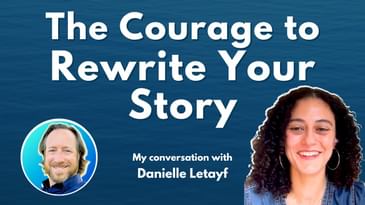
As people leaders, coaches and talent professionals, many of us help others tell their story. We might even get involved in helping them rewrite their stories.
Today’s guest Danielle Letayf is a pro at this.
Danielle is the founder of Badassery, a podcast guest agency. Not only is she helping her clients tell their stories on podcasts around the world, she rolls her sleeves up and gets into the mix with her clients to rewrite their own stories.
And while her clients need to adapt and embrace their new stores, adaptability is also part of Danielle’s secret sauce in how she approaches each individual she works with.
Danielle shares three key lessons in this conversation for the process of developing your personal brand:
1️⃣A willingness to go into uncomfortable places
2️⃣The courage to do the hard work
3️⃣It will be a grind
As you can imagine, if you were getting up on stage or about to be interviewed on a podcast, you might have a little imposter syndrome.
If you’re lucky enough to know Danielle, she’d likely share her surprising attitude towards Imposter Syndrome, which she shares in this conversation too.
================
Recommended Next Videos to Watch:
▶️How To Design Your Future Of Life & Work | Insights from Kason Morris: https://www.youtube.com/watch?v=bqHLXMMNhXg&list=PLbWfh34FP_dUcAaCrI31z00_fLdphi6b7&index=5&t=57s
▶️ These Frameworks Are So Powerful, People and Teams Thrive: https://www.youtube.com/watch?v=9yv9I11h5ro&list=PLbWfh34FP_dUcAaCrI31z00_fLdphi6b7&index=4&t=2s
▶️ The Courage to Connect With Our True Self | Jules Kuroda: https://www.youtube.com/watch?v=E5eJl8VSsio&list=PLbWfh34FP_dUcAaCrI31z00_fLdphi6b7&index=2&t=437s
================
*** Don't miss another episode with amazing guests l- subscribe here: https://www.youtube.com/@WDYKTBT?sub_confirmation=1 ***
In this episode, Danielle answers the following questions:
➡️What does rewriting your story mean?
➡️How do you rewrite your own story?
➡️How do you develop your personal brand?
➡️ Who can help me develop my personal brand?
My favorite quote from the episode: “A badass is not someone who is complete, but rather someone who is willing to grow even when they now it will hurt.”
If this quote feels similar to the Teddy Roosevelt “man in the arena” quote, it should. Not because Danielle lifted it, but because they are both talking about the courage it takes to be vulnerable especially because it will hurt in the middle.
Resources mentioned in the episode:
➡️Danielle’s company, Badassery: https://www.badassery-hq.com/
➡️Danielle’s LinkedIn: https://www.linkedin.com/in/danielleletayf/
Chapters
0:00 Intro & Welcome
4:05 Tupperware
7:51 Characteristics for Navigating Transformations
11:58 Biggest Tension for Client Journeys
14:14 Imposter Syndrome is a Friend Made Enemy
16:41 Badassery and Courage
19:40 Role of Adaptability
24:38 Inspiration for Superpower
26:37 Making them Fall 10% More In Love With Themselves
29:06 What’s Next for Danielle & Superpower
33:51 Lightning Round
Music in this episode by Ian Kastner.
"What Do You Know To Be True?" is a series of conversations where I speak with interesting people about their special talent or superhero power and the meaningful impact it has on others. The intention is to learn more about their experience with their superhero power, so that we can learn something about the special talent in each of us which allows us to connect more deeply with our purpose and achieve our potential.
For more info about the podcast or to check out more episodes, go to: https://www.youtube.com/@WDYKTBT?sub_confirmation=1
"What Do You Know To Be True?" is hosted by Roger Kastner, is a production of Three Blue Pens, and is recorded on the ancestral lands of the Duwamish and Suquamish people. To discover the ancestral lands of the indigenous people whose land you may be on, go to: https://native-land.ca/
Keywords
#personalbrand #courage #rewriteyourstory #adaptability
TRANSCRIPT: The Courage To Grow Even When It'll Hurt
[Danielle]
And so the bare bones, bare bones is that when people come to me, they're ready to like have me demolish everything that they have created in a way that comes from a place of love, not just demolish it, but also after demolition day, find the pieces that really come to life that speak to them. They're ready to re-understand themselves in a new lens because of a greater mission at stake, which is I want to promote my very important story of being a founder. I want to inspire people as a mentor.
I want to do X, I want to do Y. So there's always the eyes on the prize about why this matters versus, you know, that, that piece of, I'm going to, you know, act a fool on a podcast recording. I don't want to do this.
So I would say the first characteristic is definitely going to be a willingness to be vulnerable.
[Roger]
As people, leaders, coaches, and talent professionals, many of us help others tell their story. We might even get involved in helping them rewrite their stories. And today's guest, Danielle Letayf is a pro at this.
Danielle is the founder of Badassery, a podcast guest agency. And not only is she helping her clients tell their stories on podcasts around the world, she rolls up her sleeves and gets into the mix with her clients to rewrite their stories. And while her clients need to adapt and embrace their new stories, adaptability is also part of Danielle's secret sauce and how she approaches working with individuals.
[Danielle]
This adaptability piece, it comes, it comes in so many ways, but it is the most fun part of the work that I do because it is like a game. It's sort of like, how can I help this person feel the best about how they share their story, but also make it magic because everybody I'm not, I genuinely believe everyone that I've worked with or everybody in general, they have a magic in them, but sometimes they're just too close to their genius to see it. And so it's just like me shape-shifting when I'm, when I'm figuring it out, it feels almost like having patients or something where you're like, how do I diagnose this?
And how do we shift it in a way that feels comfortable for them?
[Roger]
As you can imagine, if you're getting up on stage or about to be interviewed on a podcast, you might feel a little bit of what some people call it imposter syndrome. And if you're lucky enough to work with Danielle or listen to this podcast, you'll hear her surprising attitude towards imposter syndrome, which might be a game changer for you. Hi, I'm Roger Kastner and welcome to the, What Do You Know To Be True podcast.
I work with leaders and teams to co-create new pathways to living more into their possibilities. And these conversations are intended to amplify the stories and experiences of people who have done just that. The invitation is to become inspired from their experiences with their superpowers.
So we'll go discover more about ourselves and our special talents and live more fully into our possibilities. If you're ready, let's begin. Hey, Danielle, it's great to be speaking with you today.
Thank you for joining me.
[Danielle]
Thanks for having me, Roger.
[Roger]
I'm excited to learn more about your superpower of helping people understand their unique value and articulate it to the world in a way that resonates. I came to know you from your company, Badassery, where you work with leaders and founders to discover and express their unique value. And during our first conversation, we also discovered that we both worked at AOL in previous iterations of our careers.
So we have these bookends, but there's a lot in the middle and there's a lot about you that I don't know yet. So could you take a little bit right off the top of letting us know what's important for us to know about you?
[Danielle]
I would say the big things to know about me is I love community building. It's what I have done in so many different ways throughout my career, including when I was at AOL and corporate and now in my own job. I also really love storytelling and feel there is so much power to stories shared.
And Roger, obviously you and I share that because you are hosting this podcast. I really love salsa dancing and I would say I also love when food fits perfectly into Tupperware. I don't know if that's happened to you, but it happens to me and it brings me the most joy.
So those would be, I would say the highlights and then we can dive in wherever you'd like.
[Roger]
You know, so of course I'm picturing the food that fits perfectly in the Tupperware. And you might like, maybe you're talking about volume, but I was thinking like, okay, square pieces of cake, lasagna.
[Danielle]
Yes, Roger. And then sometimes you don't anticipate it and it just goes directly. It's like they were meant to be.
It just, it makes me exhale too.
[Roger]
Can I read way too much into this? I think it's like your love for food fitting exactly in the space it needs to be. You feel the same way towards the people you work with.
Boom. Way big assumption there, but yeah.
[Danielle]
We can end the podcast now. That's right. Yeah, that's right.
No, I don't know. I honestly don't know. I don't know what it is.
There's just something to, maybe it's a serendipity thing where you don't expect that stuff will just fit as it should. You're like, that's just how it should be.
[Roger]
For one, you're already winning with big words like serendipity. And again, like it is so relatable because I'm just thinking about when I, you know, you get all the different shapes and sizes of Tupperware when you have the leftovers and you're like, I think it's this. So I'm always proud when I don't have to use two containers because I misjudged it.
So I think I'm vibing there with you on that one. But yeah, there's something about like, you know, you just got the last couple of scrapes of the pan and it just fits and the lid goes on and it's, and there's just a little bit of a kiss between the food and the lid.
[Danielle]
You're my spirit animal, Roger. It's official. Yeah, that's, that's, that's completely right.
There's just something to it. So simple pleasures where you don't have to try so hard, especially when we're working in really tough jobs and you're like, oh, it's just easy. This moment is easy.
So obviously permeates beyond Tupperware, but it's a big part of my life.
[Roger]
This is so Zen. Okay. So as someone who works, I'll try to get a speck.
No, I mean, this isn't really off track. This is such a great insight into you. And I do think it's, it's probably speaks to how you approach a lot of the work that you do, because I'm sure there's a lot of the, a lot of the leaders that you're working with and trying to help them find their value and articulate it, which a lot of leaders struggle with because they get to the places where they're at because of technical skill or, you know, sometimes right place, right time.
And they learn it on the, on the way, but then being able to turn that around and then be a great communicator to be able to not only recognize their own value, which is hard for a lot of people in general, but then to be able to articulate it in a way that inspires people, that's going to be, that's, that's a challenge for a lot of people because it's, it's requiring different skills than maybe they've been focused on in the past, running their business, building up that talent, whatnot. So the, the question that, that I want to ask you around, like helping people move from, you know, one level of high proficiency to another level of high proficiency and that transformation, I, you get to see a lot of that. So I'm very curious about the reflections you get to do of people before and after, like literally you, there might be the, the photographs of them before and after, but you actually, you get to see it in real life.
So I think of that as, you know, people who are able to make those transitions successfully build up a lot of adaptability and resilience to successfully navigate that, those series of experiences that can be very, leave you feeling very exposed and vulnerable. So I'm curious, what are some of the critical characteristics that you've seen help people navigate those major transformations?
[Danielle]
I think the first thing I would say, if I think about all the people that I've worked with is an understanding that they will not sound perfect right from the start. And this is, I think, a reason many people avoid taking a podcast interview, saying yes to an invitation on stage, putting something out on LinkedIn, because there's a tension between how you see yourself and how the world might see yourself. Right.
And as you said, Roger, it's extremely vulnerable and it takes time before you understand how to talk about yourself between what you know, people know, but what you think people are understanding about you. And so the bare bones, is that when people come to me, they're ready to like have me demolish everything that they have created in a way that comes from a place of love, not just demolish it, but also after demolition day, find the pieces that really come to life, that speak to them. They're ready to re-understand themselves in a new lens because of a greater mission at stake, which is I want to promote my very important story of being a founder.
I want to inspire people as a mentor. I want to do X, I want to do Y. So there's always the eyes on the prize about why this matters versus, you know, that piece of, I'm going to, you know, act a fool on a podcast recording.
I don't want to do this. So I would say the first characteristic is definitely going to be a willingness to be vulnerable. And that's my job to make sure that they feel comfortable doing that.
Obviously me and my team, right. The way that we've designed the experience, the way that I also do my sessions with them, it's very much like I'm in the trenches with you. This is whatever secrets you want to tell me, it stays here.
I would say the second characteristic would be genuinely believing that there is a story to share. So versus just saying, I think we should package it this way. I think we should package it that way.
In fact, like actually being willing to do the digging and understand having those aha moments together and believing that they have the value and it doesn't have to happen right away, but if there's no self-belief, then there's going to be no progress. And it's really hard to build off of a place of deficit. I would say it's normal to judge, you know, to question whether, you know, you know, even when you ask me, what's your superpower?
And I told you this very honestly, I don't even know how to say this to you, but it doesn't mean I don't believe that I have, it just means I don't know how to say it in this phase of my life. Right. So I would say the second is, is genuine belief that there is something to say, but it's, you know, there is that, that gap.
And while I would say the third one is actually putting in the work, because even if, for example, you work with us, you work with another agency, whatever it is, and you expect that you have, whatever the sessions you get on a podcast, you kind of just let the podcast host do the work, right? Roger, it only takes 10 hours for you to edit this. If the guest doesn't promote it, what, where are we at?
We're not going to do anything. And so this is another key thing is that my clients that have had the biggest transformations to your point, they're constantly hustling, they're constantly promoting, they're constantly putting messy stuff out there until it sticks or until maybe it doesn't. And that's okay.
So I think it's not just sitting and learning, it's actually actively doing, it's kind of like being the student, but then doing your homework afterwards.
[Roger]
That grind that never, never, never stops. There's a t-shirt in there somewhere about even, even when you get so much, you know, looking in the rear view mirror and you see how far you've come, there's still opportunities to continue to grow, still opportunities to get the message out there. And sometimes the message is going to change because of that journey you've taken.
And so keep working at it because I'm sure for a lot of these people, their intent, I imagine some of them maybe, but most of them is not to promote themselves, but to promote an idea, to inspire others.
[Danielle]
Right.
[Roger]
And there's opportunities to do that in new and interesting ways. And that only happens by staying at the work.
[Danielle]
Exactly. The, the biggest point of tension for the people that I've worked with, and it's extremely high performers, really brilliant founders is that they don't want to talk about themselves to your point. They would do anything except talk about themselves, but it's to your point of, you know, understanding that personal brand still means that you're serving your greater mission.
So does it mean that, you know, you have to be so vulnerable with every detail of your life? Absolutely not. You know, there's some things that are completely personal.
You don't have to share. And I think that's where the misconception is. It's about how do you speak about your mission, the things you're good at to the people that you're, that you want to serve in different ways.
It doesn't always have to be, you know, me, me, me content. You know, and I think this is the qualm I have with personal brand or the idea around thought leadership is that people think it's, it's selfish or it's self promotional. And I'm telling you for a fact, the people who I work with are like, I would rather crawl under my desk and not, you know, I don't know if you feel the same, but, and not, not talk about, about, about me.
And it's more just feeling like it's sort of calling to share because of a greater mission that you're serving. So I do want to make that distinction as well. It's not really about, you know, creating influencers and there's nothing wrong with being an influencer.
If you want to do that, obviously great. But that's really not, not my lane at all. You know, I gave the, my company, this name a long time ago, and I think there's a perception that you have to be X, Y, and Z to be a badass.
And in fact, the thing I've loved the most about my job is realizing how nuanced being a badass can be. Obviously, right. There are people, people assume that it's somebody who's extremely outspoken, has a very strong presence.
In fact, the people that I think have been the most loyal, the most giving the most, you know, the most, all the things you would, you would expect out of a good friend, a good client and a community member have been the most quiet, the most thoughtful, the most behind the scenes. And I, so I don't think, you know, it has to be of a certain personality per se. And sometimes it takes people longer.
And I'm sure with your coaching clients, maybe you feel this too, it takes people longer to show who they, who they are, but it doesn't mean, you know, they're badass or he's not there. It just exists in a different way. So I kind of love the name of my company.
I kind of really hate it too, because it almost feels like we're assigning people like badass or not. And I just think really it exists in everybody in different ways.
[Roger]
And one of our previous conversations, you said something that was really interesting that I think speaks to resilience. You talked about the feeling of imposter syndrome as a positive thing for you, which is the interesting part is most people think of it as a very negative thing and something they don't want to experience. And yet you said that when you get that feeling, it's, it's almost like a fuel for you and you use it in a positive way.
So, yeah. Tell, tell us about your relationship with imposter syndrome and how you use it in situations of growth.
[Danielle]
It's like the best friend that you get in fights with, but you know, will always be your best friend. As a founder, or I think as any professional or as anybody who's trying to do something great, we will always experience situations where we feel discomfort, where we feel less than, where we, you know, all of these things that might come with feeling like an imposter. So I would say, you know, I'm not like a superstar where I feel imposter syndrome.
I'm like, oh yes, I'm so excited. I feel like an imposter, right? My initial reaction as long as like, oh my gosh, you know, I, I'm going to sound lame on this podcast.
I want to hear my voice. I, you know, all the normal thoughts that come, but then I'm like, you know what? Having this feeling means that it is just the step before a big piece of growth.
An example is, and I told you this, Roger, this is my first time coming on a podcast after shifting my business, which was an extremely vulnerable and terrifying and sad thing to do. And I had to shut down a big piece of it last year. So for me, even in this situation, I do feel some discomfort, but I mostly feel excited to see how am I going to transform what I have built the past six years into this, this moment, right?
And so to answer your question about my relationship with it, it's, I guess my gut reaction is this sucks. And then I say, okay, so, but why am I feeling this? And what am I going to learn from this?
Right? Because if I'm not in a position where I feel uncomfortable, then I'm just coasting. I was like, what's the point?
I didn't, you know, I didn't start a company. I didn't do hard things just so I could coast. I want to do things that challenge me that I have control over.
Um, and that are within my parameters and you know, who knows what might come from it. So I would say, I just look at it as a, as a moment of growth. It comes that simply and growth doesn't mean that you succeed.
And I think that's, I've detached myself from the idea of doing something to think it's going to get me somewhere only positive. Cause that's, that's actually not real.
[Roger]
As we've talked before, like your company badassery is helping, helping badasses share their badassery ways with the world. Um, and like, I think about the people that I've been so fortunate to have conversations with in this medium and I'm like, Oh, they're badasses too. Like, and so, uh, one, I'm going to point them to you to, to, you know, if they want to work with you and help promote their ideas again, not themselves, but their ideas to share with the world.
Um, but I love, I love that term badass. Cause these people are badasses and not in like, you know, that Chuck Norris roadhouse kind of like, you know, gruff, tough, uh, way, but in like actually making the world a better place and being, you know, having the courage to be able to step into the arena and be vulnerable to share their experiences as a way of helping demonstrate that growth. So it inspires other people.
[Danielle]
I mean, that was a beautiful definition of, of badasses. Honestly, the courage to step into the arena. I think that's completely right.
Because with that courage comes to point, not just the vulnerability, but the acceptance that you're definitely going to trip a zillion times. Right. And it's funny, cause I'm, I've been going to physical therapy because I had a shoulder surgery recently and they have, I look at this every time I go, they have this picture of, um, it was, I think it was like healing or progress or something like that or recovery recovery.
Right. Because every, you know, we're all going into physical therapy being like, when is my shoulder going to be completely better or in our situation, when is my business going to succeed or what, you know, whatever. And the chart is like as curly, let's say as my hair, basically it goes like up, up, up, down, backwards, upside down, blah, blah, but ultimately, right.
The progression is still up and up and right. And that gives me hope every time I go, because, you know, some weeks I'm in extreme pain, I can't lift my arm past a certain point. Some weeks I'm like, Oh yeah, party time, you know, my arms above my head.
Um, but ultimately, you know, it's the same situation where, yeah, to be a badass, I think just is a recognition. The fact that that's what success might look like or growth or whatever it is. Cause I do think oftentimes people will assume, you know, it's easier than it is.
It is really difficult.
[Roger]
Yeah. There's something that I'm like, my definition of is evolving in this conversation. A badass isn't someone isn't a badass because who they are.
They're a badass because they're willing to grow. They're a badass because they're willing to take on experiences or opportunities that they might not be prepared for, but they're willing to step into that. Okay.
This is so good. So in these conversations in this, it might not be a great segue, but, you know, let's, let's try it anyway. In these conversations on this podcast, we're exploring experiences with superpowers to better understand the building blocks of living into our possibilities.
And one of those building blocks is adaptability. What we were just talking about, this idea of resilience, of learning agility, and something I refer to as like the mindset, the mindset of self leadership, the ability to lead ourselves before we try to lead anyone else. So I'm curious, what is the relationship between adaptability and your superpower of helping people understand their value and articulated it to the world in a way that resonates?
[Danielle]
Ultimately, it is a translation. To me, I just look at it as a translation of taking a bunch of information about somebody, translating it or whittling it down to their value, and then taking that and translating it to an audience, to a podcast host, to whatever, in a way that resonates with them. Right.
And to me, translation, I mean, it's not directly correlated to adaptability, but it does require a lot because we're not binary humans where we take sort of one story, one value, and we can speak it and everybody will hear it in the same way. I think naturally in the work that I do, number one, like from a personal perspective is that every person I work with is completely different. Obviously, they're a person.
They're not, you know, they have a voice, they have different experiences, they grew up in different countries. And so personally, when I step into their arena, I have no idea what I'm stepping into. It's different personalities, it's different willingness to be open.
I ask some really tough questions about their life, what they were like as kids, what some people don't want to answer. And that means I have to adjust how I approach what we're going to talk about. Also on the flip side, right, we work with hundreds of podcast hosts to get our clients on them or with, you know, in the previous version of my business, people who would book them for public speaking opportunities, and they heard the message differently than you might hear it, Roger, as a podcast host.
And so this adaptability piece, it comes in so many ways, but it is the most fun part of the work that I do because it is like a game. It's sort of like, how can I help this person feel the best about how they share their story, but also make it magic? Because I genuinely believe everyone that I've worked with or everybody in general, they have a magic in them, but sometimes they're just too close to their genius to see it or to understand the nuances of it.
And so it's just like me shape-shifting when I'm figuring it out. It feels almost like a case study, case by case, almost like having patients or something where you're like, how do I diagnose this? And how do we shift it in a way that feels comfortable for them?
And in a way with kind of like my philosophies around personal brand and the same thing on the other side. So that's kind of like the adaptability in my work.
[Roger]
And what I'm taking from that response is it's that adaptability that helps them get to where they're actually asking you to help them get. It's all about them. It's not about you.
And I think this is coming, we were just talking about resilience of looking at opportunities, not challenges, not a have to, but a get to. It's very consistent.
[Danielle]
Definitely. And the other piece is too, that the people that I work with, they change too. One of them, for example, just quit their full-time job to become a full-time founder.
So then we all switch. We switch our strategies. The reality of any situation is that people are always changing.
It's up to us to say, I could say, sorry, we already put in so much work on this other angle. This is not in our wheelhouse. We're just going to like, you have to go find someone else.
Or I can be like, this is an amazing challenge. This is awesome. And also the nature of this industry, PR, media, it's like one of the fastest changing in general.
So as a founder, I probably could have flopped as a founder of a business in this space. We went through COVID. I had a speaking business.
There's a lot of moments where it could have been like, badass, we're just done. Oh, maybe today, and now. And I was like, no.
Sort of like this adaptability of being like, what is next? And how do we pair that with the same mission that has always existed, which is to amplify really important stories. There's a million ways to do that.
And it's sort of just understanding that the form is not the same as the mission. And that to me is how the adaptability keeps going, the resilience keeps going.
[Roger]
It's such a good name. How could you ever end that company? You got to keep the name.
You just got to morph the focus. But I love what you just said there. The actions or the direction might change, but the mission stays the same, which I think speaks to your values and your integrity.
So I'm very curious now, what or who inspired you to have this superpower?
[Danielle]
I would say that sort of being a translator or a conduit has been a really big part of my upbringing. So middle child, always sort of like being the Switzerland of my siblings in between, trying to kind of like understand what they're saying and tell it to each other. Same between my siblings and my parents, sort of like, it's kind of like always having two parties, being like, what do we want to tell mom and dad?
And then, you know, I'll be the one to sort of like pitch it to them in some ways. I would say secondly, too, that my parents are immigrants from Lebanon. And so literally, if we talk about translation, understanding, all that kind of stuff, I grew up in a three language household, of which two of the languages I'm definitely not fluent in.
And so sort of taking what they're saying and literally translating it to either the outside world or inside my house or all that kind of stuff. So I've always been really good at and also enjoyed very neutrally trying to understand how to communicate something to each type of person. And I think that really helped me grow a lot of my empathy, especially as someone seeing, you know, some of my family members not be able to navigate really easily and trying to figure out how do we get places as fast as possible.
And but yeah, I would say the word empathy really comes to mind, because I would say part of my superpower is really being able to be neutral about where people are at, but also identifying different patterns and themes and things like that. So I would say the core of it would be honestly, I fell into it, luckily, I over time, as I started building communities and realizing how important it was to also serve as that voice as that conduit for others, I just kind of started to be able to do that at scale, understanding different types of people in different countries and different cities. And so my empathy has grown, my understanding has grown in the way that I translate has grown too.
[Roger]
So what do you know to be true about helping people understand their value and articulate it to the world?
[Danielle]
As someone, as I mentioned, who has gone through some really tough stuff with my business, as has every founder, what kept me going was my faith in myself, and somebody showing me that faith, showing me my skills, showing me those things. And so I feel a great responsibility when I step into that room with my with my people with my clients, and making sure they they know that I see something they might not, but I'm here to help them not just see it, but to believe it. So to me, it's really important, not to push what I see, but to, to kind of adapt myself to hang on to sort of like, a little light they might see and go deeper on it.
So I might see five things, they might see one thing. And my job is to really understand what's that one thing they're seeing? And how do we blow it up for them so that it is the most exciting thing that they want to share that will help them put one foot in front of the other in their businesses?
How do I make them 10% more in love with themselves, I would say.
[Roger]
What did you used to believe to be true about your superpower that you've learned is no longer true?
[Danielle]
I thought it, it could only take one form. I genuinely I approached this business, this is my first business, I approached it assuming like it would be my job at AOL, which is you get hired, you stay in it, it's generally the same role, you kind of are going to stay on the same team, or whatever the case is, right, like any sort of corporate mentality, when the reality of my superpower is that it can take so many forms in so many industries with so many people.
And that has been such a liberating experience. And the only reason I found out about that is because I hit rock bottom with my business. And I had one choice, I had two choices, I continue or I leave.
And I took the really hard choice of continuing and having no idea what that might mean. And that forced me to explore other industries. For example, podcast guest matching, I learned everything I know about it in the past five months.
I don't know now I have a business that's successful in it.
[Roger]
Right.
[Danielle]
And I would have never thought that that could be the case. So I love what I've learned about my my skills. I think it feels it feels completely uncontrollable in so many ways and completely liberating because I no longer feel like it's just one, one path, one thing, one one way everybody sees me in my business.
[Roger]
So Danielle, what's next for you, and your superpower of helping people understand their value and articulate it to the world?
[Danielle]
The thing that I love is that I don't really know. I just want to keep doing it more, keep doing it better, keep growing it because this version of my business has only been around since January and it is completely, I almost feel like I have a completely new job. I haven't even been a year in even though this company has been around more than six years.
So for me, now that I understand how to, I've set up my business between podcast guest matching, personal brand coaching, and we didn't talk much about this, but create custom AI personal brand coaches as well. We figured out sort of like the trilogy of this experience that's getting people to their goals extremely fast. I just want to do it better.
I don't need to do more. I no longer need to do more. I just need to do better, do it more deeply.
And of course, get more business, obviously great, but I don't need to add more. So for now, I'm just enjoying being in this new job and seeing how media shifts. Maybe next week, podcasting is going to kind of like blow up and I have to figure out another way to get my client's stories heard.
I hope not, Roger. I just realized we're on a podcast. But for now, I think it's just doing everything better, getting more depths with my clients and getting their voices heard at scale.
[Roger]
You were just talking about having an AI coach. And that got me thinking about the three things you said earlier about the willingness to go into that space of uncomfortableness, the courage to come up with a plan and do the work, and then the grind, that grind piece. It's great to have a coach during that grind piece, but you're not going to be available to answer the call all the time with all the badasses in the badassery universe.
So having that AI coach to help them, I could see being able to help them 90% of their questions and help them be their own creator of their space. And then when they get to the really tough stuff, then you're available to come in and help them with that last piece. You got it exactly.
[Danielle]
I think the thing, if we're going to take it back to superpowers, is that I don't need to leverage my superpower all the time. If I'm going to be smart about running a business that leverages my superpower, I don't want to exhaust myself with it. I actually want to do the stuff that I know is going to sustainably help me run my business as long as possible.
And so with all the tools that exist, I've gotten really good at creating custom GPTs, basically. And so exactly to your point, I come in in the most critical, let's call it 90%, which to me is the strategy sessions. We do that once, twice a month, and we go super deep, and they're really impactful.
The rest of the time, they don't need me. Honestly, they don't need me. I am coaching them through the AI, if we want to say that, or they're leveraging the AI on their own to write LinkedIn posts to prepare for their podcast interviews, to actually get feedback on their interviews.
And it's not to say I don't want to be there. It's just how do I give them control over my, not control, but access to my superpower 24-7. It doesn't have to be through me if I do it in the right way.
And so it's all about also scalability of it. Something I learned early when I used to run a community is that I didn't, I took too long to scale myself, and I completely exhausted myself. At the time, you know, I could scale myself with people, and now we obviously have all of these tools.
And so I've, yeah, I think there's a big beauty to recognizing which pieces of your superpower to access in a way that you can scale as well.
[Roger]
What I love about that response is the awareness of your own well-being and how to keep your tanks full. And also there's in coaching therapy as well, but in coaching, we talk about helping our clients attach to their self-leadership and not attach to the coach.
And by you, you know, helping them attach to their own self-leadership, it's ultimately going to help them do it themselves, get more agency, get more ownership, and the confidence and courage to keep at it, to keep at the grind and know that they have the majority of the things that they need, that they don't need to seek it elsewhere. And then every once in a while, we need help from our friends, but that we have that within us. That is so, so good.
Danielle, are you ready for the lightning round?
[Danielle]
Always.
[Roger]
Fill in the blank. Helping people understand their value and articulate it to the world is?
[Danielle]
Fulfilling.
[Roger]
Who in your life helps you understand your value and articulate it to the world?
[Danielle]
My grandma.
[Roger]
Is there a practice or routine that helps you grow, nurture, or renew your ability to do your superpower?
[Danielle]
Salsa dancing.
[Roger]
What is one thing that gets in your way of your superpower?
[Danielle]
Too many choices of platforms, of ways to tell stories, of information gathered.Too many choices.
[Roger]
What have you found to narrow down from all those choices?
[Danielle]
A trust in my gut of what I think is right. There you go.
[Roger]
Love that. If an audience member wanted to ask you a question or follow you, where do you want to point them to?
[Danielle]
My LinkedIn, please. It's backslash Danielle-Letayf.
[Roger]
And how about your company?
[Danielle]
Yes. Badassery-HQ.com.
[Roger]
Danielle, this has been everything I was hoping for and more. I know that there's similar things in how we approach what we do and being able to amplify other people's stories.
I love how you become a co-creator, a co-conspirer, actively engaged in helping badasses, founders, leaders find out how to articulate their unique value. And then I'm sure you're coaching them through these skill sets of vulnerability, courage, and then the stamina to keep at it, and helping them go through that transformation and seeing each of those challenges as opportunities when they or yourself have that little feeling of, I'm not ready for this, that little imposter syndrome that tells you that's the time to step on the gas. That's the opportunity to step into your growth and then be aware that growth is not a straight line, that we will have dips.
We will have days that we're not at our best. And let's be grateful for those because that's how we continue to learn and become a better version of ourselves. So thank you for sharing all that.
I knew this was going to be awesome you delivered, which I'm sure you have a great track record doing. And it's just wonderful to be in the space with you and have this conversation. So thank you so much.
[Danielle]
Thank you, Roger. That was awesome. You're a great host. I'm not just saying that.
[Roger]
Well, I mean, you probably should to get more people on other people's podcasts, but I really appreciate that because I know that isn't something you just throw out there.
[Danielle]
Oh, I don't lie. There's no reason to lie.
[Roger]
Yeah, so it feels really good. And I should just shut up to receive it and say thank you.
[Danielle]
You're welcome. I mean, no, honestly, I can feel you're doing this from your soul. And likewise, this seems so integral to who you are and your values.
[Roger]
Thank you so much. Take care. Bye-bye.
[Danielle]
Thanks, Roger. Bye.
[Roger]
Thank you all for being in this conversation with us. And thank you, Danielle, for being your badass self. The question I'm asking myself now after the conversation is, where can I show up with more of Danielle's definition of being a badass so I can embrace that willingness to go through it, even though I know it may hurt?
“What Do You Know To Be True?” is a Three Blue Pens production, and I'm your host, Roger Kastner. We are recording on the ancestral lands of the Duwamish and Suquamish people.
To discover the ancestral lands of the Indigenous people whose land you may be on, go to native-lands.ca.
Okay. Be well, my friends. And as always, love you, mean it.