
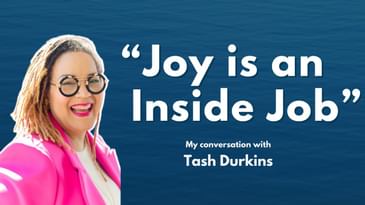
I had not thought about the relationship between authenticity and joy until I spoke with Tash Durkins. And the word authenticity keeps coming up in many conversations as an amplifier for people’s superpower.
Tash Durkins is the founder and CEO of Fiercely Joyful, and she’s authored a book of the same name. Tash is an executive coach and a former executive of the Federal Aviation Administration.
For anyone who wants to experience more joy, Tash says that for it comes down to a simple act: “joy requires a choice.”
Another word and act that keeps coming up in these conversations: a choice. Being intentional about how we want to show up and be present in the world, and how we want to respond to those things we do not control.
Tash brings a level of equanimity and wisdom to this conversation that makes me want to quiet myself, lean in, and learn as much as I can.
And while Tash says, “joy is an inside job,” Tash learned from her father that being in community is another great source for generating joy.
================
Recommended Next Videos to Watch:
- Positivity Is A Daily Habit with Stephen Minix: https://www.youtube.com/watch?v=Nnj7Aoi8YuU&list=PLbWfh34FP_dUcAaCrI31z00_fLdphi6b7&index=1&t=297s
- Four Ways to Access Joy Anytime – Fuel Your Superpower | Anna Hall https://www.youtube.com/watch?v=ej7a9sfOE94&list=PLbWfh34FP_dUcAaCrI31z00_fLdphi6b7&index=14
- From Survive to Thrive: 3 Powerful Tools to Re-Connect with Your Superpower | Dr Adam Dorsay https://www.youtube.com/watch?v=SQ6Haz3V-o0&list=PLbWfh34FP_dUcAaCrI31z00_fLdphi6b7&index=9
================
*** Subscribe here: https://www.youtube.com/@WDYKTBT?sub_confirmation=1 ***
In this episode, Tash answers the following questions:
▶️ How to find more joy?
▶️ How connection and community help to access joy?
▶️ Can one choose to be joyful?
▶️ What is the role of authenticity in joy?
My favorite quote from the episode: “Joy is an inside job.”
What makes sense to me is, while joy requires connection with something bigger than oneself, we experience more joy when we become more open we are to it.
And this is amplified by how much we allow it to reveal itself to us.
Resources mentioned in the episode:
▶️Tash's LinkedIn: https://www.linkedin.com/in/tashdurkins/
▶️Tash’s company Fiercely Joyful: https://www.fiercely-joyful.com/
▶️Tash’s book: Fiercely Joyful: https://bookshop.org/p/books/fiercely-joyful-11-keys-to-living-authentically-creating-a-life-you-love-natasha-craig-durkins/20682153?ean=9798889265252&next=t
▶️Book: “Space to Exhale” by Lisa Hurley: https://bookshop.org/p/books/space-to-exhale-strategies-for-curating-a-soft-centered-serene-life-lisa-hurley/21820215?ean=9781394290680&next=t
▶️Book: “The Four Agreements” by Don Miguel Ruiz: https://bookshop.org/p/books/the-four-agreements-a-practical-guide-to-personal-freedom-don-miguel-ruiz/15278643?ean=9781878424310&next=t
Chapters
0:00 Welcome and Intro
5:13 Authenticity and Joy
8:45 Showing Up Authentic
10:57 Fiercely Joyful
12:34 Difference between Joy and Happiness
14:10 Inspiration for Fiercely Joyful
19:14 Authenticity and Feeling Seen
24:00 Getting Comfortable with Disappointing People
28:05 WDYKTBT about Fiercely Joyful
30:39 Next for Tash
36:05 Lightning Round
Music in this episode by Ian Kastner.
"What Do You Know To Be True?" is a series of conversations where I speak with interesting people about their special talent or superhero power and the meaningful impact it has on others. The intention is to learn more about their experience with their superhero power, so that we can learn something about the special talent in each of us which allows us to connect more deeply with our purpose and achieve our potential.
For more info about the podcast or to check out more episodes, go to: https://www.youtube.com/@WDYKTBT?sub_confirmation=1
"What Do You Know To Be True?" is hosted by Roger Kastner, is a production of Three Blue Pens, and is recorded on the ancestral lands of the Duwamish and Suquamish people. To discover the ancestral lands of the indigenous people whose land you may be on, go to: https://native-land.ca/
Keywords
#Joy #Authenticity #Choice #Community #Connection
TRANSCRIPTS - The Link Between Authenticity and Joy with Tash Durkins
Roger: Have you ever thought about the role that authenticity plays in creating and experiencing joy? I had not thought about the relationship between authenticity and joy until I spoke with Tash Durkin, and now it's coming up for me all the time.
Tash: That idea of showing up more authentically. Brought me so much peace and joy that is self-generated.
And that's, that's part of my definition around fierce joy. But that joy is self-generated. It's not external. It's enter being comfortable, my own skin, open me up to experience and receive joy in ways I never had.
Roger: Tash is the founder and CEO of Fiercely Joyful, and she's authored a book of the same name.
Tash is also an executive coach and a former executive of the Federal Aviation Administration. For anyone who wants to experience more joy, Tash suggests that it comes down to a simple act. Joy requires a choice.
Tash: When I say I have this daily conversation with myself, it's around how do I want to show up in the world?
I'm reflecting on that. How do I want to show up in a world that both serves me and it just taking five minutes in the morning to think about that and kind of center myself in that way, but just doing that. Gives me the space to allow for a choice. Choice matters so much in joy and authenticity. It gives me the choice to, to decide how I show up that day.
I can show up in the way I have capacity for in that moment, which changes. Jade who can't give ourself the grace to understand that to changing
Roger: Tash brings a level of equanimity and wisdom to this conversation that makes me want to quiet myself, lean in and learn as much as I can. And while Tash says Joy is an inside job, Tash learned from her father, that being in community is another great source for generating an experience joy.
Tash: For me, once I stopped beating myself up about. The need to be in community and accepted it, I thrived. I thrived and, and the moment I'm having a struggle, it's usually because I'm sitting by myself trying to figure something out and it's just need a sounding board or I need, but the longer I sit alone trying to do a thing.
The harder it is for me. It's just how I'm built.
Roger: Hi, I am Roger Kastner and I'm the host of the What Do You Know To Be True Podcast. For over 25 years, I've been working with leaders and teams to co-create pathways to being better versions of themselves, and these conversations are intended to amplify the stories and experiences of people who have done just that.
The goal here is not to emulate or hack our way to a new talent. Instead, the intention is to learn more about. Their experience with their superpower, and in doing so, maybe we can learn something about the special talent in each of us that drives us towards our potential and living into our possibilities.
If you're ready. Let's dive in.
Hey Tash, I'm grateful for us to be here together today. Thank you for joining me.
Tash: Thank you, Roger. I'm so excited to be with you. It's an honor to be here today.
Roger: Very mutual and in fact, I'm so appreciative of our mutual friend, Mai Moore. 'cause I was talking to her a little while ago about her superpower and joy, and she's like, oh.
You need to talk with Tash about Joy. And so here we are and we've had a couple conversations and I'm so excited to get this one recorded and I know the good stuff's gonna be coming today. I know you to be the author of Fiercely Joyful 11 Keys to Living Authentically and Creating the Life you Love.
You're also a public speaker, a coach, and former executive leader with the. Federal, uh, aviation administration. So you know a lot about the role of authenticity and how it plays in the role of great leadership. I'm excited to learn more about your superpower of fiercely joyful. But before we get too far, what else is important for us to know about you?
Tash: Well, thank you for the glowing, um, intro, Roger. I feel so special. Thank you for that. I think the other thing that's important to know about me is I am truly. Obsessed with joy and authenticity is just everything to me, and not just obsessed with having it myself, because I think we all deserve to have it, but I'm obsessed with helping everyone have it.
Everyone. That's my quest every single day, whether I'm working or not, is to find ways to help people show up more authentically themselves. And to find and choose joy for themselves.
Roger: A couple words in there that I love, authenticity and choice. We'll talk about both of those. Let's, but I'm really excited to talk about authenticity.
'cause when we first talked at the end of the conversation, you dropped a truth bomb about authenticity right at the very end. And it still has had ripples in so many conversations that I've had. So, and you just mentioned the role of authenticity as an. Amplifier and expander for joy. And while it might seem obvious, the idea of being authentic has reverberated and and unfolded for me, as I said in some really powerful ways.
Since our first conversation, can you share what you know to be true about authenticity and how it amplifies joy?
Tash: Hmm, absolutely. And I love that you say that it amplifies joy. I love characterizing it that way. I have not done it. And I love it. Essentially, when I decided to get comfortable being me, my life changed completely, completely.
And one of the emphasis, uh, for it was the reading of the book, the Four Agreements by Dom Miguel Ruiz. That agreement about not taking things personally. Ooh, honey Child. Lemme just say, I took everything personally for so long, for so many years in my life, and that was the start of me working on me. Part of not taking things personally is getting comfortable with the fact that you are not a vice cup of tea, and that's okay, right?
But it's more important to show up in alignment with your core values, what you deem to be true for you. Versus please the Rogers of the world who are all amazing people, but don't have to go home and live with who I am or, or sit with how it is. I've showed up in the world, right? I have to do that. That idea of showing up more authentically brought me so much peace.
Joy that is self-generated, and that's, that's part of my definition around fierce joy. But that joy is self-generated. It's not external, it's internal. Being comfortable in my own skin opened me up to experience and receive joy in ways I never had.
Roger: I think so many of us, um, and some of us named Roger are so interested and so like driven to get other people's acceptance.
And I think what I've come, what's what's come into my awareness is I'm, I think part of my drive to get other people, to accept me, to get that sense of belonging is maybe a que you know, me actually questioning my own worth.
Tash: Hmm.
Roger: And do you know, am I, do I value myself? Do I, you know, do I feel like I belong with myself?
Am I comfortable with myself? And I don't know if the, you know, the younger Roger, maybe as of two months ago, was willing to ask those questions of myself, but I was looking for it from other people, and then came to realize, oh, no, no, no, no. The one, the the person who I need to get it from is me.
Tash: See that's, that's a beautiful realization.
What a beautiful realization for you. My friends always remind me to make sure I tell people there's some parts of us that are authentic and not so pretty. We all got 'em. It's okay. Like we know they're there. It's up to us to navigate how those parts of us show up. How do we allow for them? Create safety, but also ensure we're not driving everybody away.
You know, ensure that other people can still show up authentically, not just us. There's that space we get to have to grapple with those parts that aren't so fabulous, but are who we are. Right? And still. Contribute to the making of what it is we're supposed to do on this. For me at least, it's kind of a daily discussion with myself, the how of, of all these things.
It's a daily discussion. What I'd say about authenticity and joy. You don't just arrive and like. I, right. I'm there, you know, I'm showing up fully authentic at all times. 100% focused on joy through gratitude every day. Yeah. Like, no. When I say I have this daily conversation with myself, I, it's around how do I want to show up in the world?
I'm reflecting on that. How do I want to show up in a world that both serves me and it just taking five minutes. In the morning to think about that and kind of center myself in that way, but just doing that gives me the space to allow for a choice. Choice matters so much in joy and authenticity. It matters so much.
It gives me the choice to, to decide how I show up that day, and I don't have to show up the same every day. There's no pressure for that. I can show up in the way I have capacity for. In that moment, which changes change can give ourself the grace to understand that it change it.
Roger: Your superpower and book are called Fiercely Joyful.
What does fiercely joyful mean to you?
Tash: To me, a fiercely is really all about bold truth. It is unapologetically truth. Um, truthfulness in how one shows up and the joy, um, is self-generated. It is not coming from an external thing that I have or did or place I went, but it comes from the inside. I get to create that every single day.
And in the surplus form, fiercely joyful is. Bold truth and sustain joy. And when you are creating it, can't nobody take it? Can't nobody take it away from you. It's yours. And that's why it can be sustained, right? Because you're creating it. You're not waiting on your partner to do something to make you happy and feel joy.
You know, you're not waiting for your kids to achieve a thing, you're not waiting for a certain promotion to. It's coming from the inside. Self-generated like that was, I worked really hard on what is the definition of this whole thing, and that was the part for me that was so critical. Bold truth, sustained joy.
That's fiercely joyful.
Roger: Yeah, I've noticed that. Um, psychologist. Thought leaders, um, a whole host of people kind of use joy and happiness interchangeably. Like we know, we feel the difference between when something makes us happy and when something is joyful. And you're right, it does kind of emanate from us versus received by us.
Tash: For me, happiness and joy are not interchangeable at all. Happiness generally, the, the, the basic difference for me is that happiness is bleeding. It's a wonderful emotion, but it is fleeting and often for me, not self-generated. I get kept this beautiful message on LinkedIn this morning from someone who said they love learning from me, and when I show up in a way that allows for me to impact someone for the good or impact a group or community or a thing for the good.
That derives joy from me and I hold onto it for dear life, like that's sustained. I can go back to it at any moment. Pull back, pull it back up to the surface, sit and revel and do a shoulder dance and wanna think like that was bad. You know, wear the happy things. They're kind of gone when they're gone.
There are still amazing things, but they're gone when and gone. So it's, it's just a decision I made for me that they are distinct and I approach it that way in my practice.
Roger: So, Tash, what or who inspired you to have the superpower of fiercely joyful?
Tash: It comes from my mom, Roger. Um, my mom passed away when I was young and she was young.
I was just turned 20, not quite 20. Hmm, and she was 49 and it was, it was the latter portion of her life. She had cancer lymphoma, and I became her caretaker and she insisted on speaking openly about her terminal illness and impending death. I'm like, why do we have about this then? One of the things that.
She wondered out loud was who's gonna come to her funeral? We sat there guessing and wondering, Hey, who might come? It was just this interesting conversation and then in the back of my mind I said, why can't we show her now? And I decided to have an appreciation ceremony for her. And so we had this appreciation ceremony from my mom at the church and you know.
This is pre a lot of stuff. So folks were sending videotapes, Roger, who couldn't come. You know, this is, there was no zooming, you know, but the church was fault. People were standing around the church and outside and she couldn't believe it. She couldn't believe it. And, and when I heard people's messages about her.
When I saw people show up for her and that way, and in many other instances, I was like, I, I just wanna be a piece of that. If I can make people feel a little bit of that, such that they would show up for me in some way, shape, or form, then I know I'm doing the right thing. And that's, that's, that's who I wanna be.
I wanna give people that. It was that mostly as well as my dad. He passed away roughly a decade later. Um, he was kind of obsessed with being in community with people, and it brought him so much joy to bring people in and to share whatever it was he had with the world, whether he knew you or not. Now, let me just tell you, as a kid it was very annoying.
You couldn't go to dinner and just have a private dinner ever. It was like, who's at the table next that you didn't know? Hey, have you guys tried this Las you want some of ours? It's delicious. Like, like that's how the experience was. And next thing you know, our two tables of four was a table of eight pushed together.
But there was something about community that he loved and embraced, and, and I did too. I got that same thing from him and. That joy that you could create for people by connecting them. Like, I just love it. So people, all my friends call me Connector and I know it comes from dad. Um, so between how my mother made people feel, that then made people show up for her in amazing ways.
Like she even did. We had, we were struggling financially. They literally came to the door with, with. Tens of thousands of dollars in checks for my mom to pay for medical bills, her coworkers, and then my dad with the sense of community and literally we could go anywhere in the world. We were from Scranton, Pennsylvania.
We went to on a vacation to Hawaii one time, and he ran into folk. He knew. Because it was so big. We're walking down the street, somebody's calling Angelo, hey. It was like, seriously, we're, who are you? But that community, but how people felt so good spending time in community and being connected like those, those two.
Experiences of a lifetime with my parents made me want to do more of that and figure out what does joy look like for me? How can I bring it to this world?
Roger: I love that your mom brought that sense of making people feel joy, and in doing so, it gave her joy as well as your father's need to connect and create community gave, I'm sure it gave him a great sense of connection and community as well.
Those are things we can do, whether we're starting off at the beginning of our journey or towards the middle or end of our journey. Yeah. Making sure everyone, uh, every people, other people feel good about the experience that you're having with them, as well as making sure they feel like they're part of, they're connected and part of the community with you.
That's, that's powerful.
Tash: And, and you know, I'll, I'll pull the thread just a tiny bit too, 'cause I love how you, you wrap that Roger, people would say with my mom, they felt seen in a way they never felt seen before. And she was that person who ever hear those, those people who always get the perfect gift for somebody.
Doesn't matter how well they know 'em or don't, but they know exactly what was needed. It's 'cause mom would listen so well. She would listen and pay attention to what people shared about themselves. And so people felt seen and valued. And that for me is the other reason why I've been on this quest around authenticity.
Because when you are given space to show up as yourself, you do feel seen. I had some amazing, um, colleagues and bosses at work who created that space for me, and I felt it and still do our responsibility to continue doing the same for others. You know, it's just, it's, it's, for me, it feels like a blessing.
I'm grateful that I get to do that. How cool that I get to do that in a simple, I'll tell you a very quick story about people being me able to feel seen. One of the things for me and write about this in my book as a black woman, I was on my natural hair journey, and that is like just a whole other episode.
But just being able, that is very much around authenticity because being comfortable showing up with my hair the way it grows out of my head. And not feeling like I have to blow dry it straight to look acceptable to society. That's not how my hair grows. But I was doing it for years and years, or straightening chemicals, all these things, and I finally decided I didn't wanna do it anymore, and one of my bosses had natural hair, so I felt like, okay, maybe I can do this.
I finally made the transition, but that day I was walking to work. I was like, am I gonna get fired? Am I gonna be stared at? I don't know, like that's how bad and how anxious, uh, the experience was. And nothing happened. Like nothing went wrong. It was fine. Now, not everybody has that experience. Others had different experiences.
Just to be clear. My experience was, it was fine. It was about me getting comfortable in my own skin and I joke around that I was single at the time and there were some guys who never paid me any attention on my walk to work, who paid me a lot of attention that day. Clearly, they liked the natural hair own girl, the natural hair girl, but that being able to show up more authentically me.
The difference in the world. All the difference.
Roger: Yeah. That feels, that feels like a superpower in and of itself. And not only because it, it feels like it gave you a sense of not only authenticity, but also strength in that authenticity city. You were inspired by someone else. Who was being their authentic self and other people noticed you being your authentic self.
And it probably had, you know, the ripple effect there. And I'll often say that superheroes only get capes when they're in service of other people. So that living, living into our authenticity feels like a superpower as well. And we're allowed to have multiple superpowers.
Tash: Yes. Right. Absolutely. Thank goodness.
And get to, you know, but one thing I would point out, I learned this at a conference years ago, such a simple way. There are some superpowers we have that we actually don't enjoy, employee, that we get to say no. Yeah. Because, you know, folk wanna make you do some things that, that you're really good at. And they're like, okay, Roger, I need, you're so good at.
I'm good at it, but I don't care for it. Thank you. And you can say no.
Roger: Yeah. That speaks to, again, being authentic and knowing ourselves, knowing what gives us strength, what gives, what we're passionate about, what we want to do. Mm-hmm. And it feels so good when we get asked to do that thing we're good at, but if it doesn't fill our tank, we're just getting more and more depleted when we do that thing that.
Tash: The process of becoming more authentic includes getting comfortable disappointing people because you're gonna disappoint some people when you're focused on staying in alignment with who you truly are. And I feel like my mom would've never done this. Mm, she was sometimes, but I, um, I had a relationship with a friend who felt incredibly draining.
It wasn't toxic, but it was incredibly draining and it felt like work all the time, and I felt like I wasn't being myself when I spent time with this woman and I finally made a decision I needed to end that friendship. And I, you know, went back to that, the, the saying about people in your life for a reason, a season or a lifetime.
I'm like, I think our season has ended as what I come to grips with. So I rehearsed it, you know, the conversation I needed to have and I had it, um, with my friend and course she was up not pleased and I hated to have to have that conversation. But can I tell you the piece? I felt after like my shoulders were not so heavy and I felt like I was being disrespectful to myself and her pretending I wanted to hang.
And spend time and, you know, row together and do all this together stuff that I did not want to do. It was essentially a lie. And so I was willing to accept the, the response that I knew wasn't going to be a good one. Um, it wouldn't be for any of us. We're all human. Right? Versus continue to perpetuate in this nonsense.
That was really disrespectful. It was a lie. Well, years later. Uh, when I was writing my book, I was interviewing the same best friend that I had. I maintained the relationship with, obviously, and she said, you know, back then it felt harsh to me. He said, I realize now it felt harsh because I was uncomfortable with it and I didn't have the words I would've never done, and I would've tolerated the relationship.
She said, what I know now is you were ahead of us, you were committed to who you were back then. We weren't there yet. Now, that gave me some joy. That gave me some joy because that means she saw me showing up in alignment with who I was even decades ago and doing so unapologetically. It was just we have to prepare ourselves for the fallout of showing up authentically because there is a cost.
You do a calculus around the, uh, cost benefit, so to speak, uh, inside your soap and figure out what is the best approach to take. But for me it was, it was as, as difficult as it was and how, I guess I'm pretty sure my mom would never done that. She was way too calm, more kind. But for me, kindness was also not just making people happy.
But standing in my truth in a way that honors me and that the word that's coming up for me is love.
Roger: Mm-hmm. And it's not only love for yourself, but it's also love for this other person. And that you weren't be, you weren't able to be your authentic self with this other person, and you were allowing them to perpetuate that negativity.
Um. And you weren't willing to put up with it anymore. So it was not outta malice, but out of love that you were able to stand up for what you needed and likely what the other person needed as well. But that was their choice, whether they accepted that or not.
Tash: Right. Right. And And thank you for saying that.
I appreciate that.
Roger: So, Tash, what do you know to be true about your superpower of fiercely joyful?
Tash: You can choose it. As long as you're willing and the willing is around holding ourselves accountable to make the choice. It's sometimes inconvenient. It's sometimes incredibly difficult, but it is a choice.
And when I hear myself and others say, I didn't have a choice, yes, we did. We made. We made, we made a choice. Absolutely made a choice. And we may have felt like there was only one choice we could make. Agree, but it was a choice nonetheless. And so is fierce joy, bold truth. You get to choose to live and stand in your truth, and you get to choose sustained joy.
Self, self-generated, sustained joy. You get to choose those things. That's what I know to be true.
Roger: And what did you believe early on about your superpower of fiercely joyful that you've come to learn is not true?
Tash: You know, it was that arrival thing. I was certain I was gonna arrive at this space of authenticity that would give me sustained joy.
All the time, and that was it. And I wasn't giving acknowledgement to the truth that we evolve constantly. And so there are moments to even today, as much as an authenticity advocate and joy advocate that I'm, that I will sit and wonder about a choice. How I'm gonna show up that is not in keeping with my true self because I'm worried about the consequences.
Because you know, I'm worried about who's gonna think something is much, much, much, much less than it ever was years ago. But it doesn't disappear, and that's why it's so important to have that connection with self so you can sit, reflect, and figure out when that's happening and have that. Board of directors or kitchen cabinet to check you on it.
Roger: So what's next for you and your superpower of fiercely joyful?
Tash: I think it's actually going to revolve around community. I fought myself really around how important community is to me. For a long time, I felt guilty because. Society says you should be able to achieve things on your own. You shouldn't need so much support.
You should be able to just get it done. And I had been talking about writing Fiercely Joyful for 10 years, and I had about 325 words on it in those 10 years. It wasn't until I found a group writing program in which the motto. Was never right along. So I got to go right in community. And it's not like all we were doing was getting on Zoom and looking at each other and typing right, or holding one another accountable, sending a text message, whatever that was, manuscript to process my publisher.
They got to them for, for creating that community. But it wasn't until I was in my happy place of being a community. I got my book written and published in eight months. Mm-hmm. After 10 years of nothing. So I am going to focus my practice on more things around community that serve the greater good, particularly for people like me who realize they thrive in community and they want communities support to get things done.
Roger: Hmm. I love that. The, the power of community. The power of team. The power of family. I've heard the critique of the Maslow's hierarchy of needs of everything we need to be able to achieve that level of potential or self-actualization. And the big critique of it that I've heard is that it doesn't talk about the contribution of.
The community, the team, the family, and yet we all, I think, intuitively know like no one achieves greatness or their potential by themselves. Like there is a team behind everyone on that world stage or any other stage. And therefore, why, why do we have a society that is so focused on individuality when we know that those individuals don't achieve it themselves?
Tash: Mm-hmm.
Roger: I had a friend recently who talked about, um, how she, she feels so busy and she can't get everything done that she wants to get done. And then she says, well, I mean, Beyonce only has 24 hours in a day as well. Like Beyonce's got a very big team.
Tash: That's right. She not cooking, she not shopping, she not cleaning this.
Let's just go with the basic,
Roger: it's a probably a very long list that, that queen bee doesn't have to do herself, but like, what, what do we not have to do ourselves is what I'm, I'm taking from your response there and, and it makes me think about even this podcast, the series of conversations that I'm having with people as a means to learn more about, you know, this, this, I mean, I, you've probably heard the term.
Me search, like all research is me search. I'm very interested in this idea of achieving our, you know, possible self. And I'm interested in the pillars of the building blocks. Um, but it, it. The early formation of those pillars did not include the sense of team or community. And then I heard the critique of the Maslow's Hierarchy of Needs.
I'm like, okay, that came to me for a reason because I'm not thinking about it in these building blocks as well. Mm-hmm. And I think about everything I've learned in the year and a half I've been having these conversations, how much I've learned, and. None of it was self-generated, right? It's all from all these conversations and these wonderful people like yourself who are sharing and, uh, there's a lot of common themes, and it's so powerful to hear these same themes and concepts come up again and again to really cement what I know to be true about what it takes to live into our full possible self.
Tash: For me, once I stopped beating myself up about. The need to be in community and accepted it. I thrived. I thrived and, and the moment I'm having a struggle, it's usually because I'm sitting by myself trying to figure something out and it's just need a sounding board or I need, but the longer I sit alone trying to do a thing, the harder it's for miss just how I'm built.
I've been able to cultivate community in which I can show up authentically and my community brings me joy, always bringing joy.
Roger: Now it just came to my awareness. Is Angelo and all his friends looking upon you saying, that's my girl? Yeah.
Tash: Thank you. Yes.
Roger: Yeah, that's lovely. So, Tash, are you ready for the lightning round?
Tash: Let's do it.
Roger: Let's do it. Okay. Fill in the blank. Fiercely joyful is bold truth and sustain joy. Who in your life provides fiercely joyful for you?
Tash: I have a long list, but I'll say my husband and my community.
Roger: Is there a practice or routine that helps you grow, nurture, or renew your ability to be fiercely joyful?
Tash: Yes, reflection.
Roger: Is there a book or movie you recently read or watched that you would recommend that has fiercely joyful as a theme? A
Tash: book is called, uh, and I'm still reading it, but it makes me so happy, uh, space to Exhale. And it's a book about essentially rest, and it is, um, a, a book that is targeted to women.
And women of color around just taking a beat and exhaling him, resting, and that brings me a ton of joy right now. Makes me feel really comfortable sitting in my space of not rushing through life and actually just taking my time.
Roger: Seems like that book probably came to you at just the right time. Mm-hmm.
As you mentioned, the transition that you're going through, you just wrote the book, you're starting your business, you got a lot of things going on, and wow, this, this little book just sort of floated into your life to say, uh, you know, rest and as you said, flexion, very important. What is one thing that gets in your way of being fiercely joyful?
Tash: Wanting to do it all yesterday.
I just, you know, that gets in my way all the time. I constantly have to put my, uh, put some perspective in place.
Roger: So what word or phrase describes what fiercely joyful, fierce feels like when it's had an impact on others? Peace. Mm. Feels like peace without question. If an audience member wanted to follow up with you and ask you a question or follow you on social, where do you wanna point them to?
Tash: Find me on LinkedIn. That's the best place to find me. Tash Durkin, where you could go to the website, fiercely-joyful.com. And I'm posting stuff every day on LinkedIn. Uh, my. My proprietary framework is called the Freedom Framework because I do believe that authenticity gets you to freedom and that's why you get the joy and the, the freedom framework that I use in my practice is around being rooted in your truth, rising in your voice, in reigning, in who you are.
Those three things, and so I'll talk about that quite a bit. It seems to be resonating with people. Let that interest you. Follow me on LinkedIn,
Roger: Tash. This has been a very, okay, it's gonna sound cliche. It's been a very joyful conversation for me. Um, but I, what I love about every time we talk you are imparting.
Your truth, but also wisdom on me that I am so grateful for. As I mentioned before, authenticity was that word that resonated with me in our first conversation. And this one community is really standing out and the power and how, um, your own experience of leaning on your community, of when you have questions going to them, when you have needs.
And then making sure everyone feels a part of your community. Um, yeah, that, that has a profound impact on me and I really appreciate that and I appreciate you. Thank you for taking the time to have this conversation with me and I so look forward to our next conversation.
Tash: Thank you. Thank you. Thank you.
You're incredibly kind, Raja. I'm very grateful and I have learned so much from you. Like you would definitely be. Just so you know, in the community so far, I made it call. I'd be like, lemme bounce this off of you. And I, I appreciate that you sharing. All this goodness with the world and that you would see fit to, uh, include me in it.
Thank you.
Roger: It's an honor to be part of your community and in, in this conversation with you. Thank you. Take care. Bye-bye.
Tash: Take care. Bye-bye.
Roger: Thank you all for being in this conversation with us, and thank you, Tash, for sharing what you know to be true about being fiercely joyful. And the role that authenticity, choice, and community have in creating and experiencing more joy. The question I'm asking myself now after this conversation is, where can I be more authentic in the moment so I can experience more joy and equanimity throughout my day?
What do you know to be true is a Three Blue Pens production. And I'm your host Roger Kassner. We are recording on the ancestral lands of the Duwamish and Suquamish people to discover the ancestral lands of the indigenous people whose land you may be on. You can go to native hyphen. Ca Okay. Be well my friends, and as always, love you mean it.Tash: That idea of showing up more authentically. Brought me so much peace and joy that is self-generated.
And that's, that's part of my definition around fierce joy. But that joy is self-generated. It's not external. It's enter being comfortable, my own skin, open me up to experience and receive joy in ways I never had.
Roger: Tash is the founder and CEO of Fiercely Joyful, and she's authored a book of the same name.
Tash is also an executive coach and a former executive of the Federal Aviation Administration. For anyone who wants to experience more joy, Tash suggests that it comes down to a simple act. Joy requires a choice.
Tash: When I say I have this daily conversation with myself, it's around how do I want to show up in the world?
I'm reflecting on that. How do I want to show up in a world that both serves me and it just taking five minutes in the morning to think about that and kind of center myself in that way, but just doing that. Gives me the space to allow for a choice. Choice matters so much in joy and authenticity. It gives me the choice to, to decide how I show up that day.
I can show up in the way I have capacity for in that moment, which changes. Jade who can't give ourself the grace to understand that to changing
Roger: Tash brings a level of equanimity and wisdom to this conversation that makes me want to quiet myself, lean in and learn as much as I can. And while Tash says Joy is an inside job, Tash learned from her father, that being in community is another great source for generating an experience joy.
Tash: For me, once I stopped beating myself up about. The need to be in community and accepted it, I thrived. I thrived and, and the moment I'm having a struggle, it's usually because I'm sitting by myself trying to figure something out and it's just need a sounding board or I need, but the longer I sit alone trying to do a thing.
The harder it is for me. It's just how I'm built.
Roger: Hi, I am Roger Kassner and I'm the host of the What Do You Know To Be True Podcast. For over 25 years, I've been working with leaders and teams to co-create pathways to being better versions of themselves, and these conversations are intended to amplify the stories and experiences of people who have done just that.
The goal here is not to emulate or hack our way to a new talent. Instead, the intention is to learn more about. Their experience with their superpower, and in doing so, maybe we can learn something about the special talent in each of us that drives us towards our potential and living into our possibilities.
If you're ready. Let's dive in.
Hey Tash, I'm grateful for us to be here together today. Thank you for joining me.
Tash: Thank you, Roger. I'm so excited to be with you. It's an honor to be here today.
Roger: Very mutual and in fact, I'm so appreciative of our mutual friend, Mai Moore. 'cause I was talking to her a little while ago about her superpower and joy, and she's like, oh.
You need to talk with Tash about Joy. And so here we are and we've had a couple conversations and I'm so excited to get this one recorded and I know the good stuff's gonna be coming today. I know you to be the author of Fiercely Joyful 11 Keys to Living Authentically and Creating the Life you Love.
You're also a public speaker, a coach, and former executive leader with the. Federal, uh, aviation administration. So you know a lot about the role of authenticity and how it plays in the role of great leadership. I'm excited to learn more about your superpower of fiercely joyful. But before we get too far, what else is important for us to know about you?
Tash: Well, thank you for the glowing, um, intro, Roger. I feel so special. Thank you for that. I think the other thing that's important to know about me is I am truly. Obsessed with joy and authenticity is just everything to me, and not just obsessed with having it myself, because I think we all deserve to have it, but I'm obsessed with helping everyone have it.
Everyone. That's my quest every single day, whether I'm working or not, is to find ways to help people show up more authentically themselves. And to find and choose joy for themselves.
Roger: A couple words in there that I love, authenticity and choice. We'll talk about both of those. Let's, but I'm really excited to talk about authenticity.
'cause when we first talked at the end of the conversation, you dropped a truth bomb about authenticity right at the very end. And it still has had ripples in so many conversations that I've had. So, and you just mentioned the role of authenticity as an. Amplifier and expander for joy. And while it might seem obvious, the idea of being authentic has reverberated and and unfolded for me, as I said in some really powerful ways.
Since our first conversation, can you share what you know to be true about authenticity and how it amplifies joy?
Tash: Hmm, absolutely. And I love that you say that it amplifies joy. I love characterizing it that way. I have not done it. And I love it. Essentially, when I decided to get comfortable being me, my life changed completely, completely.
And one of the emphasis, uh, for it was the reading of the book, the Four Agreements by Dom Miguel Ruiz. That agreement about not taking things personally. Ooh, honey Child. Lemme just say, I took everything personally for so long, for so many years in my life, and that was the start of me working on me. Part of not taking things personally is getting comfortable with the fact that you are not a vice cup of tea, and that's okay, right?
But it's more important to show up in alignment with your core values, what you deem to be true for you. Versus please the Rogers of the world who are all amazing people, but don't have to go home and live with who I am or, or sit with how it is. I've showed up in the world, right? I have to do that. That idea of showing up more authentically brought me so much peace.
Joy that is self-generated, and that's, that's part of my definition around fierce joy. But that joy is self-generated. It's not external, it's internal. Being comfortable in my own skin opened me up to experience and receive joy in ways I never had.
Roger: I think so many of us, um, and some of us named Roger are so interested and so like driven to get other people's acceptance.
And I think what I've come, what's what's come into my awareness is I'm, I think part of my drive to get other people, to accept me, to get that sense of belonging is maybe a que you know, me actually questioning my own worth.
Tash: Hmm.
Roger: And do you know, am I, do I value myself? Do I, you know, do I feel like I belong with myself?
Am I comfortable with myself? And I don't know if the, you know, the younger Roger, maybe as of two months ago, was willing to ask those questions of myself, but I was looking for it from other people, and then came to realize, oh, no, no, no, no. The one, the the person who I need to get it from is me.
Tash: See that's, that's a beautiful realization.
What a beautiful realization for you. My friends always remind me to make sure I tell people there's some parts of us that are authentic and not so pretty. We all got 'em. It's okay. Like we know they're there. It's up to us to navigate how those parts of us show up. How do we allow for them? Create safety, but also ensure we're not driving everybody away.
You know, ensure that other people can still show up authentically, not just us. There's that space we get to have to grapple with those parts that aren't so fabulous, but are who we are. Right? And still. Contribute to the making of what it is we're supposed to do on this. For me at least, it's kind of a daily discussion with myself, the how of, of all these things.
It's a daily discussion. What I'd say about authenticity and joy. You don't just arrive and like. I, right. I'm there, you know, I'm showing up fully authentic at all times. 100% focused on joy through gratitude every day. Yeah. Like, no. When I say I have this daily conversation with myself, I, it's around how do I want to show up in the world?
I'm reflecting on that. How do I want to show up in a world that both serves me and it just taking five minutes. In the morning to think about that and kind of center myself in that way, but just doing that gives me the space to allow for a choice. Choice matters so much in joy and authenticity. It matters so much.
It gives me the choice to, to decide how I show up that day, and I don't have to show up the same every day. There's no pressure for that. I can show up in the way I have capacity for. In that moment, which changes change can give ourself the grace to understand that it change it.
Roger: Your superpower and book are called Fiercely Joyful.
What does fiercely joyful mean to you?
Tash: To me, a fiercely is really all about bold truth. It is unapologetically truth. Um, truthfulness in how one shows up and the joy, um, is self-generated. Ken, it is not coming from an external thing that I have or did or place I went, but it comes from the inside. I get to create that every single day.
And in the surplus form, fiercely joyful is. Bold truth and sustain joy. And when you are creating it, can't nobody take it? Can't nobody take it away from you. It's yours. And that's why it can be sustained, right? Because you're creating it. You're not waiting on your partner to do something to make you happy and feel joy.
You know, you're not. Waiting for your kids to achieve a thing, you're not waiting for a certain promotion to. It's coming from the inside. Self-generated like that was, I worked really hard on what is the definition of this whole thing, and that was the part for me that was so critical. Bold truth, sustained joy.
That's fiercely joyful.
Roger: Yeah, I've noticed that. Um, psychologist. Thought leaders, um, a whole host of people kind of use joy and happiness interchangeably. Like we know, we feel the difference between when something makes us happy and when something is joyful. And you're right, it does kind of emanate from us versus received by us.
Tash: For me, happiness and joy are not interchangeable at all. Happiness generally, the, the, the basic difference for me is that happiness is bleeding. It's a wonderful emotion, but it is fleeting and often for me, not self-generated. I get kept this beautiful message on LinkedIn this morning from someone who said they love learning from me, and when I show up in a way that allows for me to impact someone for the good or impact a group or community or a thing for the good.
That derives joy from me and I hold onto it for dear life, like that's sustained. I can go back to it at any moment. Pull back, pull it back up to the surface, sit and revel and do a shoulder dance and wanna think like that was bad. You know, wear the happy things. They're kind of gone when they're gone.
There are still amazing things, but they're gone when and gone. So it's, it's just a decision I made for me that they are distinct and I approach it that way in my practice.
Roger: So, Tash, what or who inspired you to have the superpower of fiercely joyful?
Tash: It comes from my mom, Roger. Um, my mom passed away when I was young and she was young.
I was just turned 20, not quite 20. Hmm, and she was 49 and it was, it was the latter portion of her life. She had cancer lymphoma, and I became her caretaker and she insisted on speaking openly about her terminal illness and impending death. I'm like, why do we have about this then? One of the things that.
She wondered out loud was who's gonna come to her funeral? We sat there guessing and wondering, Hey, who might come? It was just this interesting conversation and then in the back of my mind I said, why can't we show her now? And I decided to have an appreciation ceremony for her. And so we had this appreciation ceremony from my mom at the church and you know.
This is pre a lot of stuff. So folks were sending videotapes, Roger, who couldn't come. You know, this is, there was no zooming, you know, but the church was fault. People were standing around the church and outside and she couldn't believe it. She couldn't believe it. And, and when I heard people's messages about her.
When I saw people show up for her and that way, and in many other instances, I was like, I, I just wanna be a piece of that. If I can make people feel a little bit of that, such that they would show up for me in some way, shape, or form, then I know I'm doing the right thing. And that's, that's, that's who I wanna be.
I wanna give people that. It was that mostly as well as my dad. He passed away roughly a decade later. Um, he was kind of obsessed with being in community with people, and it brought him so much joy to bring people in and to share whatever it was he had with the world, whether he knew you or not. Now, let me just tell you, as a kid it was very annoying.
You couldn't go to dinner and just have a private dinner ever. It was like, who's at the table next that you didn't know? Hey, have you guys tried this Las you want some of ours? It's delicious. Like, like that's how the experience was. And next thing you know, our two tables of four was a table of eight pushed together.
But there was something about community that he loved and embraced, and, and I did too. I got that same thing from him and. That joy that you could create for people by connecting them. Like, I just love it. So people, all my friends call me Connector and I know it comes from dad. Um, so between how my mother made people feel, that then made people show up for her in amazing ways.
Like she even did. We had, we were struggling financially. They literally came to the door with, with. Tens of thousands of dollars in checks for my mom to pay for medical bills, her coworkers, and then my dad with the sense of community and literally we could go anywhere in the world. We were from Scranton, Pennsylvania.
We went to on a vacation to Hawaii one time, and he ran into folk. He knew. Because it was so big. We're walking down the street, somebody's calling Angelo, hey. It was like, seriously, we're, who are you? But that community, but how people felt so good spending time in community and being connected like those, those two.
Experiences of a lifetime with my parents made me want to do more of that and figure out what does joy look like for me? How can I bring it to this world?
Roger: I love that your mom brought that sense of making people feel joy, and in doing so, it gave her joy as well as your father's need to connect and create community gave, I'm sure it gave him a great sense of connection and community as well.
Those are things we can do, whether we're starting off at the beginning of our journey or towards the middle or end of our journey. Yeah. Making sure everyone, uh, every people, other people feel good about the experience that you're having with them, as well as making sure they feel like they're part of, they're connected and part of the community with you.
That's, that's powerful.
Tash: And, and you know, I'll, I'll pull the thread just a tiny bit too, 'cause I love how you, you wrap that Roger, people would say with my mom, they felt seen in a way they never felt seen before. And she was that person who ever hear those, those people who always get the perfect gift for somebody.
Doesn't matter how well they know 'em or don't, but they know exactly what was needed. It's 'cause mom would listen so well. She would listen and pay attention to what people shared about themselves. And so people felt seen and valued. And that for me is the other reason why I've been on this quest around authenticity.
Because when you are given space to show up as yourself, you do feel seen. I had some amazing, um, colleagues and bosses at work who created that space for me, and I felt it and still do our responsibility to continue doing the same for others. You know, it's just, it's, it's, for me, it feels like a blessing.
I'm grateful that I get to do that. How cool that I get to do that in a simple, I'll tell you a very quick story about people being me able to feel seen. One of the things for me and write about this in my book as a black woman, I was on my natural hair journey, and that is like just a whole other episode.
But just being able, that is very much around authenticity because being comfortable showing up with my hair the way it grows out of my head. And not feeling like I have to blow dry it straight to look acceptable to society. That's not how my hair grows. But I was doing it for years and years, or straightening chemicals, all these things, and I finally decided I didn't wanna do it anymore, and one of my bosses had natural hair, so I felt like, okay, maybe I can do this.
I finally made the transition, but that day I was walking to work. I was like, am I gonna get fired? Am I gonna be stared at? I don't know, like that's how bad and how anxious, uh, the experience was. And nothing happened. Like nothing went wrong. It was fine. Now, not everybody has that experience. Others had different experiences.
Just to be clear. My experience was, it was fine. It was about me getting comfortable in my own skin and I joke around that I was single at the time and there were some guys who never paid me any attention on my walk to work, who paid me a lot of attention that day. Clearly, they liked the natural hair own girl, the natural hair girl, but that being able to show up more authentically me.
The difference in the world. All the difference.
Roger: Yeah. That feels, that feels like a superpower in and of itself. And not only because it, it feels like it gave you a sense of not only authenticity, but also strength in that authenticity city. You were inspired by someone else. Who was being their authentic self and other people noticed you being your authentic self.
And it probably had, you know, the ripple effect there. And I'll often say that superheroes only get capes when they're in service of other people. So that living, living into our authenticity feels like a superpower as well. And we're allowed to have multiple superpowers.
Tash: Yes. Right. Absolutely. Thank goodness.
And get to, you know, but one thing I would point out, I learned this at a conference years ago, such a simple way. There are some superpowers we have that we actually don't enjoy, employee, that we get to say no. Yeah. Because, you know, folk wanna make you do some things that, that you're really good at. And they're like, okay, Roger, I need, you're so good at.
I'm good at it, but I don't care for it. Thank you. And you can say
Roger: no. Yeah. That speaks to, again, being authentic and knowing ourselves, knowing what gives us strength, what gives, what we're passionate about, what we want to do. Mm-hmm. And it feels so good when we get asked to do that thing we're good at, but if it doesn't fill our tank, we're just getting more and more depleted when we do that thing
Tash: that.
Process of becoming more authentic includes getting comfortable, disappointing people because you're gonna disappoint some people when you're focused on staying in alignment with who you truly are. And I feel like my mom would've never done this. Mm, she was sometimes, but I, um, I had a relationship with a friend who felt incredibly draining.
It wasn't toxic, but it was incredibly draining and it felt like work all the time, and I felt like I wasn't being myself when I spent time with this woman and I finally made a decision I needed to end that friendship. And I, you know, went back to that, the, the saying about people in your life for a reason, a season or a lifetime.
I'm like, I think our season has ended as what I come to grips with. So I rehearsed it, you know, the conversation I needed to have and I had it, um, with my friend and course she was up not pleased and I hated to have to have that conversation. But can I tell you the piece? I felt after like my shoulders were not so heavy and I felt like I was being disrespectful to myself and her pretending I wanted to hang.
And spend time and, you know, row together and do all this together stuff that I did not want to do. It was essentially a lie. And so I was willing to accept the, the response that I knew wasn't going to be a good one. Um, it wouldn't be for any of us. We're all human. Right? Versus continue to perpetuate in this nonsense.
That was really disrespectful. It was a lie. Well, years later. Uh, when I was writing my book, I was interviewing the same best friend that I had. I maintained the relationship with, obviously, and she said, you know, back then it felt harsh to me. He said, I realize now it felt harsh because I was uncomfortable with it and I didn't have the words I would've never done, and I would've tolerated the relationship.
She said, what I know now is you were ahead of us, you were committed to who you were back then. We weren't there yet. Now, that gave me some joy. That gave me some joy because that means she saw me showing up in alignment with who I was even decades ago and doing so unapologetically. It was just we have to prepare ourselves for the fallout of showing up authentically because there is a cost.
You do a calculus around the, uh, cost benefit, so to speak, uh, inside your soap and figure out what is the best approach to take. But for me it was, it was as, as difficult as it was and how, I guess I'm pretty sure my mom would never done that. She was way too calm, more kind. But for me, kindness was also not just making people happy.
But standing in my truth in a way that honors me and that
Roger: the word that's coming up for me is love. Mm-hmm. And it's not only love for yourself, but it's also love for this other person. And that you weren't be, you weren't able to be your authentic self with this other person, and you were allowing them to perpetuate that negativity.
Um. And you weren't willing to put up with it anymore. So it was not outta malice, but out of love that you were able to stand up for what you needed and likely what the other person needed as well. But that was their choice, whether they accepted that or not.
Tash: Right. Right. And And thank you for saying that.
I appreciate that.
Roger: So, Tash, what do you know to be true about your superpower of fiercely joyful?
Tash: You can't choose it. As long as you're willing and the willing is around holding ourselves accountable to make the choice. It's sometimes inconvenient. It's sometimes incredibly difficult, but it is a choice.
And when I hear myself and others say, I didn't have a choice, yes, we did. We made. We made, we made a choice. Absolutely made a choice. And we may have felt like there was only one choice we could make. Agree, but it was a choice nonetheless. And so is fierce joy, bold truth. You get to choose to live and stand in your truth, and you get to choose sustained joy.
Self, self-generated, sustained joy. You get to choose those things. That's what I know to be true.
Roger: And what did you believe early on about your superpower of fiercely joyful that you've come to learn is not true?
Tash: You know, it was that arrival thing. I was certain I was gonna arrive at this space of authenticity that would give me sustained joy.
All the time, and that was it. And I wasn't giving acknowledgement to the truth that we evolve constantly. And so there are moments to even today, as much as an authenticity advocate and joy advocate that I'm, that I will sit and wonder about a choice. How I'm gonna show up that is not in keeping with my true self because I'm worried about the consequences.
Because you know, I'm worried about who's gonna think something is much, much, much, much less than it ever was years ago. But it doesn't disappear, and that's why it's so important to have that connection with self so you can sit, reflect, and figure out when that's happening and have that. Board of directors or kitchen cabinet to check you on it.
Roger: So what's next for you and your superpower of fiercely joyful?
Tash: I think it's actually going to revolve around community. I fought myself really around how important community is to me. For a long time, I felt guilty because. Society says you should be able to achieve things on your own. You shouldn't need so much support.
You should be able to just get it done. And I had been talking about writing Fiercely Joyful for 10 years, and I had about 325 words on it in those 10 years. It wasn't until I found a group writing program in which the motto. Was never right along. So I got to go right in community. And it's not like all we were doing was getting on Zoom and looking at each other and typing right, or holding one another accountable, sending a text message, whatever that was, manuscript to process my publisher.
They got to them for, for creating that community. But it wasn't until I was in my happy place of being a community. I got my book written and published in eight months. Mm-hmm. After 10 years of nothing. So I am going to focus my practice on more things around community that serve the greater good, particularly for people like me who realize they thrive in community and they want communities support to get things done.
Roger: Hmm. I love that. The, the power of community. The power of team. The power of family. I've heard the critique of the Maslow's hierarchy of needs of everything we need to be able to achieve that level of potential or self-actualization. And the big critique of it that I've heard is that it doesn't talk about the contribution of.
The community, the team, the family, and yet we all, I think, intuitively know like no one achieves greatness or their potential by themselves. Like there is a team behind everyone on that world stage or any other stage. And therefore, why, why do we have a society that is so focused on individuality when we know that those individuals don't achieve it themselves?
Tash: Mm-hmm. I had a, I had a
Roger: friend recently who talked about, um, how she, she feels so busy and she can't get everything done that she wants to get done. And then she says, well, I mean, Beyonce only has 24 hours in a day as well. Like Beyonce's got a very big team.
Tash: That's right. She not cooking, she not shopping, she not cleaning this.
Let's just go with the basic,
Roger: it's a probably a very long list that, that queen bee doesn't have to do herself, but like, what, what do we not have to do ourselves is what I'm, I'm taking from your response there and, and it makes me think about even this podcast, the series of conversations that I'm having with people as a means to learn more about, you know, this, this, I mean, I, you've probably heard the term.
Me search, like all research is me search. I'm very interested in this idea of achieving our, you know, possible self. And I'm interested in the pillars of the building blocks. Um, but it, it. The early formation of those pillars did not include the sense of team or community. And then I heard the critique of the Maslow's Hierarchy of Needs.
I'm like, okay, that came to me for a reason because I'm not thinking about it in these building blocks as well. Mm-hmm. And I think about everything I've learned in the year and a half I've been having these conversations, how much I've learned, and. None of it was self-generated, right? It's all from all these conversations and these wonderful people like yourself who are sharing and, uh, there's a lot of common themes, and it's so powerful to hear these same themes and concepts come up again and again to really cement what I know to be true about what it takes to live into our full possible self.
Tash: For me, once I stopped beating myself up about. The need to be in community and accepted it. I thrived. I thrived and, and the moment I'm having a struggle, it's usually because I'm sitting by myself trying to figure something out and it's just need a sounding board or I need, but the longer I sit alone trying to do a thing, the harder it's for miss just how I'm built.
I've been able to cultivate community in which I can show up authentically and my community brings me joy, always bringing joy.
Roger: Now it just came to my awareness. Is Angelo and all his friends looking upon you saying, that's my girl? Yeah.
Tash: Thank you. Yes.
Roger: Yeah, that's lovely. So, Tash, are you ready for the lightning round?
Tash: Let's do it.
Roger: Let's do it. Okay. Fill in the blank. Fiercely joyful is bold truth and sustain joy. Who in your life provides fiercely joyful for you?
Tash: I have a long list, but I'll say my husband and my community.
Roger: Is there a practice or routine that helps you grow, nurture, or renew your ability to be fiercely joyful?
Tash: Yes, reflection.
Roger: Is there a book or movie you recently read or watched that you would recommend that has fiercely joyful as a theme? A
Tash: book is called, uh, and I'm still reading it, but it makes me so happy, uh, space to Exhale. And it's a book about essentially rest, and it is, um, a, a book that is targeted to women.
And women of color around just taking a beat and exhaling him, resting, and that brings me a ton of joy right now. Makes me feel really comfortable sitting in my space of not rushing through life and actually just taking my time.
Roger: Seems like that book probably came to you at just the right time. Mm-hmm.
As you mentioned, the transition that you're going through, you just wrote the book, you're starting your business, you got a lot of things going on, and wow, this, this little book just sort of floated into your life to say, uh, you know, rest and as you said, flexion, very important. What is one thing that gets in your way of being fiercely joyful?
Tash: Wanting to do it all yesterday.
I just, you know, that gets in my way all the time. I constantly have to put my, uh, put some perspective in place.
Roger: So what word or phrase describes what fiercely joyful, fierce feels like when it's had an impact on others? Peace. Mm. Feels like peace without question. If an audience member wanted to follow up with you and ask you a question or follow you on social, where do you wanna point them to?
Tash: Find me on LinkedIn. That's the best place to find me. Tash Durkin, where you could go to the website, fiercely-joyful.com. And I'm posting stuff every day on LinkedIn. Uh, my. My proprietary framework is called the Freedom Framework because I do believe that authenticity gets you to freedom and that's why you get the joy and the, the freedom framework that I use in my practice is around being rooted in your truth, rising in your voice, in reigning, in who you are.
Those three things, and so I'll talk about that quite a bit. It seems to be resonating with people. Let that interest you. Follow me on LinkedIn,
Roger: Tash. This has been a very, okay, it's gonna sound cliche. It's been a very joyful conversation for me. Um, but I, what I love about every time we talk you are imparting.
Your truth, but also wisdom on me that I am so grateful for. As I mentioned before, authenticity was that word that resonated with me in our first conversation. And this one community is really standing out and the power and how, um, your own experience of leaning on your community, of when you have questions going to them, when you have needs.
And then making sure everyone feels a part of your community. Um, yeah, that, that has a profound impact on me and I really appreciate that and I appreciate you. Thank you for taking the time to have this conversation with me and I so look forward to our next conversation.
Tash: Thank you. Thank you. Thank you.
You're incredibly kind, Raja. I'm very grateful and I have learned so much from you. Like you would definitely be. Just so you know, in the community so far, I made it call. I'd be like, lemme bounce this off of you. And I, I appreciate that you sharing. All this goodness with the world and that you would see fit to, uh, include me in it.
Thank you.
Roger: It's an honor to be part of your community and in, in this conversation with you. Thank you. Take care. Bye-bye.
Tash: Take care. Bye-bye.
Roger: Thank you all for being in this conversation with us, and thank you, Tash, for sharing what you know to be true about being fiercely joyful. And the role that authenticity, choice, and community have in creating and experiencing more joy. The question I'm asking myself now after this conversation is, where can I be more authentic in the moment so I can experience more joy and equanimity throughout my day?
What do you know to be true is a Three Blue Pens production. And I'm your host Roger Kassner. We are recording on the ancestral lands of the Duwamish and Suquamish people to discover the ancestral lands of the indigenous people whose land you may be on. You can go to native hyphen. Ca Okay. Be well my friends, and as always, love you mean it.